
Labour market won't be seriously affected by AEC: recruiter


Play
DESPITE CONCERN over the free flow of skilled labour within Asean countries when the Asean Economic Community falls into place at the end of next year, the Thai labour market is unlikely to be seriously affected, an executive of a job recruitment company
Noppawan Chulakanista, managing director of jobsDB Recruitment Thailand, told The Nation last week that even without the AEC, skilled workers would be able to move freely to work in other countries if they wanted.
“When the AEC begins, the numbers in the free flow [of workers] won’t change much. It’s not that easy to make such a move in specific careers. You need to look into details of the requirements,” she said.
Although some fear that there will be more Asean workers vying for jobs in Thailand, many regulations issued by the Labour Ministry mean the hiring of foreign workers isn’t easy. There is a limit, for example, on the number of expatriates a company can employ. And the cost of hiring them is more expensive than for Thais.
“It won’t be that easy and in fact it’s not totally free (flowing),” she said.
The main difference was migrants who do work that is hard, dangerous or dirty, and thus largely shunned by Thai workers.

A Chulalongkorn University study has revealed earlier that the agreement on the free flow of labour in eight professions may face problems, including different regulations to allow skilled workers in each country and different languages and culture.
More-developed countries would benefit from the ‘free flow’ the most. The Thai service industry would be the most affected by labour shortages, followed by agriculture and industry.
The eight professions are physicians, engineers, nurses, architects, surveyors, accountants, medical practitioners and tourism industry workers.
Another reason why the ‘free flow’ won’t affect the Thai labour market significantly was that people in some Asean countries still lack enthusiasm or knowledge about what changes will occur after the AEC begins, she said.
However, border trade in Thailand would benefit and expand when the AEC begins.
Wholesale and retail trade in provinces along the borders and major provinces in all regions would receive a positive impact because the expansion of investment in Asean countries. This should lead to more demand for workers.
It’s hard to say which countries in Asean will be the most competitive in terms of their labour market after the AEC opens up, because it’s quite different. While other countries tend to hire their citizens, Singapore needs to hire many ethnic workers because there various nationalities live there.
“It is neither difficult nor easy to get a job in Singapore because if you graduate from the direct field of the post you apply to, you will get it easily,” she said.
While Indonesia tends to hire workers who know local languages because most of the country’s businesses or service firms cater to local people, Filipinos often work abroad because there were few big businesses in the country. So, it’s hard for a foreigner to get a job in Indonesia.
According to the largest recruitment network across Asia-Pacific, jobsDB, the top six job functions needed most in Asean countries are sales, engineering, IT, accounting, administration and HR, and marketing/public relations. However, the order was different in each country, she said.
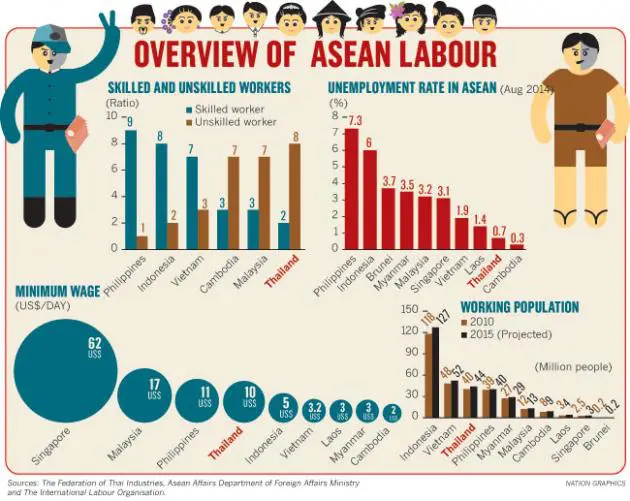
Unemployment in Thailand was 0.7 per cent as of August. It was not in a critical condition but the greatest concern is graduates in subjects that are not in demand by the labour market.
Unlike other Asean countries, Thais tend to study for certificates or degrees and are not interested in vocational education, which many jobs require.
