
Yingluck urges fair treatment from NLA


Play
Maintaining her innocence against allegations of corruption and dereliction of duty in the rice-pledging scheme, former prime minister Yingluck Shinawatra urged the National Legislative Assembly (NLA) yesterday to be fair for the sake of national reconcil
Yingluck spent an hour defending herself to the NLA after National Anti-Corruption Commission (NACC) member Wicha Mahakhun accused her of dereliction of duty. Wicha said her actions had inflicted a Bt229-billion “loss” on the government. He said rice millers had exploited the scheme for their own benefits while more than 10 rice farmers had committed suicide because of delayed payments under the programme.
In urging the NLA to be fair to her, the former prime minister said “the country can only move forward if there’s justice”, adding that the unelected assembly should not be a political tool of anyone.
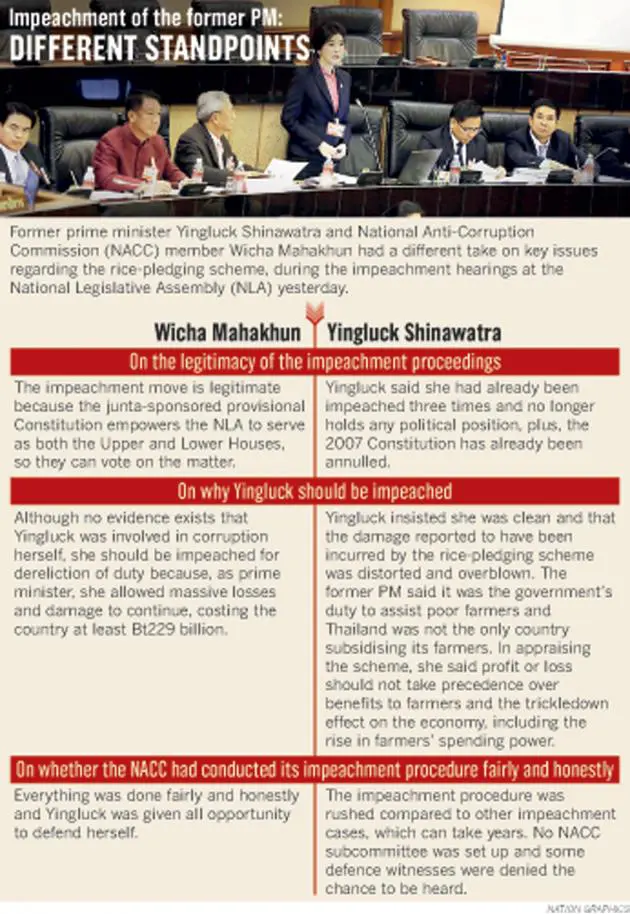
Yingluck said she had lost her position three times: first, when she dissolved the House of Representatives at the end of 2013, second when the Constitution Court impeached her, and third through the coup last May.
“How can you impeach someone who does not have any [political] position?” Yingluck asked the NLA yesterday, adding that the 2007 charter was also no longer in existence.
Wicha insisted that the NLA had the authority and legitimacy to conduct the impeachment proceedings. Impeachment could lead to Yingluck being banned from politics for five years.
At the beginning of his hour-long speech, Wicha said the junta-sponsored provisional constitution empowered the NLA to serve as both the upper and lower houses of Parliament, so its members could vote on the matter.
Although Wicha acknowledged in his speech that there existed no evidence of Yingluck’s involvement in any corruption related to the rice-pledging scheme, he said than as prime minister and chairwoman of the National Rice Policy Committee she should be impeached because she had allowed the severe losses and corruption to continue.
He said more than 10 farmers had committed suicide because of the failed rice-pledging scheme. He said the NACC had also warned the administration twice to stop the project but the government refused because it had been a major policy pledge to voters by the Pheu Thai Party.
Yingluck insisted she was clean and that the claims of damage incurred by the rice-subsidy programme was distorted and overblown. The former PM added that it was the government’s duty to assist poor farmers and this was not the first such scheme in the Kingdom, and Thailand is not the only country to subsidise farmers.
She said that in appraising the programme, profit or loss should not take precedence over benefits to farmers who are the backbone of the country. She said the trickle-down effect on the economy, including the resultant increase in the spending power of farmers and tax collected, should also be considered.
The former prime minister added that her government had made attempts to tackle corruption, citing the ban on 12 rice mills from the programme on top of 276 legal cases filed against those who had allegedly committed irregularities.
In his remarks to the assembly, Wicha stressed that the NACC had sought Yingluck’s impeachment fairly and honestly, adding that the ex-PM was given all opportunities to defend herself.
However, Yingluck described the NACC-led procedure as rushed compared with other impeachment cases, which had taken years. She said no NACC subcommittee was set up and some defence witnesses were denied a chance to be heard.
Wicha said the Yingluck administration’s mismanagement of the subsidy programme had led to Thailand’s rice exports falling by 35 per cent, bringing the country down from the world’s top rice exporter to No 3. Yingluck argued that this had happened because of massive dumping of rice by one major rice-producing nation and not the pledging scheme.
Yingluck predicted that Thailand would this year regain its position as the world’s top rice exporter, adding that this would be due to the rice stocks stored under the pledging programme.
After her defence arguments, Yingluck told the media that she had done her best and felt relieved. Wicha later told the media that no one could make up for the loss of farmers’ lives who had committed suicide because they were not paid by the government in time.
The NLA’s inquiry panel is scheduled to question the NACC and Yingluck next Friday. Later, both sides will be given a chance to make their closing arguments, either in person or in writing. The assembly tentatively is scheduled to vote on the matter on January 23. Police and some military officers were present in front of the Parliament Building yesterday, although only a few people showed up to offer their support to Yingluck. A Pheu Thai source who asked not to be named said the party had dissuaded Yingluck’s supporters from gathering to show the public that one woman had the guts to confront a group of men.
