
Defibrillators in public places for heart attack victims


Play
IN A MOVE to save more cardiac arrest patients, the National Institute for Emergency Medicine (NIEM) has joined forces with the private sector to install automated external defibrillators at public places frequented by high-risk individuals. The agency is
A defibrillator can be used to check a patient’s heartbeat and will direct an electric shock if it detects the rhythm to be abnormal.
The institute believes lives could be save if these devices are more readily available and more people are taught how to use them.
Earlier this month, a video clip that “went viral” showed a male passenger in his 60s passing out onboard a Nok Air flight to Chiang Mai and a crew member performing cardiopulmonary resuscitation on the patient. The plane returned to Don Mueang Airport, so the ill passenger could be taken to hospital.
NIEM chief Anucha Setthasathien said his agency has been continuously campaigning for public knowledge of first-aid, including use of a defibrillator, which have not been widely used in Thailand because they are expensive. Now, thanks to donations from private organisations, NIEM will be able to install these devices at state offices and public places in Bangkok and other provinces.
He said cardiac-arrest patients’ chance of survival outside hospitals or medical facilities would rise by 45 per cent if they are tended to promptly.
Anucha said Japan has installed these devices at public places, such as train stations, bus terminals, airports, aircraft and trains, a marathon event site, golf courses, shopping malls and schools, as well as at tourist destinations that cannot be immediately accessed by emergency medical staff.
Use of a defibrillator is still quite new in Thailand, but people can now use the device under supervision and guidance of a doctor or qualified officials via the 1669 emergency hotline, Anucha said.
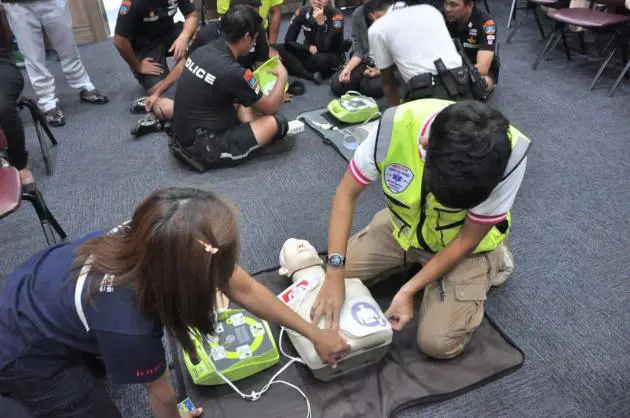
More training on correctly using an automated external defibrillator would be organised for people, he said, adding that NIEM recently trained 35 members of bicycle groups and volunteers on how to use the device.
