
Revealing the truth is still a vital part of achieving reconciliation, groups say


Play
WENG SCEPTICAL ABOUT NEW BODY'S CHANCE OF SUCCESS, BUT ALL SAY IT IS IMPORTANT
DESPITE attempting to promote reconciliation via the new charter, political stakeholders have voiced serious doubts about the independent body being set up for that purpose. Some said revealing truth to the public would be of equal importance in achieving that goal.
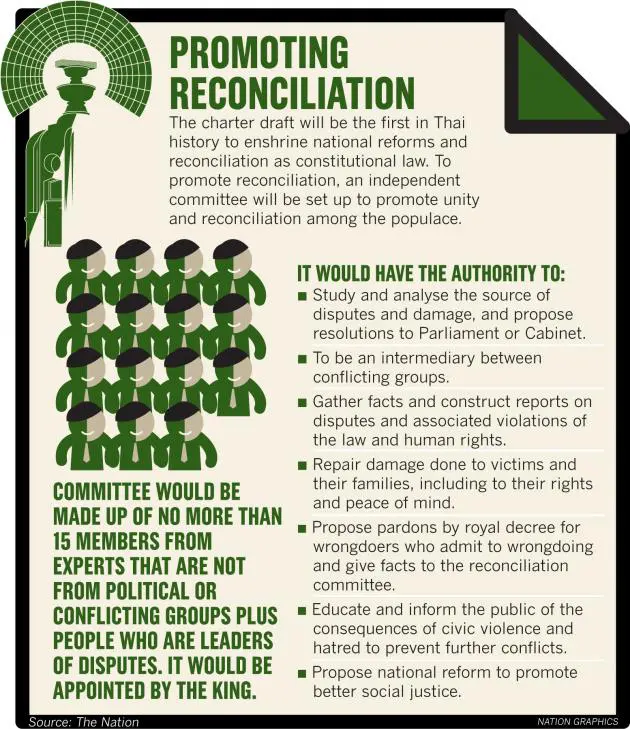
The Constitution Drafting Committee (CDC) created a section on “national reform and promoting reconciliation” in the new charter, in which drafters resolved to set up a new independent body to promote reconciliation.
This new reconciliation body, which will last only five years after the new charter comes into force, would invite conflicting sides including political colour-coded groups at the centre of disputes to discuss the promoting of unity and reconciliation together.
But United Front for Democracy against Dictatorship (UDD) or red-shirt co-leader Weng Tojira-karn said he does not see any hope that Thailand could achieve reconciliation.
“Reconciliation could be promoted once
the truth is revealed and justice has given back to the people,” he said, adding that there were ways to achieve reconciliation, but the |committee trying to do this was on the wrong track from the start.
Weng explained that although he could see the sincerity of the committee’s chairman Anek Laothamatas in wanting to achieve reconciliation for the country, he could not fathom how Anek or his committee could give justice to the people.
The red-shirt leader said that, judging by the work process of the committee, they will request a pardon for wrongdoers who took part in protests. But he said this was not enough to achieve unity and reconciliation in society.
“Freeing every wrongdoer from prison via a form of pardon or amnesty would not bring out the truth from their cases,” the UDD leader said.
Instead, the public could perceive them [the reconciliation committee] as a decoration of the junta-government, Weng said.
When asked how the authorities could seek the truth for some people’s cases, Weng said people pursuing cases and finding the truth must abide by orders of the courts.
He noted that former Prime Minister Abhisit Vejjajiva and his then deputy Suthep Thaugsuban had “got away” with their actions when red-shirt protesters were dispersed in May 2010 – saying such an outcome was a huge injustice that |would obstruct reconciliation.
The red-shirt leader believes the pair badly mishandled the dispersal of red-shirt demonstrators in mid-2010, when at least 99 people were killed over a two-month period.
He said the dispute of this matter continued longer than it should because Prime Minister Prayut Chan-o-cha had seized power.
The UDD leader referred to a meeting of leaders of rival groups chaired by Prayut before he staged the coup in May last year, which he insists could have reduced violence in society, but he said the then army chief let the opportunity slip.
“That time was the great opportunity to discuss the conflicting issues, but Prayut seized power instead of grasping an opportunity to end the disputes,” Weng said.
When asked whether if he or his fellow UDD leaders would be a part of the reconciliation committee that the charter would set up, he said the red-shirts want reconciliation to be promoted, but with one condition – truth must be revealed to the public.
Meanwhile, PDRC co-leader Tankhun Jitt-itsara, said social conflict may have dragged on too far, so there was little hope for reconciliation being achieved within five years if every side still blamed and attacked each other.
However, Tankhun said there must be a middleman to reduce the issues and try to solve the problems of inequality.
“Reconciliation is not a way to make everyone forget the problem, but the reconciliation process should start with gathering the facts on various cases,” he said.
Tankhun suggested the reconciliation process should involve the public, adding that people who were not considered to be conflicting parties were the key to achieving unity in society.
“The public and people might believe that reconciliation is getting everyone to love each other, and to put all problems aside. But justice should be promoted while gathering the facts on cases,” the PDRC co-leader said.
So, people should be correctly informed about social issues. A peaceful society was not one in which everyone thinks and believes the same ideology, the PDRC man said – but a democratic society that does not have violence.
He explained that according to the reconciliation committee, whether they will grant a pardon or amnesty to protesters who have done wrong, it was necessary to promote reconciliation. However, they would have to thoroughly explain the process to the public.
Tankhun said the idea of inviting conflicting parties to be a part of the reconciliation committee was a good idea, yet the leaders of these groups may not like the idea or represent “their people” as a whole.
The PDRC co-leader said the fundamental problem of these disputes emerged with a group strongly opposed to the government’s policies, in particular populist policies.
“The government’s policies sometimes promote inequality among its people, and inequality ignites opposing ideas from the people towards the government, which caused social disputes at the end,” Tankhun said.
Therefore, Thailand Reform Institution (TRI) director Suriyasai Katasila, a former member of the People’s Alliance for Democracy, urged stakeholders to put aside hope for reconciliation being achieved and just said we must act on this now.
He also voiced support on the structure of the proposed reconciliation committee – that it should have members of conflicting parties. But he said a bigger issue was whether representatives of colour-coded groups fully represent their supporters or not.
Suriyasai questioned, for example, if red-shirt leader Jatuporn Phomphan was an appropriate representative of the reds who could they have the authority to claim what “his” people want, or if he could speak for all red shirts. And the same thing applied for the PDRC.
“There might not be only these two groups who are in conflict,” he explained, suggesting factions within both groups.
Suriyasai said the new reconciliation body should have people such as political scientists and psychologists, as well as “middle-men” and members of conflicting groups.
“There should be preparations for the people involved, including youth because they would be an important aspect to reduce inequality in the future. Maybe adults are sometimes too stubborn to admit the truth that doesn’t fit their opinions,” he said.
And like Weng and Tankhun, he said finding the truth and inform the public about it would help promote better justice and reduce conflicts, even if finding the truth was not easy – as every side has their stories, differ from one another. So the courts should play a key role in this.
Nonetheless he voiced support for the idea to give a pardon to ordinary protesters. But he said people who led their people to lose their lives should not be included.
