
Landless farmers join protest to demand urgent help from govt


Play
Sansern accepts petitions but warns the protesters against rallying
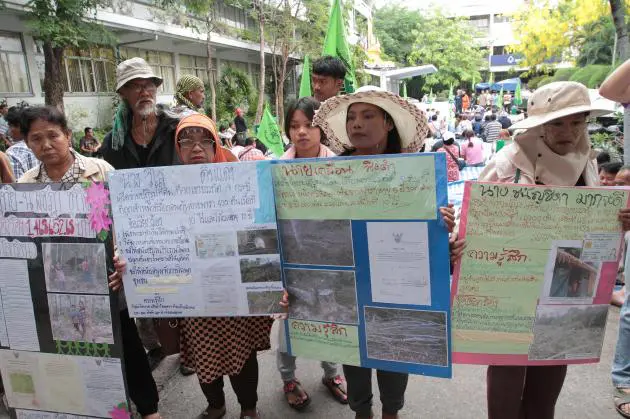
HUNDREDS OF people gathered outside Government House yesterday to demand that the government start providing solutions for their problems, most of which are land disputes with local authorities.
Deputy Government Spokesman Maj-General Sansern Kaewkamnerd later accepted petitions from the protesters, led by the People’s Movement for a Just Society (PMove), and assured them that their problems would be considered and solved as soon as possible.
“I understand your distress and anxiety, but if you really need help, contact the government directly. Do not gather like this, as the country is now under special circumstances,” Sansern said.
Prayong Doklamyai, who represented PMove, announced that most of the people “victimised by government policies” were those facing encroachment allegations even though they had been living in the areas before forest reserves or national parks were marked out. There are some 490 such cases, and those affected by them also showed up at the rally.
Also participating in the rally were people facing land disputes with other agencies, those affected by government projects, sea gypsies fighting for their right to live in marine reserves, stateless people seeking Thai nationality, Karen people fighting to maintain their cultural identity in national parks, and landless farmers.
According to PMove, the group had spoken with the government earlier and measures to tackle immediate problems had been set up in January, but nothing has been done for 90 days now.
So, he said, they had come to collect on the promise and submit three demands: that the government advance titles to solve land problems for more than 400 communities; that it continue the task of establishing a land bank for landless people; and that it get local authorities to comply with regulations to tackle poor people’s problems.
Even though the country is currently under Article 44 of the ruling junta’s interim constitution and the prohibition on gatherings of more than five persons is still in effect, PMove member Salit Sawalee said they were not afraid of being punished because their rally was not politically motivated. He said they just wanted to show their distress with the government’s slowness to solve their problems.
Kanya Pankiti, a representative of the Khao Bantad Land Reform Network, said she and others suffered seriously from the government’s forest-reclamation policy. Up to 181 rai (29 hectares) of rubber plantations and houses of 27 families had been destroyed by military officers and forest rangers in accordance with the junta’s Order No 64 as their plots were reportedly encroaching on national-park areas, she said.
“We don’t have a place to live on or any income, as our rubber plantations were destroyed. We are here to ask for a community land title so we can live on the land that our ancestors found long before national parks were established,” Kanya said.
