
Social media again play a key role after Nepal quake


Play
SOCIAL media are once again playing a hero's role, this time in immediately drawing to the world's attention the human and other consequences of the recent massive earthquake in Nepal, and playing a vital part in bringing about crucially needed global a
Twitter was the main instant communication channel informing the world about the earthquake on the afternoon of April 25.
Images were shared over social-media of Kathmandu’s Durbar Square, where important buildings were destroyed, including the nine-storey Dharahara or Bhimsen Tower built in 1832, as well as temples, houses and other structures.
Also shared were images of the Everest base camp and the efforts to find survivors of the avalanche that swept down the mountain after the quake.
Pictures of the devastation caused by the quake and the avalanche, and of survivors, were shared across Twitter and other platforms – and eventually flew across mainstream media channels around the world.
Instantly, a host of volunteer assistance campaigns emerged from countries in all corners of the globe, and were posted and shared.
Governments, businesses and non-profit organisations, as well as individuals from many countries, offered their help in terms of donations of food and other essentials, as well as financial assistance for rescue teams and relief initiatives.
Donation campaigns
With rapid and effective communication crucial after the disaster, the three main mobile operators in Thailand announced assistance in the form of allowing their customers in Nepal at the time of the quake to make calls, send SMS messages and use the Internet via international roaming free of charge for a period of time.
Moreover, some companies, including Total Access Communication (DTAC), joined with Unicef Thailand to facilitate Thai financial donations via text messages.
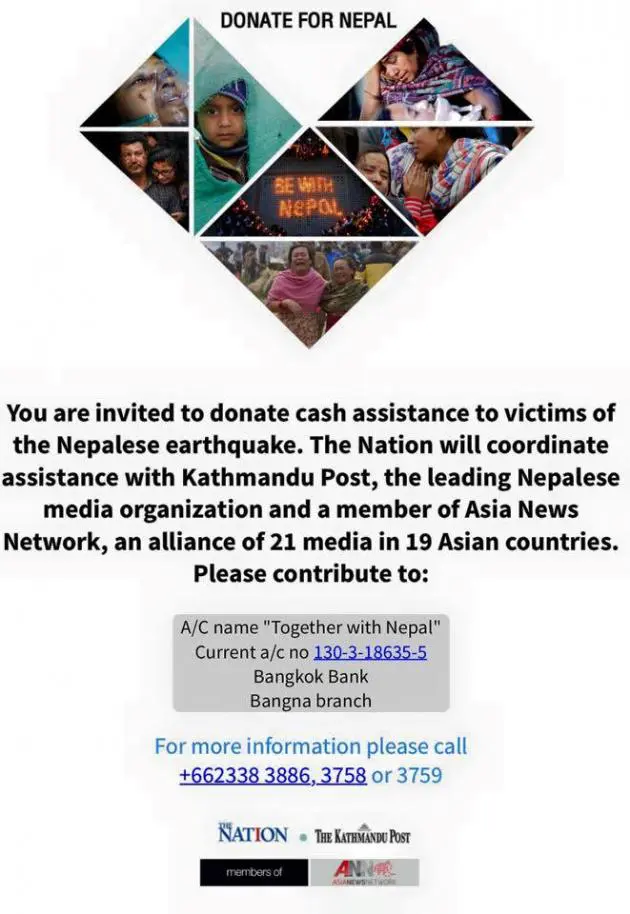
The Nation also coordinated assistance with The Kathmandu Post, the leading Nepalese media organisation and a member of Asia News Network – an alliance of 21 media outlets in 19 Asian countries – to receive donations from Thais.
Social-media platform Line launched “Pray for Nepal” stickers at a price of 50 Line coins to help its users in Thailand to donate.
Meanwhile, Apple added a button to the iTunes store to allow iOS users instantly to make a donation to the American Red Cross.
Businesses and organisations in Thailand also rolled out campaigns to facilitate people wanting to make their own donations. For example, PTT Blue Card users can make a donation for Nepal via a points redemption, with 100 points becoming Bt20 for the cause.
KledThai also launched a campaign to allow customers to donate Bt10 for each Bt100 they spend on books via www.kledthai.com www.kledthai.com, while KTC credit-card users can redeem 1,000 points as a Bt100 donation for Nepal.
Many Thais have donated via these various channels, with some sharing their transaction records on their social-media timelines.
The Thai Chamber of Commerce and Board of Trade of Thailand, together with the University of the Thai Chamber of Commerce, have also opened a bank account to receive donations.
However, on the downside, there have been a lot of fraudulent messages about donations for Nepal, and people should therefore check carefully and verify the source of each message before making a donation.
Nepal still desperately needs assistance in many forms, so please keep calm and give help in any way you can for the people of that country.
