
Thailand on the 'back foot' internationally


Play
Foreign policy has been held 'hostage due to domestic situation'
THAILAND’S ability to form and implement foreign policy following the coup has been hindered due to a backlash from western countries while many Asian nations have befriended the Kingdom as a counter balance, academics have said.
“Thailand’s foreign relations over the past year have been on the back foot when trying to compensate for the military coup,” Thitinan Pongsudhirak, an expert on Thai foreign policy at Chulalongkorn University, said.
Since the coup on May 22 last year, powerful nations – in particular the US and EU countries – have put pressure on Thailand by calling for a rapid return to democracy.
The coup led the US and the EU to temporarily suspend economic, development and military cooperation with the Kingdom.
The US has suspended US$4.7 million (Bt158 million) in military aid, while the EU has postponed official visits and major cooperation such as negotiations on a free-trade agreement.
Japan and Australia also condemned the coup but are starting to re-engage with Thailand. This is largely due to the geo-political location of Thailand and the political game between major powers – be they western or eastern.
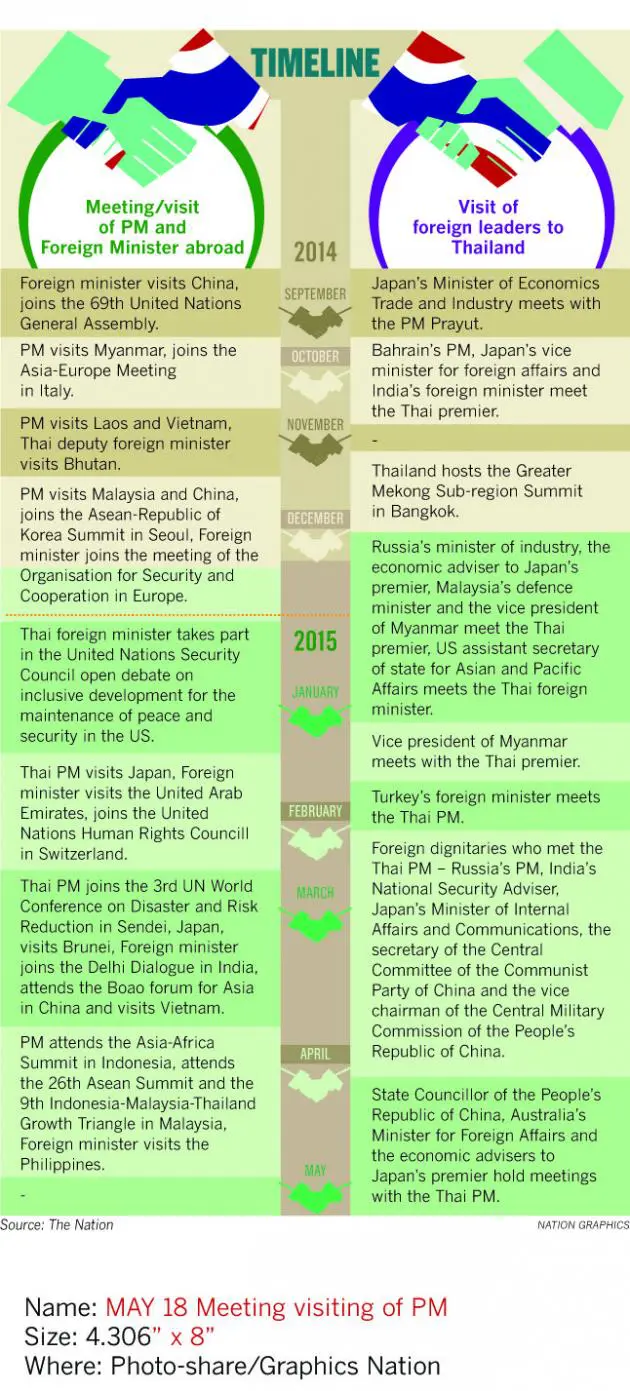
Thailand has handled western criticism of the coup by moving closer to China and Russia and relying on Asean support. The Russian Premier Dmitry Medvedev’s visit to Thailand and the Thai premier’s visit to China, Japan and other Asean member nations are cases in point. Thitinan said: “The Prayut government has recalibrated and tried to regain some foreign policy balance in view of Thailand’s national interest of not tilting too far to one side or another.”
Harvard fellow Benjamin Zawacki, who is writing a book on Thailand’s changing foreign policy, said Thai diplomacy was currently in a responsive mode.
The premier is primarily focused on domestic policy, even if mindful of its effects abroad – a trend that has not changed since 2006, Zawacki said.
As for Thailand’s policy with Asean, Thammasat University’s director of the Centre for Asean Studies, Prapat Thepchatree, said the government had performed well in responding to immediate needs and current issues such as the development of Dawei and the bid to create Asean connectivity.
However, the government needed a strategic master plan to help the country envision its role, especially as hub and gateway to the region, he said.
Prime Minister Prayut Chan-o-cha’s move to try and show that Thailand is not lonely on the international stage by visiting foreign countries has been significant, although most visits have been with Asian countries.
Most of the talks and agreements made with those countries cover areas including trade, investment in infrastructure to support special economic zones and to create linkages with other countries in Asean, human resource development, science, technology and innovation.
“Those visits – be it at bilateral or multilateral levels – display a consistency in Thai foreign policy to engage with the international community. However, Thailand should know how to approach each of its partners,” said a Walailak University expert on Thai foreign policy who asked not to be named.
Thitinan suggested that the China-Japan relationship was of most consequence looking ahead. He said the economic and geopolitical interests of the two countries were clear.
To improve Thailand’s international image, General Prayut’s government has tried hard to abide by international norms, such as those relating to human rights and the protection of wildlife, by improving policy efficiency.
“[But] Thailand has not demonstrated a proactive interest in being part of the democratic side of the international community,” Zawacki said.
Thitinan said for the foreseeable future “Thai foreign policy will remain hostage to domestic politics”.
“What is the most worrying issue is the democratic aspect of the new constitution,” the academic from Walailuk University said. “A referendum would be crucial to maintain the stability of domestic politics.
“Past experience has demonstrated how political instability may impact on the orientation of our foreign policy.”
