
'Crackdown has curbed graft'


Top civil servant among 152 facing corruption probe
STRICT enforcement of anti-corruption measures has helped reduce corrupt practices involving central government officials over the past year, according to Pramon Sutheewong, head of a network of anti-graft organisations. But provincial procurement has worsened – due to weak enforcement of local rules and regulations.
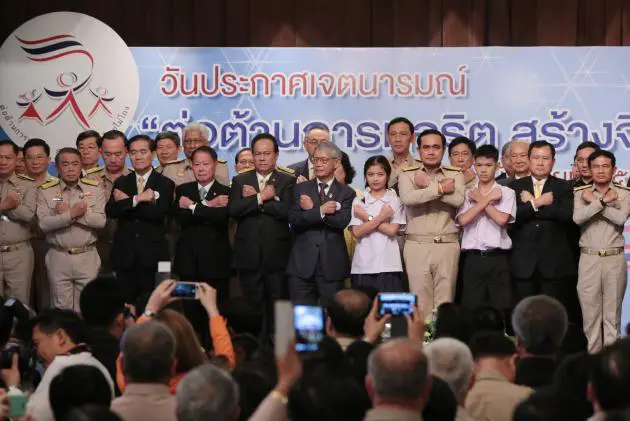
Meanwhile, at least one former or current permanent secretary is on the second list of 152 senior civil servants being investigated for alleged corrupt practices – as Prime Minister General Prayut Chan-o-cha yesterday kicked off a nationwide campaign to boost public awareness of the government’s anti-corruption drive.
Prayut said corrupt practices happen in many forms and hurt the country drastically – so the public must have the courage to report such activities to authorities like the Damrongtham Centre if they do not trust police or soldiers.
Prayut said he had already received the second list of 152 allegedly corrupt senior government officials. This was in addition to the first list of 100 senior officials – and internal investigation is underway to check the evidence pertinent to their alleged wrongdoing.
Prayong Preeyajit, secretary-general of the Public Sector Anti-Corruption Commission (PACC), said he could not elaborate on these cases but there would be a public announcement when all internal checks were done and final decisions made by the prime minister, who would exercise his authority under Article 44 of the interim charter in some cases.
He said it would take some time to ensure that action taken against the wrongdoers was fair and transparent, adding that the second list included senior officials with the highest rank of permanent secretary.
The PACC chief said the Justice Ministry would not rule out the possibility of submitting a third list of allegedly corrupt civil servants to Prayut after identifying a total of 252 persons in the first and second lists handed over to the premier.
Pramon, head of the anti-graft organisations' network, said corrupt practices appeared to have slowed because some civil servants and businessmen expected a change of government soon – but provincial procurement had become more graft-prone because the central government could not yet enforce stricter rules on local authorities' projects.
Tortrakul Yomnak, president of the Engineering Institute of Thailand, said e-auction and e-bidding procurement had not worked in Thailand in terms of curbing corrupt practices so they should be reviewed to prevent further public damage. Over the past nine years, he said electronic methods had resulted in damage estimated at over Bt50 billion because there had been bidders’ collusion prior to the start of e-bidding and e-auction.
“There was no real competition in the bidding process even though we’d switched to the electronic method. We found that the price differences among the highest and second highest bids were very small, maybe, Bt500 or Bt100.”
“Actually, there ought to be a much more significant difference, like 5 per cent over or below the median price to reflect genuine competition among bidders. Sometimes, we also found that the highest and second highest bids had addresses in the same building [so they were actually the same persons or business groups],” he said.
