
From crops to cargo, the fear of drought casts a wide shadow over the Chao Phraya


Play
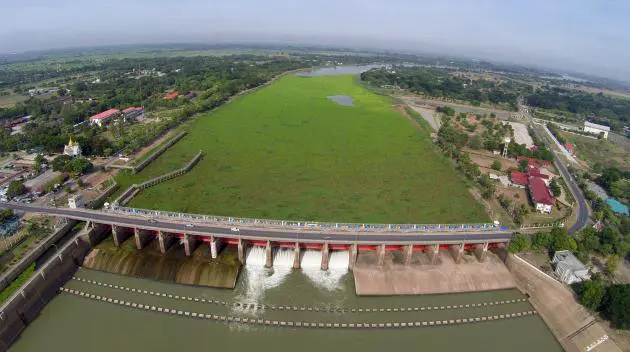
Angthong Provincial Irrigation Department and the Harbour Department have warnings for groups as different as farmers and cargo ship operators about the drought and low levels in the Chao Phraya River.
Speaking for the Irrigation Department yesterday, representative Pricha Punwa, said farmers planning to grow rice in the coming months should be careful about water usage.
“The amount of water in the four dams - Bhumibol, Sirikit, Kwainoibamrungdan, and Pasakchonlasit - is not enough for the next two months.”
He added that the four dams have a total capacity of 1,500 million cubic metres - with the draining level of 60 million cubic metres per day, or around 30 days’ usage. Now the department has decreased this to 30 million cubic metres per day - or around enough usage for 40 days.
Therefore, farmers who have not prepared for growing rice this season should reconsider well because of the low water capacity, Pricha warned.
Meanwhile, Vichian Pemanukornruk, director of Ayuthaya Provincial Harbour Department, said cargo carriers in the Chao Phraya and Pasak rivers should lower their carrying weights and take caution while travelling because some areas are so shallow.
“In some of these areas under water there are sand bars. Vessels carrying full capacity could crash the bars and cause accidents.”
Because of the low water level in the Chao Phraya, many shipping companies have told their carriers passing Angthong to make regular interval stops. Many are using smaller carriers with a capacity of 5 or 6 tonnes to deliver goods, instead of the bigger carriers of 1,000 tonne capacity.
The C7A station at the Angthong 12th irrigation station in front of the city hall reported the latest water level of 0.64 metres from 9.32 metres at the riverbank. The level is lower than the same period last year following the consecutive draining and is expected to continually decrease. Also, the provincial government has already provided an assistance centre to help people suffering from drought.
Some Pathumthani farmers disagree with the government’s two-month postponement of the rice growing period. They said the postponement would damage the crop following the two-months-delay harvest period. Also, many farmers did not have other jobs to earn income during the time.
On the other hand, farmers in southern Thailand are not affected by the drought due to highly available water resources.
Dech Lekvichi, director of the water distribution and maintenance project in Songkla’s Ranodkrasaesin district, said the Songkla leak is 8,754 square kilometres in area – and one of 25 lagoons in Thailand. The amount of water in the leak still depends on sea water levels, and is a mixture of sea and freshwater in some parts. In order to continue efficiently growing plants, farmers should keep in touch with the Irrigation Department announcements, he said.
Meanwhile, Sansern Kaewkamnerd, Deputy Government spokesperson, said during the weekly press conference that the prime minister had instructed authorities to come up with immediate measures to cope with the drought situation.
These may range from switching farm crops to less water consuming crops, switching farm work to temporary laboring, and calculated use of groundwater. The authorities were instructed to draw plans and table them before the Cabinet meets again, he said.
In the issue of drawing groundwater for use, the level must be stored at certain points so that it and the surface level would not be affected, he said.
Boonyong Tansakul, CEO of Singer Thailand, said the drought impact is increasing on both farmers and others in the agricultural sector, apart from the low price of crop products.
The purchasing power of people in this sector would further weaken as the drought pulls down their income - affecting the Thai GDP this year as well, he said.
Agricultural clients account for 10 per cent of the total customer base at Singer Thailand. The drought has not affected the company much so far because in its debt collection programme it has increased installments.
The drought is seen as a short-term problem, unlike the decline in agricultural prices, which has seriously affected the income of people in the agricultural sector.
