
PM ready to shorten time before next poll


Play
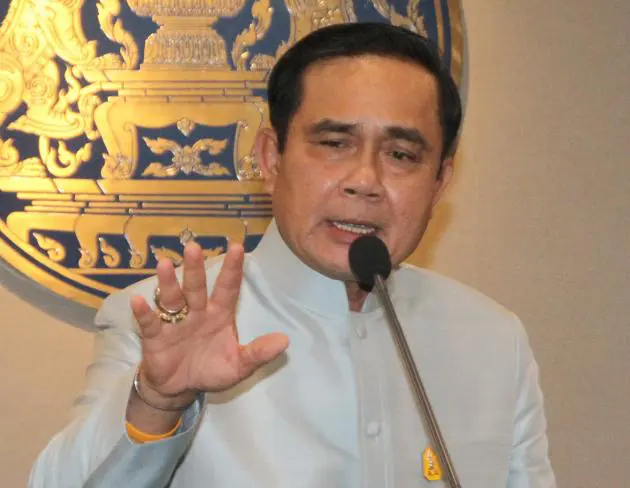
FOLLOWING mounting pressure, Prime Minister Prayut Chan-o-cha said yesterday that he would shorten the road map timeline and hold a general election in less than the previously planned 20 months.
The idea was discussed during a joint meeting of the Cabinet, the National Legislative Assembly (NLA) and the National Council for Peace and Order (NCPO), chaired by Prayut.
The premier said the timeline for a new draft could possibly be shortened, as Deputy Prime Minister Wissanu Krea-ngam had earlier indicated. For example, he said the previously envisaged “6-4-6-4” formula, with each number referring to the number of months required for each step of the charter-drafting, consideration and referendum process, could be changed to “4-3.5-4-3.5” instead.
This would make it roughly 15 months, rather than 20 as had been planned.
Prayut also said that the process of charter-writing in Samut Khoi (Thai traditional book), as a traditional way to record charter documents, would consume most of the time in the drafting process as it required pure handwriting to complete the book.
“It will take time because the law says so, and I have to follow it,” the premier said. “It’s not that I want to stay [in power] longer.”
NLA president Pornpetch Wichitcholchai said yesterday’s meeting had discussed preparation for the formation of a National Reform Steering Committee (NRSC) and a new Constitution Drafting Committee (CDC), because the NLA had to coordinate with the two agencies to draft bills as stipulated in the first amendment to the 2014 interim charter.
Prayut said he might select the CDC members before his departure to New York for the United Nations General Assembly, but final approval will be given after he returns next month. The controversial National Strategic Reform and Reconciliation Committee (NSRCC) is needed to keep peace in the country, the premier said.
“Election is not everything for democracy. Rather, what matters is that those elected need to have good governance,” he stressed.

“The elected [future] government will be in charge for four years, so should [the NSRCC] stay for the first five years to fix problems?” he said in regard to the government that would succeed his term in office. “This [the NSRCC] is not in order for me to stay in power,” Prayut insisted, commenting on the fact that the committee would include the premier and would be able to exercise special authority over the Cabinet in times of crisis.
The PM declined, however, to say whether the NSRCC clause would be inserted in the new charter draft and, if so, where it would appear, only stating that it was a matter for the future.
Deputy Prime Minister Prawit Wongsuwan, meanwhile, said Prayut had instructed the Cabinet to help him select 21 CDC members. Prawit declined to reveal the names of the CDC candidates the NCPO would nominate.
He also refused to state whether the new charter draft would include the NSRRC, saying it was premature to say.
Democrat Party leader Abhisit Vejjajiva said that in order to get a charter draft accepted by the public, there should not be a political context involved in appointing members of the NRSC and the CDC.
He said that to prevent a scenario in which charter drafts are again rejected, the next draft should be written so that if the public rejected it in a plebiscite, it was absolutely clear which constitution should be used instead.
Abhisit recommended that the 2007 charter be adopted in such circumstances. “The 2007 charter is acceptable in terms of democratic content, but some political groups do not accept it; unlike the 1997 charter, which all sectors believe carries flaws and must be wholly rewritten,” the former prime minister explained.
British Ambassador to Thailand Mark Kent wrote yesterday on the occasion of Democracy Day that democracy required people’s equal right and opportunity to participate in the political process.
“As Thailand once again begins the process of agreeing a new constitution, I hope there will be a full and free public debate on the implications for democracy,” he said.
