
Could this be a transitional period to non-democracy?


Play
EXPERTS WARY OF REGIMES THAT CAN LEGALLY OVERRULE ELECTED BODIES
THE PROBLEM with Thai politics is that the majority of the votes are being exploited by politicians; however, the way out is to strengthen democracy rather than abandoning it, political scientists have pointed out.
While the powers-that-be are trying to convince us that they have a road map to democracy, said Kasian Tejapira, a lecturer at Thammasat University, we are in fact in a transitional period to non-democracy.
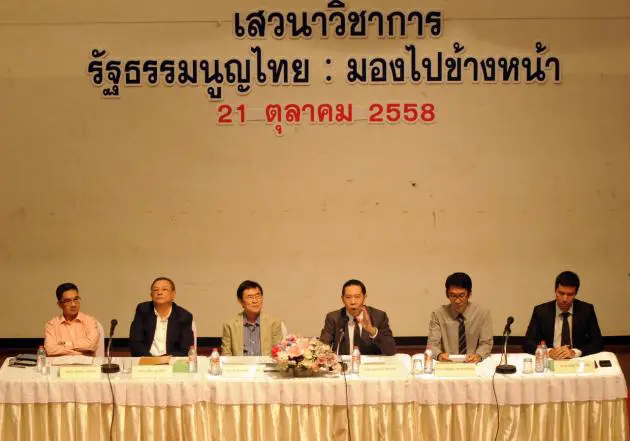
Speaking at a seminar entitled “Thai Constitution: Forward Outlook” at Thammasat University’s Tha Phrachan Campus, he said that an attempt has been made under the current charter drafting process to create a |regime with institutions to constitutionally limit or overrule the elected ones.
This idea came to the powers-that-be when they saw the flaws in democracy being exploited by politicians, he explained. But to prevent that, Kasian suggested, direct democracy should be imposed.
He said people should be able to exercise their power directly. For example, when MPs fail to perform their duties, the people should have the power to recall the election or impeach them.
Worachet Pakeerut, a law professor from Thammasat University and a key member of a pro-democracy lawyer group Nitirat, said that because the charter has to be written in line with the 2014 interim charter’s Article 35, it can be anticipated that the new draft will not be much different from its predecessor.
He agreed that the new Constitution would include some institution or body, like the National Strategic Reform and Reconciliation Committee, designed to suppress the people’s power. Such a body was in the recently-rejected draft because the powers-that-be see it as necessary.
Worachet said that even if the new draft is approved by a national referendum, it still won’t solve the problems facing the country because it won’t reflect the real problem, which needs to be solved by democratic means.
However, he admitted that he wasn’t sure whether or not the junta wants the charter to pass.
If these drafts keep getting rejected, the country will be trapped in a charter-writing cycle, he said. The government should make it clear what options the people have if the draft is voted down in the referendum.
Parinya Thaewanarumitkul, another Thammasat University law professor, said the only way to know if the junta wants the draft to pass is to see if its does something about the disputed Article 37, which many view a stumbling block.
Parinya said that if they do not amend the controversial article, it means they do not want the charter to pass.
Jade Donavanik, a former member of defunct Constitution Drafting Committee (CDC) and an adviser to the current drafting panel, was also a speaker at the seminar.
Jade tried to explain the charter draft with an analogy. “‘You can’t know what an apple tastes like unless you try it yourself.”
Despite all the controversies, Jade said, the draft will be judged by a national referendum, which will link it to the people.
