
Paween's allegations infuriate his ex-bosses


Play
Police chief says former human-trafficking investigator's accusations harm the country's reputation, considering libel case; NCPO 'focused on tackling trafficking'
SUPERVISORS OF the former chief investigator probing a high-profile human smuggling case reacted angrily yesterday to his accusation that he got no protection from them despite death threats faced by him.
Pol Maj-General Paween Pongsirin, who quit the police force last month and is now seeking political asylum in Australia, told Australian media that he feared for his life because influential figures in the military and police implicated in the illicit trade wanted him dead.
“There are some bad police and bad military who do this kind of thing,” Paween told the Australian Broadcasting Corporation. “Unfortunately, those bad police and military are the ones that have power.”
National police chief General Chakthip Chaijinda said that he suspected Paween’s comments might be politically motivated and that they were intended to damage Thailand’s reputation. He suggested that legal action could be taken against him.
“I have ordered the legal team to look into Paween’s claim about the influential figures to determine their identities. We are also considering taking legal action against him for defamation,” Chakthip said.
He maintained that Paween’s transfer to the southern border area was not done out of spite. “There was no attempt to persecute him or anything,” Chakthip said.
He explained that it was done because Paween had good knowledge about human smuggling so he should have fit the new position well.
He said Paween’s supervisor at the Provincial Police Region 8, which covers the upper southern provinces, also did not want him to work there.
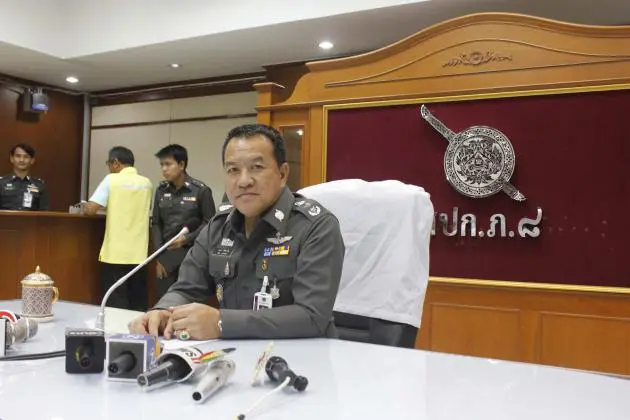
Maj-General Tesa Siriwato, the Provincial Police Region 8 commander who was Paween’s supervisor in question, said that his former subordinate “lacked discipline and failed to follow orders by his supervisors”.
Tesa accused Paween of telling only half-truth, which he said would damage Thailand’s reputation in the eyes of foreign countries. He said that what Paween had told the Australian media could discourage several thousand junior police officers all over the country.
The senior policeman said that as Paween’s former boss, he would never work with him again.
Meanwhile, Colonel Winthai Suvari, spokesman for the Royal Thai Army and the National Council for Peace and Order, said that he believed Paween’s supervisors and the Royal Thai Police had measures to help him in relation to the death threats against him. However, he added that he suspected personal dissatisfaction might have something to do with this matter.
The spokesman maintained that the government was working efficiently in tackling the problem of human trafficking and trade. He added that a number of state officials were being prosecuted as part of the effort.
Paween resigned from his post as deputy commissioner of Provincial Police Region 8 in November, saying that an order to transfer him to the deep South could expose him to revenge attacks by members of trafficking syndicates still at large. He said suspects he was investigating for trafficking were influential in the region.
The crackdown on lucrative smuggling gangs followed the discovery in May of 36 bodies in shallow graves hidden deep in a mountain near the Thailand-Malaysia border. The discovery sparked an international outcry.
A case has been brought against 88 suspected human traffickers but interviewing the some 500 witnesses could take as long as two years.
Paween was listed as a key witness set to testify against officials and other individuals facing criminal charges over their alleged involvement in human trafficking.
Chakthip said there were no issues with the trafficking case and that Paween was the only police officer to raise allegations of intimidation. The police chief said he had “no idea” what prompted Paween’s allegations.
