
Prayut shuns rubber farmers’ bid for help


latex price slumps but govt has limited cash, PM says
THE GOVERNMENT is facing a looming protest from rubber planters in the southern provinces and elsewhere who have been hit by extremely low latex prices, which have already dropped to about Bt25 per kilogram due to the global commodity price slump.
Prime Minister Prayut Chan-o-cha said yesterday that the government had limited funds to help farmers, as rubber planters in the southern provinces of Nakhon Si Thammarat and Trang sought extraordinary meetings of provincial councils of farmers tomorrow and Friday, respectively, in a bid to press for more government help.
A southern rubber planters’ network will also hold a meeting on the issue next Tuesday.
Niwat Soonsan, chairman of the Trang council’s working group on rubber plantations, said the price slump had seriously hurt many planters in provinces nationwide.
Previously, planters in 16 southern provinces threatened to rally due to the price slump.
Niwat said his farmers’ council needed to find measures to help members and forward the proposals to Bangkok via the governor.
He complained that the government had not taken enough action to prevent latex prices from falling, thus hurting the livelihood of rubber planters and their families.
Farmers have also blamed middlemen for causing downward pressure on latex prices as they seek profit margins of Bt10-Bt12 per kilogram. Planters say a fair profit should be Bt4-Bt5 for converting latex into smoked rubber sheets.
Prayut said there are limited public funds to help farmers because it was not possible financially for the government to cover every project, including healthcare and the rice and rubber-subsidy programmes.
The prime minister added that crude oil prices have plunged to record lows worldwide, which has been a key factor underlying the global commodity and rubber price slump.
Wanichsan Ruangsri, a merchant in Trang, said he had to stop selling rubber seedlings during the prolonged slump, as some planters had switched to other crops such as palm and fruit trees.
Suffering workers angry
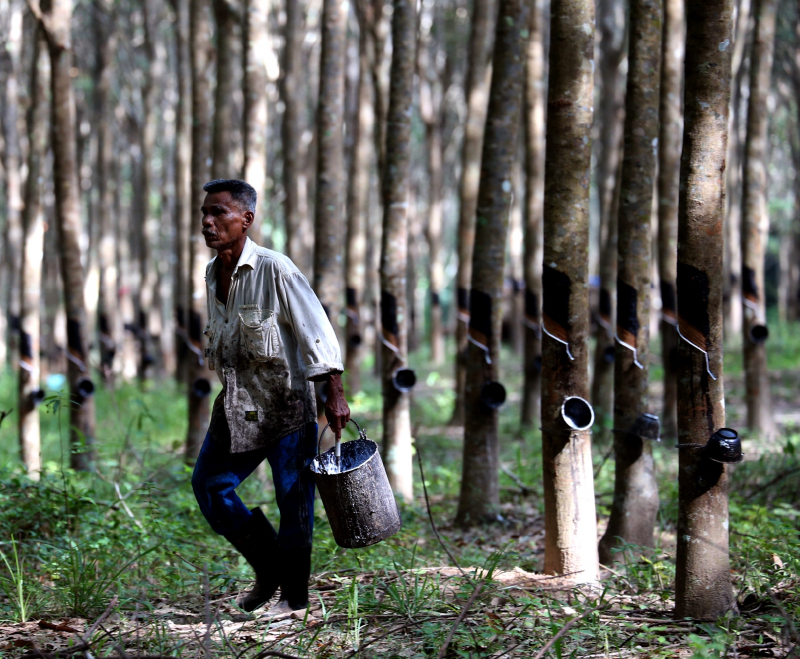
Aree Sina, a worker in a Trang rubber plantation, said her family was suffering due to the price slump and urged the government to find remedies to help tappers.
She said she would join a rally against the government since she and her husband now earned less than Bt300 a day, which was not enough to keep their children in school.
Aree said the price had to rise again to about Bt60 per kilo to make it viable for people to work on rubber plantations.
Another worker, Somjai Noonsong, said her family had incurred debts because of declining income from working in the rubber plantations. She said she would also join an anti-government rally.
The government last year approved a budget of Bt12 billion to help owners and workers of rubber plantations. According to this assistance programme, plantation owners received 60 per cent of the subsidy, or Bt900 per rai, while workers received the remaining 40 per cent of the money, or Bt600 per rai.
In 2014, the government also allotted considerable funds to help rubber planters when the price fell to about Bt33 per kilogram. The measures included a subsidy of Bt2,520 per rai and a credit facility worth Bt5 billion to shore up prices.
