
Thai delegation dodges questions by UN human rights body
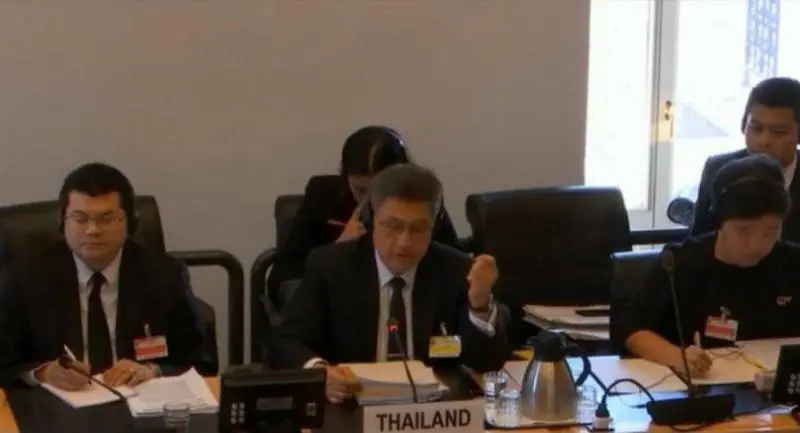


The Thai delegation has continued to dodge queries about freedom of expression, freedom of assembly and child labour in its response in front of the United Nations Human Rights Committee.
In the session on Monday and Tuesday in Geneva, the 46-member delegation merely stated that freedom of expression was “clearly defined under the law” with restrictions only to maintain public order and curb violence, according to the records by the Office of the UN High Commissioner for Human Rights (OHCHR).
The reply was to the committee’s claim that freedoms of expression and assembly in Thailand had been significantly curbed since May 2015 and in the months before the referendum on the charter draft took place. Certain laws had also been invoked to detain human rights defenders who expressed their opinions, the committee said.
The statement could refer to the enforcement of the referendum law, which punished people who disseminated “untrue, provocative, vulgar and intimidating” messages in the run-up to the vote. The law, however, was in practice applied against opponents of the junta-written charter draft, with 44 cases prosecuted for violating the law, including student activists from the defiant New Democracy Movement.
In regards to freedom of assembly, the Thai delegation said that while the public assembly bill had been effective since August, public assemblies were “easily granted” permission, provided that they did not block important public facilities. There had been 53 requests to assemble, all of which were granted permission, the delegates said.
The committee continued to question whether Thai authorities planned to lift restrictions, how many criminal penalties had been imposed and the appeal procedure when permission to assemble was denied.
However, those questions went unanswered by the Thai team, which also did not touch on the junta’s ban against political gatherings of five or more people, which has been in place since 2014.
Regarding child labour, another query remaining unanswered after the committee asked the Thai delegation to estimate the number of children under 15 working in Thailand in various fields and what measures had been adopted to prevent child exploitation.
The delegation, led by Justice Ministry permanent secretary Charnchao Chaiyanukij, attended the sessions in Geneva on Monday and Tuesday to argue for Thailand’s compliance with the International Covenant on Civil and Political Rights.
Among the rights concerns they had to clarify included the extrajudicial power of the junta-led National Council for Peace and Order granted by the interim charter, detention of civilians including prosecutions in military court, lese majeste charges, the computer crime bill, and progress on laws on torture and enforced disappearance.
“The [NCPO’s] aim had been to stop the ongoing political conflict and put an end to deep divisions in Thai society,” the Thai delegation said. “The council attempted to reconcile the different parties to the conflict and present an escalation of the situation.”
People detained by the NCPO had the right to a lawyer, to see a doctor and communicate with family members while not being deprived of the right to participate in the political process, such as running in future elections, delegates said.
The NCPO’s so-called “attitude adjustment” sessions, to which hundreds were summoned due to differing opinions, amounting to detention in military camps were technically cancelled last year. However, the military still continues the practice of “visiting” civilians, including Pheu Thai politician Watana Muangsook, who has been called in four times.
In regards to lese majeste, the delegation said: “The lese majeste law gave protection to the King or the Queen, and it was not aimed at curbing the freedom of expression … People charged for lese majeste were [also] entitled to the rights as persons charged for other criminal offences, including the right to a fair trial.”
With lese majeste being swiftly enforced by the junta government, along with the computer crime bill, the most prominent recent case is that of activist Jatupat “Pai Dao Din” Boonpataraksa, who allegedly broke both laws by sharing a controversial BBC Thai article online. Several bail attempts have been made for him but the were revoked or denied without clear reasons.
