
I am a freedom fighter, not a political leader - 88 icon


Play
Life as a political prisoner for more than 20 years was terrible, but former student leader of the 88 Generation Min Ko Naing has found hardship of a different kind since his release. These days he is weighed down with all kinds of expectations from his f
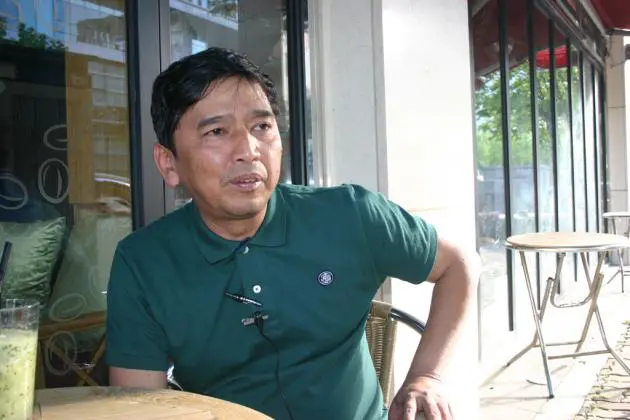
Speaking during our interview at a coffee shop in Gwangju, South Korea last week, he said he wanted to return to ordinary life as an artist. But many of his countrymen are urging him to enter politics and contest the next election in 2015, while others want him to lead a people’s movement for democracy.
“I would like to live an ordinary life – I have no intention to enter politics,” he said.
Since being released last year, Min Ko Naing has travelled extensively both at home and abroad, meeting demands to see people, join workshops and conferences, and receive prizes for his political struggle.
He was in South Korea last week to receive his latest international award, the Gwangju Prize for Human Rights, which he won in 2009 but had no chance to pick up because he was behind bars in Myanmar.
At home, 50-year-old Min Ko Naing is revered as a leader of the student activists who fought the military dictatorship of Ne Win in 1988. He was jailed for 15 years after the uprising, released in 2004, but then arrested again in 2007 for his role in continuing the fight for democracy. The New York Times has described him as Myanmar’s “most influential opposition figure after Aung San Suu Kyi”.
When he first entered Myanmar’s notoriously harsh prison system he was prohibited human contact.
“I raised a cat in the cell and trained it as a messenger to communicate with others,” he recalls. “I wrote short messages and used the cat to transport them to other cells.”
Sometimes he spoke into a water pipe to communicate with prisoners in neighbouring cells.
“I talked to one old man through a pipe and only later realised that he was a grandson of Myanmar’s last king, Thibaw,” he said.
Outside the prison walls, communication is far easier and Min Ko Naing is much in demand. People are eager to ask him questions, have their pictures taken with him and even consult him on private matters like divorce. Meanwhile, many of his former student activist colleagues are preparing to run in the next election. Min Ko Naing says he will not be standing for office himself, but has no objection to his comrades doing so.
“I regard the 2015 election as merely a milestone, not our goal. I want to concentrate on building up civil society in the country as a foundation for democracy,” he said.
One important element missing in Myanmar’s citizens is a strong sense of institutions and organisation, says Min Ko Naing.
“People have grown up under the junta’s orders. They don’t know about rights and responsibilities.” He added that most ordinary citizens fear and hate power, as they have been oppressed by people in power for a long time.
Democracy in Myanmar, he says, needs to move away from one-person leadership. “I want the country to have a good system for political development. I confess that I have no ability to lead anybody.
“People who want me as a political leader should change their mindset. I myself am just a freedom fighter and I prefer the role of people like Martin Luther King Jr and Mahatma Gandhi. They were free and influential. I want to live among a grass-roots community and enjoy that kind of life.
“I do not believe that I can run the country. I don’t know how to construct the future of the country. Let others be the architects. If freedom is suppressed, we will fight. I am not an architect of the nation,” he said. “I have so many artworks in mind, so many plots for novels and songs to be written, so I want to do that job.”
