
Local partnership crucial to success for any business, seminar told


Play
Forging local partnerships will be the key success factor for foreign companies looking to establish a presence in Myanmar, said local businessmen.
Tun Aung, central executive member of the Union of Myanmar Federation of Chambers of Commerce and Industry, urged businesses to come to Myanmar to “see for yourself” and find partners.
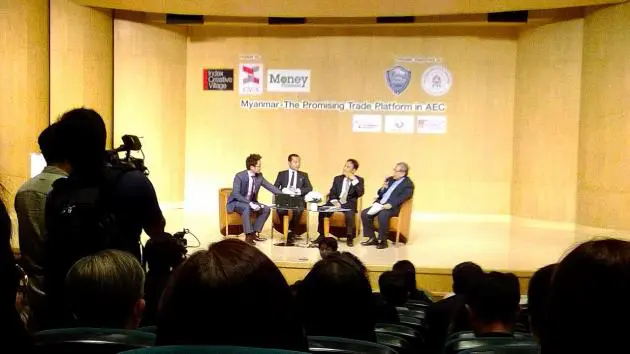
“If you’re not here, you can’t 100 per cent understand our country,” Tun Aung said at a seminar yesterday hosted in Bangkok by Index Creative Village and titled “Myanmar: The Promising Trade Platform in AEC.”
The remark was addressed to a businessman struggling to get his stainless-steel exports through a Myanmar port.
He assured the businessman that all the troubles he was experiencing - including frequent changes in import duties that result in months of clearance delays – would be solved if he had a local partner.
Small and medium-size enterprises are yearning for foreign partners who can share more advanced manufacturing technology with them.
Tun Aung invited businesses to contact the chamber so partnership could be facilitated.
Khant Win, the joint secretary of the Myanmar Automobile Manufacturer and Distributor Association, gave a similar advice.
He noted that no manufacturing and assembly plant is operating now in the country, but several local companies are ready to join hands with foreigners.
Toyota, though being the most popular brand in the country, does not have a plant mainly to the unstable power supply. Still, local companies are ready to produce parts and the market is still open for the imports of completely built units (CBU).
Myanmar’s auto demand is huge but the market is still short of service centres to keep up with the demand.
Khant Win, joint secretary of the Myanmar Automobile Manufacturer and Distributor Association, said that in the past two years or since the country reopened, 300,000 cars were registered, a strong indication of the huge demand. Because of the law that prohibited the import of vehicles dated before 2000, the number of registered cars are now about 500,000. Due to the increasing number of new cars, the locals also need more service centres.
“You need to talk about localisation and seek partnerships with the locals to supply parts. You have to open your eyes,” he said, adding that the auto sector is considered the most reformed economic sector in the country.
Before 2010, vehicle imports were restricted to companies such as an entity owned by the military, which runs multiple businesses such as manufacturing, trading and transport. However, since 2011, private companies have been allowed to import vehicles, resulting in more brands and types of commercial vehicles.
Tun Aung added that Myanmar offered huge investment potential.
Despite abundant natural resources and a “trainable and well-educated labour force,” the country still depends on imports to satisfy domestic demand.
In the snack market, up to 80 per cent of items on shelves are imported from Thailand and China.
He urged Thai investors to be patient when experiencing the three main business obstacles in Myanmar: workers that are not as “fully trained” as their Thai counterparts; a foreign-exchange market restricted to a few currencies; and a banking sector that is not yet fully liberalised.
Dealing with a bank that is not up to international standards might pose problems regarding financing, he said.
“Myanmar has hamburgers and fried chicken, but we don’t have McDonald’s hamburgers or Kentucky Fried Chicken,” he said.
