
First visit since WWII by Japan's top military officer


Play
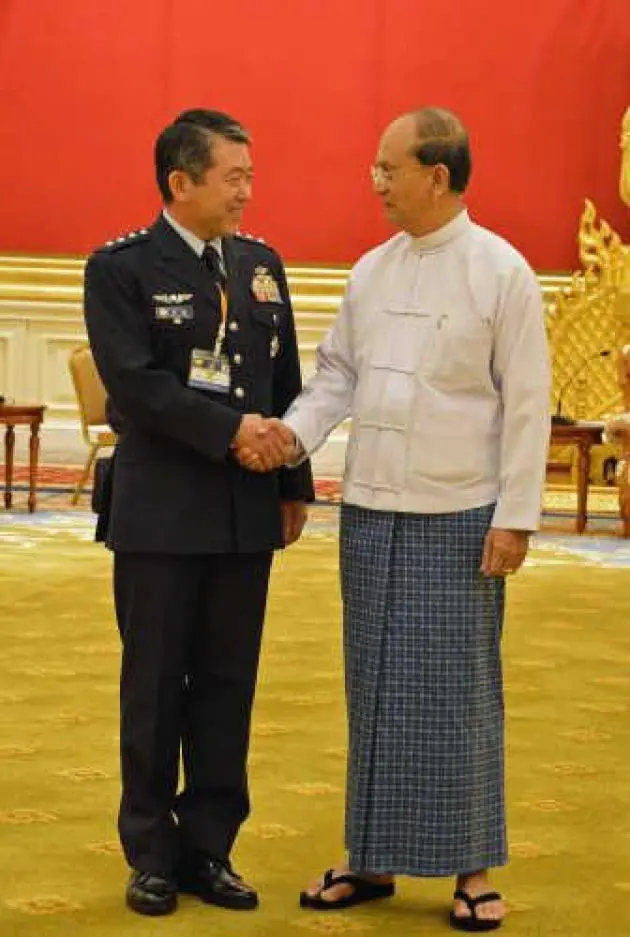
The four-day trip to Myanmar of General Shigeru Iwasaki, chief of the joint staff of Japan Self-Defence Forces, marked the first visit by a top military officer from Japan since World War II.
Iwasaki is the highest-ranking military officer in Japan. His visit coincided with the 60th anniversary of Japan and Myanmar’s establishment of diplomatic relations, which falls in 2014.
According to the Japanese Embassy in Yangon, he had accepted the invitation of Senior General Min Aung Hlaing. During his visit starting from May 26, he was scheduled to meet with President Thein Sein in Nay Pyi Taw on May 27 and made an inspection of Myanmar army units. The Japanese military’s top officer also held meetings with his Myanmar counterpart on the day.
According to officials from the embassy, Iwasaki will discuss military ties between the two countries, promoting the army’s capacity for disaster preparation and cooperation in defence and security issues.
There were no military relations between the two countries during the time of the military junta. His tour is aimed at launching military ties between the two countries after President Thein Sein came to power.
Shigeru Iwasaki attended the National Defence Academy of Japan, graduating to the Self-Defence Forces. In January 2012, he was promoted as chief of staff of the Joint Staff Council, becoming the highest-ranking official in Japan’s Self-Defence Forces.
During the junta’s rule, Japan never implemented economic sanctions against Myanmar but limited its official development assistance to humanitarian purposes.
Those restrictions have also been gradually relaxed since the latter half of 2011, allowing for use of such assistance to support the construction of social infrastructure and the resumption of yen loans.
In 2012, Thein Sein was in Tokyo. He said, “The people will enjoy the benefits [of the lifting of sanctions]. It will become easier for Japanese companies to invest if the United States also lifted its financial sanctions.”
In May 2013, Japanese Prime Minister Shinzo Abe made a three-day visit to the country. He was the first Japanese leader to visit the Southeast Asian country in 36 years. Japan acknowledged Myanmar’s reform programme by writing off nearly US$2 billion debt and extended new aid, some of which will help support an industrial zone being developed by Japanese firms near the commercial capital, Yangon.
Japan agreed a year ago to waive 176.1 billion yen ($1.74 billion) in arrears owed to it by Myanmar’s government and, at the end of a three-day visit by Prime Minister Shinzo Abe, it said Myanmar had met the necessary conditions, including a series of political and economic reforms.
“Since both governments acknowledged the continuation of Myanmar’s reform efforts, the government of Japan has decided to clear the said overdue charges,” Japan’s ministry of foreign affairs said in a statement after the prime minister’s visit.
