
Some restrictions on Thilawa Phase II


Play
Developers of the special economic zone appear to be paying more attention to the needs of local residents.
Not all types of businesses will be allowed to operate in the second phase of the Thilawa Special Economic Zone, if such investment is not associated with job offers and technology transfers.
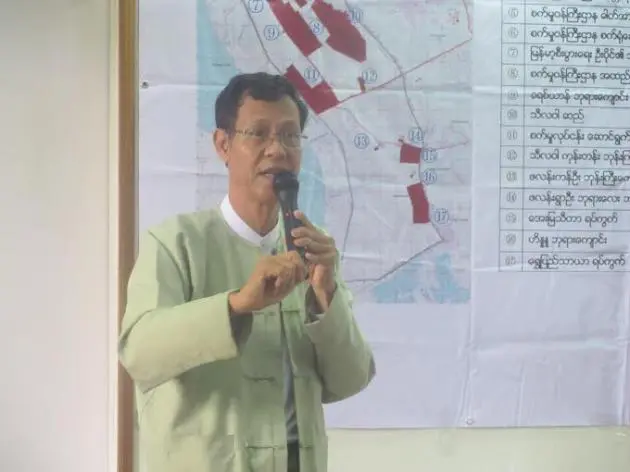
The new policy was announced last Friday at the second Thilawa Stakeholders Meeting, where local people were informed of some modifications in the development plan to serve their interests.
Than Than Thwe, associate secretary of Thilawa SEZ Management Committee, emphasised that as the SEZ aims at technology transfer and creating more job opportunities, the Committee did not allow some foreign firms - for example, packaging companies - to invest in the zone because they may not transfer technology to the country.
The official added that some plans for the SEZ have been modified for the interest of local people. The total land area for Phase II has been reduced from 1,980 hectares to 1,819 hectares. The committee has reduced the industrial land area from 1158 hectares to 986 hectares, reduced residential area from 200 hectares to 131 hectares, reduced trading area from 70 hectares to 15 hectares. The green land area - which involve public buildings and roads, etc - is planned to increase from 552 hectares to 687 hectares.
“Now we are doing environmental impacts assessment (EIA) for the Phase II. In doing so, there are five main points we will take into serious consideration - accelerating the momentum, building safe and secure lifestyle for local people, ensuring not to hurt the environment, building high-quality infrastructure, and maintaining the ecosystem by using Eco-Smart Technology,” said Than Than Thwe.
Earlier this month, villagers living on the land appealed for more constructive discussions with the Yangon Regional Government and the Japanese International Cooperation Agency (JICA), as they suffered from relocation problems. Without good answers, this could turn to opposition to the project, highlighted as a key part towards Myanmar’s economic development.
Thilawa is planned to be a manufacturing hub, to boost export income as the country has been living with huge trade deficits.
So far, 50 international companies have shown the committee their interest to invest in the zone. Among these companies, a total of 10 firms have signed the Memorandum of Understanding to invest in the SEZ. These include the US conglomerate Ball Corporation, construction materials manufacturing companies, garment firms, etc.
Japan’s Strategic Environment Assessment and locally-owned “eguard” Environmental Services are doing environmental impacts assessment in the Phase II area of the SEZ.
Aye Thiha, managing director of eguard Environmental Services, said that the draft EIA report is expected to be completed by September. After launching the draft report, another stakeholders meeting will be called in order to listen to the public voices over the report.
“We started a feasibility study last September and started doing research on November. In December, we discussed with the authorities concerned,” said Aye Thiha in an interview.
“We will take the villagers’ interest and their opinions into serious consideration. There will be a public hearing before we submit the final report to the Department of Environmental Conservation,” he added.
“What we can do is to do research on the impacts of the project and give advice on how to reduce these impacts as less as possible. But the management committee and other authorities concerned need to monitor how much local residents follow our suggestions.”
Mya Hlaing, a villager from Alwansut village which will have to transferred due to the project, said that EIA report must be transparent and urged the authorities to distribute the report in a way which all the local people can read.
“Dr.Than Than Thwe just said that the report would be published online. We all are farmers. So how can we access the Internet?” he questioned.
In response to his complaint, Than Than Thwe said, “If so, we will distribute the EIA report through Township Administrative Office, village administrative officers and village patrons, etc.
