
Asean should look beyond 2015: Thein Sein


Play
President Thein Sein called for more efforts for Asean nations to fully implement the Asean Economic Community (AEC) blueprint, which so far has been completed by only 82.1 per cent though the region has set a goal of achieving regional economic integrati
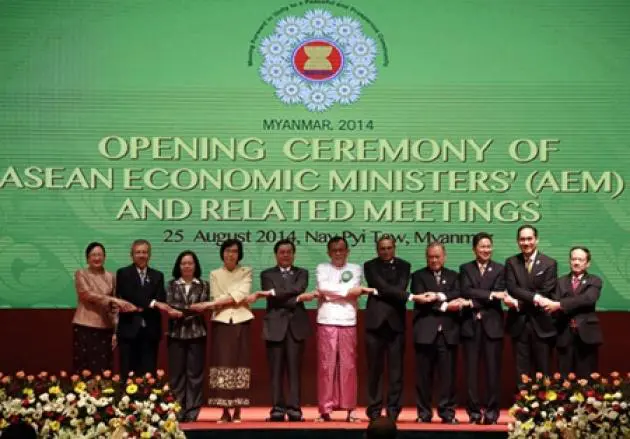
Issues concerning the upcoming establishment of the AEC in 2015 will be discussed at the 46th Asean economic ministers meeting, along with post-AEC 2015 scenarios and the regional comprehensive economic partnership.
Speaking at the opening session, President Thein Sein called on Asean to implement the remaining measures to realise the AEC that is to launch next year.
“As the realisation of AEC by 2015 is fast approaching, I would like to encourage the Asean member states to make utmost efforts to implement the remaining measures in a timely manner and the AEC blueprint be implemented expeditiously,” he said.
“We should pay more attention to increase the awareness and involvement of the people and businessmen in the region on the Asean Economic Community. We also take note of the support rendered by the dialogue partners for the realisation of AEC,” Thein Sein added.
Myanmar is the current rotating chair of Asean.
He also said that Asean would also focus on equitable development. In this regard, Myanmar – as the Asean chair – is compiling a report on programmes under the Asean Framework for Equitable Economic Development, with the World Bank’s help. The report will be submitted to the 25th Asean Summit in November.
Meanwhile, Asean also looks forward to expanding the Asean Free Trade Area, he added. Asean now has free trade agreements with six partner countries: China, Japan, South Korea, India, Australia and New Zealand. Thein Sein said he welcomed discussion for an FTA between Asean and Hong Kong as well as measures to push forward the Regional Comprehensive Economic Partnership (RCEP).
Talks on the RCEP started in 2012. Under the scheme, Asean and the six partner countries aim to extend partnership to cover trade in goods, trade in services, investment, economic and technical cooperation, intellectual property, competition, dispute settlement and other issues.
Once in place, the RCEP may turn into the world’s biggest trading bloc, as this group of nations reportedly will account for 40 per cent of the world’s trade, with a combined GDP of about US$17 trillion.
The main goal of the RCEP is to “create a comprehensive trade agreement that will facilitate economic integration between all the countries involved”. Main negotiating issues involved are trade in goods and services, investment, economic and technical cooperation and dispute settlement.
Like the AEC, the RCEP is expected to be concluded by the end of 2015.
Those attending the opening ceremony included Vice-President Nyan Tun, Lower House speaker Thura Shwe Mann, Upper House speaker Khin Aung Myint, Union Chief Justice Tun Tun Oo, Defence Services Commander-in-Chief Senior General Min Aung Hlaing, Union Election Commission chairman Tin Aye and Union ministers.
Philippine Trade Secretary Gregory L Domingo Domingo revealed that as many as 21 meetings among the 10 member states of the Asean and its eight dialogue partners, were expected to take place during the 46th Asean Economic Ministers Meeting. These would include one-on-one bilateral meetings and subcommittee group meetings.
According to the official agenda yesterday, the ministerial discussions would include issuance of an Asean Trade in Goods Agreement for the lesser-developed members of Asean – Cambodia, Laos, Myanmar and Vietnam – tariff liberalisation, elimination of non tariff barriers, Asean trade facilitation, development in customer integration, the AEC blueprint and scorecard and sectoral developments.
Myanmar National Planning Minister Kan Zaw, in his opening remarks, said the development gap among Asean countries is “still a great threat” to sustainability of the already achieved socio-economic development of the bloc, which marked its 47th anniversary of its founding earlier this month.
The situation calls for further strengthening of unity among member states to jointly narrow the gap and promote the role of small and medium enterprises, he said.
On Wednesday, the ministers will hold their second meeting of the RCEP where ministers plan to discuss the progress of negotiations.
Asean consists of Brunei, Cambodia, Indonesia, Laos, Malaysia, Myanmar, the Philippines, Singapore, Thailand and Vietnam.
