
Govt pressed to release more political prisoners


Play
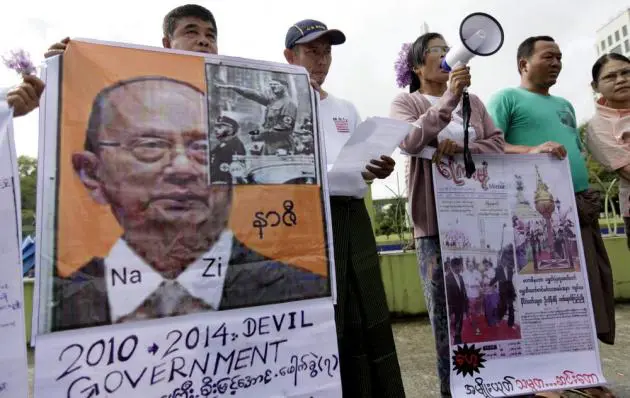
Some protesters on Friday gathered in Yangon, demanding for the release of their leader, activist Htin Kyaw, 52.
Considered a political prisoner, Htin Kyaw has been sentenced to 12 years in prison for organising anti-government marches without permission, as spontaneous protests are illegal in Myanmar.
Htin Kyaw started his life as a human rights defender with the establishment of the Myanmar Development Committee (MDC) in February 2007. Its main target then was commodity prices. MDC was transformed into Movement for Democracy Current Forces (MDCF) in February 2012. Notably, both community-based organisations are not registered under the Association Law of Myanmar.
According to Than Than Maw, Htin Kyaw staged four protests in 2007, as the military junta raised fuel prices massively that year. He was interrogated and at one time met former National Police Chief Major General Khin Ye. He and asked him to make public well being the priority.
His first arrest occurred on August 25, 2007, a month before the Saffron Revolution – a series of protests throughout the country against the State Peace and Development Council’s policy to remove fuel subsidies. End of the subsidies caused the price of diesel and petrol to surge as much as 66 per cent in less than a week.
His first sentence on November 17, 2008 was a 12 year and six month jail term. He was released under an amnesty in January 2012. He continued his activism and was re-arrested in August 2013 for organising protests against land grabs.
“He only knows what he has to do. He doesn’t care about any risk or unsafe conditions. He is just like Hantharwady U Win Tin, who was a very zealous person with a mission. He asks the public to support activists,” one of his followers, Kyaw Lwin, said.
Despite the lengthy verdicts, Htin Kyaw did not blame the judicial system.
“The important thing is that we need a good government and transparent Parliament to handle the distorted judicial pillar,” he told Myanmar Eleven at the Shwepyithar Township Court last week.
Htin Kyaw is not one of more than 3,000 released on October 7 under a presidential amnesty.
Efforts are being mobilised to assess how many political prisoners were among the people freed on the day.
More than 50 farmers from Kantbalu Township, in Sagaing Region’s Shwebo District, remain in prison for protests demanding the return of seized land, according to Assistance Association for Political Prisoners.
Myanmar’s future hinges on the release of all political prisoners, said AAPP member Aung Myo Kyaw. “In this [political] context, we have a motto – ‘national reconciliation is not possible as long as political prisoners exist’,” he explained.
According to the data collected by the two associations of former political prisoners there are still more than 70 behind bars. However, the Political Prisoner Scrutiny Committee – which was formed by the President’s Office – claims there are no political prisoners in Myanmar. The former political prisoners say there is a dispute over the definition of “political prisoner”.
On Tuesday, the United States on Tuesday called on Myanmar to release all remaining political prisoners, while welcoming reports that a large-scale amnesty was underway in the Southeast Asian nation.
According to AAPP, 11 individuals were sentenced to prison terms last month for politically related activities.
