
Govt pressed for independent interrogation over killed journalist


Play
The government is pressured to launch an independent investigation into the death of a freelance journalist, Aung Kyaw Niang, who was killed during the interrogation by soldiers.
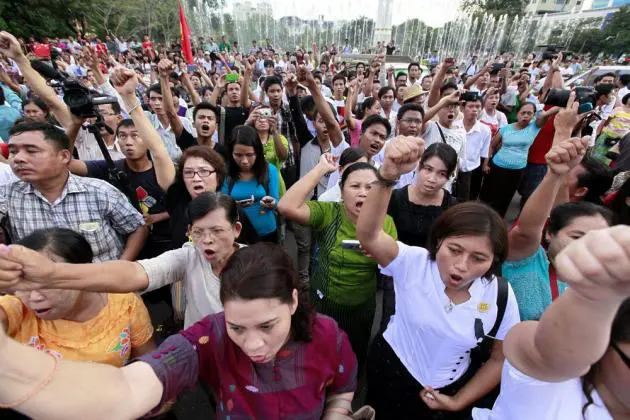
A mass protest was organised on Sunday, calling for the investigation into the killing of Aung Kyaw Niang, also known as Ko Par Gyi.
Burma Democratic Concern (BDC), a domestic movement, said in a statement released on October 24 that the government should bring anyone responsible before justice. It also called for transparent and accountable justice system. While calling for impartial role from enforcement organisations, it also urged the military to accept the fact that “in a fully democratic country- civilians control the military and there is no one above the law”.
The army had detained him since September 30 after a battle broke out near Kyaikmaraw Town.
Aung Kyaw Naing was gunned down as he tried to flee detention in Kyaikmaraw town in southeastern Mon state on October 4, the interim Myanmar Press Council (MPC) said citing a rare statement issued by the military.
He "tried to escape by fighting with a soldier and attempting to steal his weapon" said the document, adding that Aung Naing was suspected of being a member of a local armed group. The statement added that the body of the journalist had been buried in a place some 800 miles south from Shwewahchaung Village, and that his wife would be informed of his death and any necessary aid would also be given.
This was contradicted by activists and local media reports which said he was a freelance journalist covering unrest in the region, where fighting between government troops and rebels has flared in recent weeks.
The US-based Committee to Protect Journalists (CPJ) said Aung Naing was thought to have worked for several local news titles but the MPC was unable to confirm his status as a reporter.
The military statement issued Thursday - a first of its kind from the army which ruled Myanmar with an iron fist for decades - added the man had been buried in Shwe Wah Chaung village, near where he died.
Myanmar's press council Saturday said the army had admitted to shooting dead a man in its custody who activists claim was a reporter detained after covering clashes near the conflict-hit eastern border.
MPC secretary Kyaw Min Swe told AFP the burial meant it was difficult to verify the army version of events.
"This is a big question to ask the military, because they cannot show the dead body," he said, also questioning why the group had received news of the death nearly three weeks after the shooting.
On Friday the CPJ said the death of Aung Naing was "reprehensible", adding that he was the first reporter killed in the former junta-run nation since 2007.
"Civilian authorities must investigate the military's accounting of his death, which has the initial hallmarks of a cover-up," said Shawn Crispin, CPJ's Southeast Asia representative, in a statement.
"Any soldier found responsible for his extrajudicial killing or mistreatment before his death must be prosecuted to the fullest extent of the law."
Reporters were regularly detained under the junta, which meted out long jail sentences to journalists while choking off information with some of the world's most draconian censorship rules.
Reforms implemented by the current regime, including freeing most political prisoners and lifting pre-publication press scrutiny, have been lauded by the international community as the country opens up.
But the jailing of several journalists this year have raised fears that Myanmar could be sliding backwards on media freedoms.
A quasi-civilian regime, which replaced outright junta rule in 2011, has said ending decades of ethnic minority insurgency is a major part of its reform efforts.
But a nationwide ceasefire has so far proved elusive and clashes in eastern Myanmar have cast fresh doubt on the peace process.
--
Renewed call for enactment of interfaith marriage law
Nyan Win Shein
Myanmar Eleven
Around 3,000 people, including Buddhist monks, led by the Yangon Region’s Nationality and Religion Safeguarding Association, hosted a rally last weekend, calling for the enactment of the controversial interfaith marriage law.
Members of the association in Yangon Region and its members from other states and regions joined the march, which was held with permission from the authorities.
The protesters started the march from Kyay Thone Pagoda near the eastern gate of the Shwedagon Pagoda and circled the Shwedagon Pagoda by walking on the Kabaraye Pagoda
Road, Shwedagon Pagoda Road, U Wisara Road, and West Shwegonedaing Road. The protest ended with talks on the interfaith marriage bill.
“I want to request the President to enact the interfaith marriage law. The law is important to prevent the extinction of our nationality. I regard those people who are blindly opposing this law to be ‘national traitors’,” an ethnic woman, who participated in the protest, told the Daily Eleven.
Thousands of protesters shouted slogans like “We don’t want those who are opposing the interfaith marriage law” and “Those that violate nationality are our enemies”, while holding placards that read “Immediately Enact the Interfaith Marriage Law in order to Prevent Extinction of Myanmar Ethnic Races” and “People Who Oppose the Interfaith Marriage Law Are Those Who Don’t Want to Safeguard Their Nationality”.
“The interfaith marriage law is the lifeblood of Myanmar. That’s why we, the monks, are demanding that the authorities including the President and the MPs enact this immediately. This interfaith marriage law does not affect the people of different nationalities and religions. It does’t affect the government. It is in line with democracy. It is also in line with the Universal Declaration of Human Rights so we demand [the authorities] enact this immediately,” Parmaukkha, chief abbot of the Magway Monastery, said during his speech after the protest march.
