
Political powwow proves a damp squib


Play
The political talk on Friday was not exactly what opposition leader Aung San Suu Kyi asked for, explaining why some critics have dismissed the latest talks as "show business".
“I welcome this meeting but I fear it will be meaningless, only discussion," U Nyan Win, spokesman for Suu Kyi's National League for Democracy (NLD), told Deutsche Presse-Agentur.
Pro-democracy leader Suu Kyi had been requesting a meeting with the country's political and military leaders for nearly a year to discuss possible changes to the constitution, which currently bars her from running for president in elections next year.
Suu Kyi proposed four-party talks in November last year, to involve the president, parliament, the commander-in-chief of Defence Services.
President Thein Sein earlier said such talks should come only after a charter change report compiled by the Union Parliament’s Constitutional Amendment Committee. As the report is due to be discussed this month in Parliament, the talks were called. The timing was crucial, as US President Barack Obama is due to visit Myanmar for second time to attend the Asean Summit during November 12-13. Myanmar’s reform process has apparently slowed down while journalists have been sentenced or killed amid violations of human rights.
The authorities said that a nine-party meeting would be held, but the talk was designated as the five-party meeting – to involve the government, the legislative committee and the military as well as political parties and the Union Election Commission.
The five-party meeting was not described as political. The government described it as a discussion of state affairs. Every invitation letter to the unprecedented meeting was printed “Top Secret”.
Presidential spokesperson Ye Htut said the five-party meeting included all political parties.
Aside from Thein Sein, the attendees included two vice presidents - Dr Sai Mauk Kham and Nyan Tun, Commander-in-Chief of Defence Services Senior General Min Aung Hlaing and Deputy Commander-in-Chief of Defence Services Vice-Senior General Soe Win, Union Parliament speaker Thura Shwe Mann, Upper House speaker Khin Aung Myint, Union Election Commission Chairman Tin Aye and Vice-Chairman of the ruling Union Solidarity and Development Party Htay Oo.
Suu Kyi was there as the chairperson of NLD, as Khun Htun Oo was present to represent the United Nationalities Alliance.
Other political parties were the National Unity Party that won in the 2010 Election in 17 constituencies.
Shan National Democratic Party chairman Sai Aik Paung, representing the Nationalities Brotherhood Federation-NBF involving 23 MPs, and National Democratic Force chairman Khin Maung Swe, representing the Federal Democratic Alliance-FDA, were invited.
Nyan Win, secretary for the NLD executive committee, told DPA that each participant had just 10 minutes to discuss the agenda points, which they were only given at the start of the meeting, and were not allowed to comment publicly afterwards.
Journalists were allowed to take photos and a press conference was held after the meeting, but no joint statement was released.
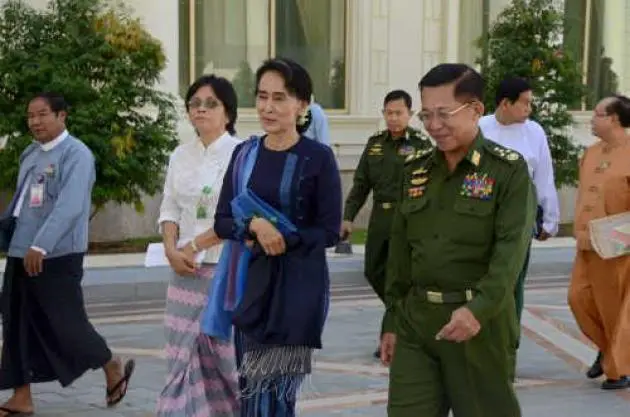
All gathered at the Presidential Palace for the roundtable talk after the photo session. Tension was high.
Khin Aung Myint, the Upper House speaker, listened without smiling to President Thein Sein’s welcoming speech. And then, Suu Kyi brusquely greeted the president when she finally arrived. President Thein Sein followed her into the meeting room.
At the meeting, President Thein Sein said the 2015 general election must be held successfully to ensure political stability. While UEC chairman stressed the promise for a free and fair 2015 general election, the two parliament speakers said that constitutional amendments are drawing near.
Min Aung Hlaing then stressed that political problems should be solved in political ways and that the military welcomed charter amendments and would be actively participating in the reform process.
Suu Kyi didn’t say anything significant. But, she said that she hadn’t told her party anything about this dialogue. It was hard to inform them because she hadn’t found time to call a meeting with her party’s CEC [Central Executives Committee] members. There was not enough time between receiving the invitation and the meeting itself.
No single agreement followed, though the government described the meeting as a political dialogue to deal with political, education, health, economic and social issues.
“Talks are always good, any kind of talks. But it should be systematic to have long-term benefits,” said Suu Kyi after the discussion was over.
Shan national race leader Khun Htun Oo saw it differently. He said the meeting was not fruitful.
Sai Nyunt Lwin, who spoke on behalf of Khun Htun Oo, said that the meeting hadn’t met the anticipated standard, though this was anticipated.
At the meeting, Ministers for the President’s Office Soe Thein, Aung Min and Myanmar Peace Centre officials were not seen. Ye Htut acted as the Master of Ceremonies.
A number of political talks took place in Nay Pyi Taw on that day and later.
Notably, some ethnic armed groups are displeased with the slowness in reaching a nationwide ceasefire agreement. At a meeting on Friday, the Nationwide Ceasefire Coordination Team (NCCT) and the Union Peacemaking Work Committee (UPWC) could find no answers. Later, UPWC had a meeting with the government while NCCT representatives were excluded. Ye Htut explained that issue did not involve the ethnic armed groups.
On the same day, Myanmar Peace Centre (MPC) held a dinner party for political parties, with Khun Htun Oo being among the invitees.
The 20th regular meeting of National Brethren Federation (NBF) also took place recently at the capital city, as well as the meeting between UPWC and Shan State Progressive Party/Shan State Army ( SSPP/SSA).
Looking in anyway, the only fruitful outcome from the five-party talk was that it marked the first time that Suu Kyi and the military chief met, though the pro-democracy leader had several meetings with other influential military figures.
In 1994, she met Than Shwe (retired Senior-General) and Khin Nyunt (retired General). During 1994, she met Than Shwe at least twice. In 2000, they met at least once, and in 2002, at least one time. In 2002 NLD top leaders including Aung San Suu Kyi had dinner with Than Shwe and Maung Aye.
Since Thein Sein came to power in 2012, she met him four times.
It remains to be seen what political gains to be sowed before Thein Sein’s term will end next year.
