
Slap in the face for Obama as Myanmar military dictates again


Play
Parliament speaker Shwe Mann has ruled out charter change to allow Aung San Suu Kyi to run for president, the latest hammer blow against democratic reform
Last week, US President Barack Obama arrived in a country where hopes for reform and democracy look a lot dimmer than the last time he visited, just two years ago. After embarking on a transition away from military rule and towards democracy, Myanmar still hasn’t addressed a host of human rights issues and has seen its reform efforts slow.
Hopes for reform embodied by the release of the country’s iconic opposition leader, Aung San Suu Kyi,from house arrest in 2010 and election to Parliament have faded amid reports of widespread human rights abuses, including what some watchdog groups call the ethnic cleansing of Myanmar’s Rohingya Muslims. And Suu Kyi recently questioned the West’s optimism in embracing Myanmar’s government early on in its promised reform process.
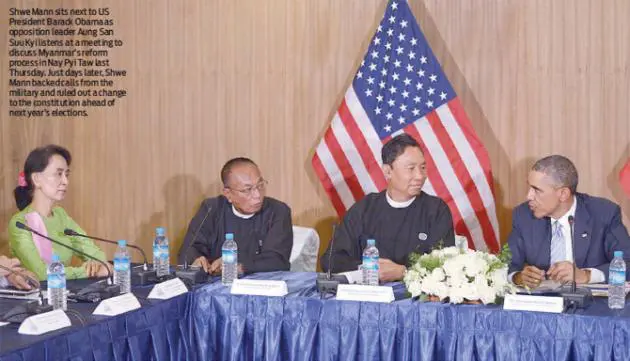
On Tuesday parliament speaker and presidential hopeful Shwe Mann ruled out a change in the juntadrafted charter to allow Suu Kyi to run for president next year. The comments by Shwe Mann came days after visiting US President Barack Obama backed Suu Kyi’s attempts to change the charter. Yesterday, Suu Kyi’s party conceded defeat in the battle for charter change.
Though Myanmar has been touted as a bright spot in Obama’s foreign policy, Obama was fairly vocal last week about the country’s shortfalls.
To coincide with his arrival,Irrawaddy magazine published an interview with the US president in
which he identified several “steps backward”, including the treatment of former political prisoners, journalists,the Rohingya, and other ethnic minorities.
But how much do Obama’s comments really matter? Not much, human rights observers say: The
United States gave up much of its leverage when it eased economic sanctions against the country two years ago, following some apparent moves toward democracy by the long-time pariah nation.
‘Sanctions surrendered too quickly’ “Almost everyone I speak to that was very critical of those sanctions has said over the past year that they were surrendered too quickly,” said David Mathieson, a senior researcher with Human Rights Watch. “When reforms started, that was exactly when the sanctions were needed, and by taking them away too quickly, the US was surrendering leverage.” According to Mathieson, people who share this view include NGO workers in Yangon and officials in the US government.
Despite the reformist attitude of President Thein Sein, a former general,Myanmar’s cadre of top military officers, who held power for most of the country’s post-colonial history, have refused to surrender much of their power. The military continues to control a constitutionally mandated
25 per cent of seats in parliament. And the constitution still contains restrictions on who can run for political office that are aimed at maintaining the military’s hold on power. Jennifer Quigley, the president of the US Campaign for Burma advocacy group, said that these aspects of Myanmar’s constitution require “much harder reforms that we need to move forward”.
“We thought that there should have been much more progress, particularly on advancing constitutional change, before lifting economic sanctions,” Quigley said. “Now it will be incredibly difficult for the military to agree to that kind of reform.” Since the United States, the European Union, Australia and several other countries lifted most of their sanctions, violence against the
Rohingya minority group in Myanmar’s western Rakhine state has escalated dramatically. As a
result, more than 100,000 Rohingyas have fled the country since mid-2012, according to United
Nations estimates, and those that remain have been forced to renounce either their identity as Rohingya or their rights as Myanmar residents.
Human rights groups say these developments may amount to ethnic cleansing.In other parts of the country, promises of a ceasefire between the government and various armed ethnic minority groups have fallen apart time and again, partly because of the military’s refusal to budge in negotiations.The US government knew these problems weren’t fully resolved when it lifted sanctions but caved under pressure by companies that were eager to invest in the long-closed
country and feared being edged out by foreign investors, Mathieson said.Still, there are a few avenues left for US leverage. Although the European Union reinstated trade privileges with Myanmar under the generalised system of preferences last year, the United States hasn’t yet
done so, and Quigley’s organisation says it shouldn’t until Myanmar has shown it’s serious about protecting land and labour rights. The United States also continues to maintain a specially designated nationals (SDN) list of sanctioned individuals and companies. Although the list has not been regularly updated and has some glaring gaps, it has the potential at least to signal US disapproval of key figures, particularly if it were expanded.
Meanwhile, moves toward a relationship between the US and Myanmar militaries have stalled, and Quigley and Mathieson said they hoped the United States would make “mil-to-mil” interactions contingent on Myanmar’s generals loosening their grip on government.
Additionally, Mathieson said, the US government should coordinate with the EU and other international players to pressure organisations like the World Bank to not carry out projects
that could destabilise areas of ethnic conflict or end up benefiting anti-reform military leaders. But the political will to exert such pressure has weakened as countries that once had no economic stake in Myanmar have poured in billions of dollars, creating an interest in maintaining friendly relations with the country.Still, it’s only by systematic coordination and pressure for reform – and
not by a one-off visit from Obama – that United States can use what leverage it has left, Mathieson said.
“It’s a wrong approach to think that Obama coming is going to change anything. What’s needed is a more long-term engagement,” he said. One option that’s now entirely off the table, though, is reinstating the lifted sanctions. “What’s that saying about slamming the gate shut after the horse
has bolted? I think it’s going to be very, very difficult to re-impose sanctions,” Mathieson said. “I don’t think there’s any political will.”
