
Hong Kong police haul away protesters from rally site
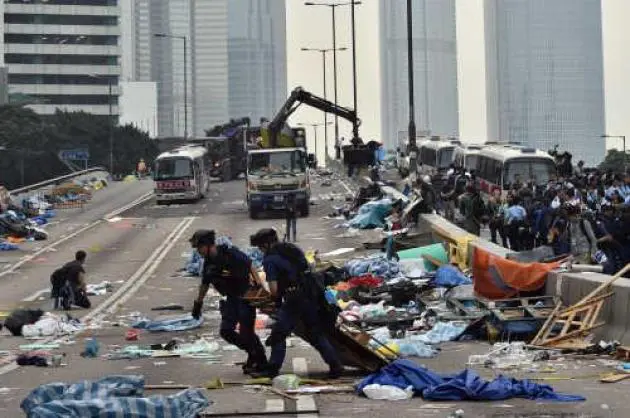


Hong Kong police began dismantling the city's main pro-democracy site Thursday, clearing away tents and barricades after more than two months of rallies, and hauling off a hard core of protesters who nevertheless vow that their struggle lives on.
Hundreds of police moved in from all sides of the Admiralty camp in the heart of the business district sweeping away tents and barricades before swooping on a core group at the centre of the site, including student leaders and lawmakers.
The dozens making a last stand were the remnants of what once numbered tens of thousands of people at the height of the protest movement, before public support waned.
Some were carried by groups of four officers while others were led off on foot. Those who remained lay on the road shouting, "We are peaceful", "We will not resist" and "I want true democracy".
The call for free leadership elections has underpinned the demonstrations, and protesters have vowed the clearance operation will not end a campaign they say has redefined the city's vexed relationship with Beijing.
"This is not the end of the movement. The political awakening amongst the young is irreversible and we will fight on," pro-democracy lawmaker Claudia Mo told AFP.
Police had announced a "lockdown" after a 30-minute window allowing protesters to voluntarily leave the site -- an encampment of tents, supply stations and art installations sprawling along a kilometre of a multi-lane highway through the Admiralty district.
Some managed to leave after the deadline, but were asked to give their identity details to police.
Thousands gathered on Wednesday night for one final mass rally at the site, but the numbers had already dwindled to hundreds by Thursday morning.
Before the police operation, bailiffs descended with cutters and pliers to take down barricades and load them into trucks to enforce court orders taken out by transport companies frustrated at the long-running disruption.
While many protesters had packed up their tents and left, others said they intended to stand their ground.
"I'm not tired (of the campaign). I'll never be tired, only the government is tired," said 19-year-old student Alice.
The start of something
The Admiralty site has been the focal point of the protest movement since rallies erupted in September, after China's Communist authorities insisted that candidates in Hong Kong's 2017 leadership election will have to be vetted by a loyalist committee.
