
Myanmar near to sign ceasefire accord


Play
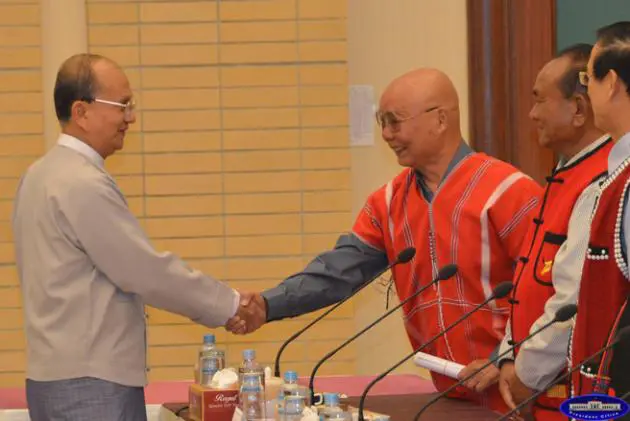
Myanmar is apparently close to have the long-awaited nation-wide ceasefire agreement signed next month, following the crucial meetings between ethnic armed group leaders and President Thein Sein and Commander-in-Chief Senior General Min Aung Hlaing in Nay
According to President Office, Thein Sein urged the 12 ethnic groups to make concerted efforts to sign the accord on the next coming Union Day which falls on February 12.
The ethnic armed groups urged that a firm political agreement must be achieved within the next month in order for the nation-wide ceasefire to be signed on Union Day, February 12, as recommended by the groups.
The meeting followed the 67th Anniversary Independence Day Ceremony and Grand Military Review Parade on January 4, which was attended by the ethnic leaders.
Union minister Aung Min said the ethnic armed groups had the chance to present their grievances to the president.
"There are those among the ethnic groups who want to speed up the national peace process and also those who wish to slow it down. Those who want a faster process said on December 22-23 that they would sign an agreement on Union Day. We need to prepare for that. That's why the president invited ethnic leaders to attend the celebration of the 67th Independence Day and military parade," said minister Aung Min.
Khum Myint Tun, chairman of the Pa-O National Liberation Organisation, noted that the meeting focused on things not discussed before.
“It’s still not a real dialogue. We just exchanged our opinions and views. That's all. Most importantly, we talked about how to complete the national peace process. It's very important to have a nation-wide ceasefire. We all agreed to work together for the sake of the nation basically," he said.
"There were previously some misunderstandings between us as we couldn’t meet like this. So we suggest more meetings. But there is no date set for the next meeting," said Colonel Sai Hla of the Restoration Council of Shan State/Shan State Army.
The internal conflict in Burma began after the country's independence in 1948, with successive fighting between central governments and ethnic groups.
Since 1989, 20 ethnic groups were forced to sign ceasefire agreements. Without political dialogues, conflicts flared up again. The agreement with Karenni National Progressive party, signed in 2005, broke down within 3 months. Fighting with Kachin Independence Organisation also resumed in June 2011 as the ceasefire agreement signed in 1994 broke down.
Lingering conflicts
Invitation was extended to 16 ethnic armed groups. Not showing up at the meeting were Kachin Independence Army, Ta'ang National Liberation Army, Karenni National Progressive Party and Chin National Front.
KIA’s camp in the northern part of the country was shelled by government troops in November, killing 23. The incident, which the army said was a warning shot gone astray, caused the umbrella organisation representing all rebel groups to pull out of ceasefire talks that month. Negotiations were rescheduled for December 22, but high-level KIA representatives did not attend and the talks were inconclusive.
January 5 marked the first time that the leaders met the commander-in-chief in person.
Shan’s Colonel Sai Hla noted that the military plays an important role in hastening the process.
“That's why we all asked for it and the commander-in-chief agreed. We talked about it,” he said.
Aside from the tentative date on February 12, they also discussed constitutional amendment during the 2-hour meeting.
According to President Office’s website, Thein Sein told ethnic leaders that internal peace plays a major role in democratic transition and the only means to restore peace is the political dialogue.
“If armed conflicts cannot be controlled while the political dialogue is going on, the political dialogue will be dragged back,” he said, urging the ethnic leaders to help to successfully hold free and fair elections in 2015 in their areas.
The president also promised to spend state budget on the requirements of local people after the ceasefire.
