
Charter veto protest lands Charges against students
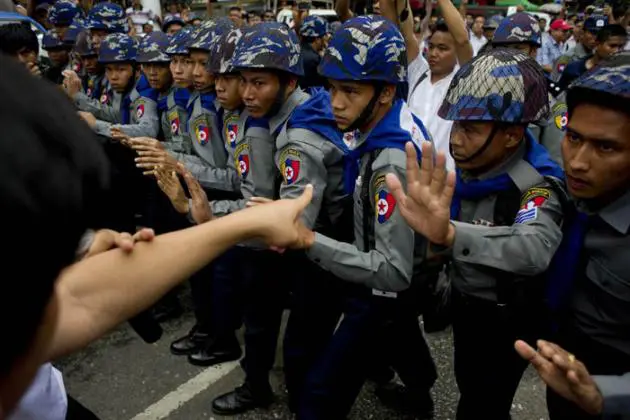


Students charged with protest political role of military without permission
Myanmar Eleven
University student leaders who led a protest calling for constitutional amendment and the abolishment of military seats from parliament were charged with violating Section 18 of the penal code by law enforcement in Pabadan and Kyautada townships on July 1, according to a police officer in Yangon, Western District.
“We charged them under Section 18 because they did not receive permission for the protest. A total of five students, including Zayyar Lwin, Paing Ye Thu and Nang Linn were charged,” said Police Colonel Kyaw Htut from Yangon Police Department, Western District.
The protest began at 3pm on June 30 at Theingyizay Market, downtown Yangon. The protesters marched from there to City Hall. Police blocked the procession three times on its way to City Hall. During the third attempt, a clash erupted between protesters and police, ending with the protesters choosing other street to reach City Hall.
Regional police officers, regional administrators and the western district police colonel participated in blocking the protest.
Under Section 18, all protests must have permission from relevant authorities.
Student leader Zayyar Lwin said: “If we had applied for permission, they wouldn’t have given it to us. So why do we need to do that? I don’t believe in Section 18. We expressed our desires because we are citizens.”
The students demanded amendments to the 2008 Constitution.
On June 25, Myanmar's parliament voted down a bill to end the military's effective veto on charter change. A number of 388 lawmakers - or around 60 per cent - voted in favour of the change to the bill to change Section 436, below the threshold of 75 per cent needed for it to pass. The section demands that all amendments to the constitution must win at least 75 per cent of votes. Myanmar's parliament is now dominated by the army. The army’s representatives control 25 per cent seats.
The amendment to Section 436 was seen as a key to changing further clauses, including Section 59(f) which bars opposition leader Aung San Suu Kyi from becoming president.
“We have two demands in our protest. The first demand is to enjoy genuine democracy, and the second is to amend the 2008 constitution. More than 5 million people signed a petition in support of constitutional amendment. But the military representatives turned a blind eye to these demands for charter change. For that reason, we staged the protest. The military regime held a referendum for the constitution while the country was still devastated in the wake of Cyclone Nargis in May 2008. The constitution has been unjust since the beginning,” said Nan Lin, a student from Dagon University.
“Our peaceful protest march was forcibly blocked by the police. But the police did not beat or arrest the protesters along the way to City Hall. Finally, we reached our target. We protested against the military MPs, as they are given special privileges by the constitution. We were delighted by our efforts to overcome obstacles,” said Zeyar Lwin, a student leader from Yangon University of Economics.
Myanmar’s university students have been a strong force behind political changes in the country.
This is the second illegal protest by students this year.
During student protests in Letpadan, Bago Region in March this year, police arrested and allegedly beat several students, many of whom are still on trial.
