
Singlish all abuzz


Play
SINGAPORE - Don't play-play, Singlish is very the powderful, okay?
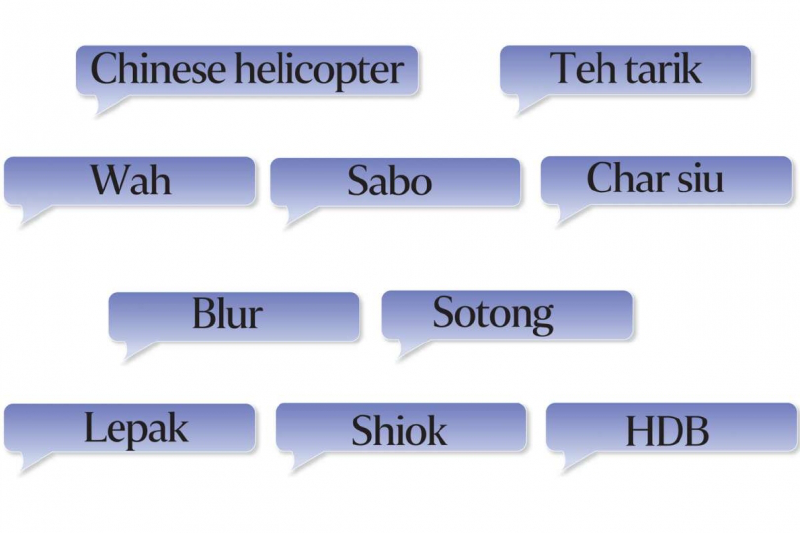
The authoritative Oxford English Dictionary (OED), in its quarterly update two months ago, took in 19 Singlish terms. Terms such as the exclamatory "wah" and "sabo", a contraction of "sabotage", are now part of "the definitive record of the English language", as the OED describes itself on its website.
Although those Singlish terms were not the first to be included in the OED - "lah" and "sinseh" made it in 2000 and "kiasu" was included in 2007 - the recent development is seen as an acknowledgement that Singlish is a deeply ingrained part of local culture by some of those who have long championed it.
Poet and literary critic Gwee Li Sui, 45, says: "The list is quite choobi (cute). I don't think any Singlish speaker would have made the same selection, but then the heart of the list is meant to be ang moh lah."
He describes Singlish as a "patchwork patois" of the four official languages along with elements of Hokkien, Bengali and other tongues.
Humourist Sylvia Toh, 69, had celebrated the "richness and colour" of Singlish before it was fashionable to do so, in her books Eh Goondu! (1982) and Lagi Goondu! (1986).
She says: "Speaking as a Singaporean, you've got to be happy and take a sense of pride as it counts as acknowledgement that Singlish is important to, and part of, our national identity. Ironically, a former colonial master is recognising this, while our own government campaigns fought to rid it."
The Speak Good English Movement was launched in 2000 to stem the tide of Singlish that had swept into every nook and cranny of the island.
But now, even politicians and officials are on the Singlish bandwagon after years of waging battle against it.
Manpower Minister Lim Swee Say is credited for coming up with "betterer" and 'betterest" back in 2010, while during the General Election last year, Senior Minister of State for Finance Sim Ann described opposition leader Chee Soon Juan as someone who likes to "chut pattern" (someone who is full of antics).
Gwee, a former academic in the English Language and Literature Department at the National University of Singapore, points out this official shift in a May 13 opinion piece for The New York Times, which was at one point among the Most Popular articles on the newspaper's app.
He is not surprised by the interest generated by the piece.
"Many Singaporeans are passionate about Singlish, and every Singlish speaker thinks of himself or herself as an authority. Visitors here are often happy like bird to complete their visits by learning a word or two," he says.
Indeed, on a recent promotional trip for the superhero flick Captain America: Civil War, American actor Anthony Mackie dropped a fairly decent-sounding "yes, lah" and "no, lah" during the press conference to demonstrate that he was down with the lingua franca.
But this does not mean that students can anyhow chut pattern in their English compositions and essays at school.
A primary school teacher, who declines to be named, says: "Some of the inclusions are words from another language, not English. In my opinion, such terms should not be accepted in examinations, especially when they are used colloquially."
Account manager Tan May Yik, 36, a mother of two children aged eight and five, says: "Singlish is like a dialect, it's just part of our lifestyle and culture. Therefore it shouldn't be considered as proper English and be accepted in exams."
Goh Eck Kheng, chairman of the Speak Good English Movement, does not think the wider acceptance of Singlish sounds the death knell for the campaign he heads.
For one thing, there are still many who confuse bad English for Singlish.
Goh, 61, says: "Not everyone who speaks Singlish can also speak English. There are those who think Singlish is English. Others habitually use ungrammatical, fractured English."
An example: "Can you off the light" is bad English, while "Turn off the light, leh" is Singlish.
Some students think using Singlish would add colour to their assignments while others think it would erode the standard of English here.
Student Abdul Alim Iskandar Dzulkhari Kajai, 14, says: "It's confirmed not allowed, but personally, I would want it to be allowed because it will make the composition more entertaining, and entertaining usually means more marks."
On the other hand, student Desiree Orien Tay, 17, says: "Since the OED is pretty well known and since we follow what goes on in Cambridge, I feel that eventually they will accept it in our exams. However, I really hope they won't. If they do, kids will not speak proper English."
Satirist and film-maker Colin Goh, 46, has no qualms giving Singlish the thumbs-up for its humour and inventiveness.
"Its mish-mash of various languages and dialects, often involving bad transliterations, is very, very funny. Contrary to popular belief, Singlish is not merely badly spoken English, akin to pidgin. There is a conscious art in Singlish - a level of ingenious and humorous wordplay that is equalled only perhaps by Cockney rhyming slang."
He and his wife, Woo Yen Yen, started the Coxford Singlish Dictionary online in 2000 and lovingly compiled the meanings of more than 1,000 words and phrases from "act blur" to "ya ya". It has been in print since 2001.
But back then, he never imagined that the OED would "validate" Singlish. He adds: "We also don't need its validation, though it's quite nice, lah. Thank you, hor."
Gwee, who parses the finer points of Singlish in a series titled SinGweesh for website The Middle Ground, expresses similar sentiments.
"It's like saying French words in the OED validate French or an international report on Afrikaans validates it. Enough of the colonial mindset. The fact that Singlish continues to thrive against all odds is its own validation."
