
Blessings of the bhikkhuni
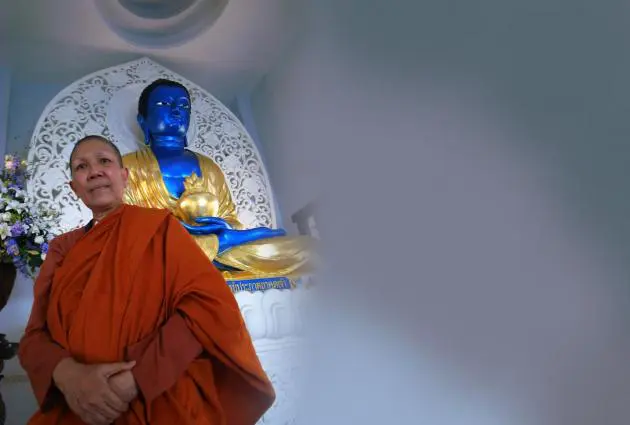


Dhammananda still has 'Mrs'on her ID card 12 years after entering the monkhood
Dhammananda has been in the Thai Buddhist monkhood for 12 years – a bhikkhuni, as the ordained women are known, in a country where Buddhism remains a male bastion. The Lord Buddha endorsed the monastic ordination of women, but Thailand’s Sangha Council will accept no female order.
Nevertheless, over the years, Dhammananda – through her religious activities and writings – has inspired quite a few women to devote themselves to the lifestyle. She firmly believes they can share in nirvana. There are currently about 35 bhikkhunis in the country.
“It’s a small number but we’re spreading out – we have bhikkhunis in 10 provinces now,” says Dhammananda, who’s based at the Songdhammakalyani Monastery in Nakhon Pathom. She divides her time between her religious commitments and writing a book about the history of bhikkhunis in Thailand and another about the process of being ordained.
“I need to go back to Sri Lanka to get more information,” she tells The Nation.
Dhammananda entered the world of the bhikkhunis after presenting a paper on their future prospects at a 1983 Harvard University conference on women, religion and social change. She was preparing for her master’s degree at the time.
“That conference marked a turning point in my life. I realised that I needed to be more than an academic to bring about change. So I became an activist and started a newsletter, which helped me connect with bhikkhunis. I had no idea that I’d be ordained one day as a monk. Now, since we’re sprouting like mushrooms everywhere, it dawned upon me that I have to write our own history.”
Earlier this year 78 bhikkhunis and samaneree – female Buddhist novices – assembled at the temple, she notes. “So I think we need to bring out a book like this, not just for bhikkhunis in Thailand, but for all bhikkhunis since the Buddha’s time.”
Dhammananda acknowledges that bhikkhunis have had a habit of losing their way on the Buddhist path and then returning. She wore the robes of a novice for two years before being ordained as a monk, in a ceremony presided over by five male and five female monks. It took place not in Thailand but Sri Lanka, since there weren’t enough female monks here to perform the rituals.
Entering the second cycle of her monkhood, Dhammananda reckons change is coming slowly to the female order. “When I step out of my temple, people watch my every move. More and more women believe it’s all right to be ordained. They go to Sri Lanka for ordination the same way I did, and come back to establish themselves in their temples in the provinces.”
The path to Buddhahood is particularly difficult for women but possible nevertheless, she affirms. Like the monks of Theravada Buddhism in general, Dhammananda rises early to pray and meditate before going on her morning alms rounds. Twelve years ago two monks followed her to collect all of the people’s offerings as she made her rounds.
These days she’s followed by a carriage to transport the huge amount of offerings from devotees.
“If you understand the Buddhist teachings, it’s not hard to be a bhikkhuni,” she says. “I’m just doing my job as a bhikkhuni.
People are overjoyed to see me during my morning rounds. The amount of food we receive is unimaginable, and more and more. I feed 40 people on Sundays with the offerings received.”
Dhammananda finds time to visit remote villages, run social activities, conduct sermons and give lectures at home and abroad.
She’s involved in a project to grow trees in Koh Yor in Songkhla at the moment, while at the same time teaching a group of students from Norway at her temple. While her busy schedule serves to illustrate her devotion, she’s often encountered strange reactions. Unlike her male counterparts, Dhammananda is not allowed to change the title on her ID card from Mrs to Bhikkhuni.
“It’s funny when you look at my ID card bearing my image with a shaven head and the title Mrs, when I’m a monk! The ID card still goes by ‘Mrs so and so’.
The officials at my district office told me they need a computer code to change my title. ‘And how do you get the code?’ ‘You have to go to a particular department to get permission, then permission from the Sangha Council.’ And the Sangha said, ‘We do not yet accept the female order.’”
Those who question her religious path are mostly senior Buddhist monks with “high positions”, she says.
“This is a part of our culture that hasn’t been questioned for a long time. But we shouldn’t be unhappy about it. Otherwise it becomes negative energy working against us. Buddha talks about change. This also has to change.
You should not be fighting against the structure unhappily. Because the structure is created by us, by people, we should come around and try to get the right understanding across while confirming to them that this lifestyle is good for you, your daughter, mother and wife. The door will open slowly. Nothing happens overnight.”
Dhammananda’s message for those who don’t understand the world of bhikkhunis is this: “You need to tell them that you’re happy. Once the message gets across, people will see that this lifestyle is good for women. Only a few women can walk this path, but it’s open and possible because the Buddha gave us the opportunity. You feel so proud and happy to be able to carry out the heritage.”
