
Politics, guns and grenades


Play
Some - certainly not everyone - will want to read Abhisit Vejjajiva's take on the violence of 2009 and 2010
Thai politics has seen much fighting between good and bad. In the past it was often a military dictatorship that was the villain and pro-democracy protesters and their politician backers who were the heroes.
But today the situation has become more complex as the line between good and evil appears to have been blurred. It is more difficult to tell for sure who is hero and who is villain – if you just listen to what they and their media say, without looking closely at what they have actually done.
Both sides claim to be saints and portray the opposite side as devils. Worse, biased media and polarised politics make it difficult for people to tell which side is good and which is bad.
The political conflict over the past decade or so has created a severe social division in modern Thailand and it became deadly in 2010, with 91 people killed and 2,000 others injured during 10 weeks of unrest from March to May.
A big difference from the past was that many of those killed and seriously injured were soldiers taking part in crowd-control operations. The casualties included an Army colonel killed and a major general seriously injured in a grenade explosion. Under military dictatorships of the past, it was usually the protesters who were at the receiving end of carnage when there was a crackdown.
Also, protesters in the past were virtually unarmed, which was not the case in 2010. Photos and footage of the unrest showed heavily armed men clad in black among the protesters.
Democrat Party leader Abhisit Vejjajiva, who was prime minister at the time of the unrest, has been blamed by his political enemies for the casualties – they called him a “blood-thirsty murderer”. In his new book “Kwam Jing Mai Mee See” (“The Truth Has No Colour”), Abhisit tells his side of the story. He said he became a victim of “shameless lies”.
Abhisit recounts what happened during the tumultuous years of his government. His time in office, slightly more than two and a half years, was interrupted by protests by red-shirt supporters of former premier Thaksin Shinawatra.
“You have heard people lie a lot already. Now please allow me to tell the truth – the truth that has no colour, the truth that is recorded from my heart, the truth that has never changed,” he says in the foreword.
The Democrat leader relates violent events during the protests against his administration in 2009 and 2010, including a mob attack on his bulletproof limousine. He points out that no protesters died in the 2009 mayhem and that the 2010 uprising began just days after Bt46 billion in Thaksin’s assets were seized by court order.
Abhisit says the 2010 deaths and injuries stemmed from political manipulation, and not of his own party’s making. “Some people wanted to cause casualties so that the bodies could be used for their political advantage”.
He said Thaksin’s “innocent supporters were cruelly used” as a political tool and that the ultimate goal was to whitewash Thaksin’s wrongdoings – not bring about a fairer, more democratic society, as claimed by the protest leaders.
Abhisit, now the opposition leader, says his fault was that he was a prime minister who Thaksin could not influence.
Little of the information in the book will be new to people who followed events in 2009 and 2010, but the author also offers a lot of behind-the-scenes stories along with his personal views.
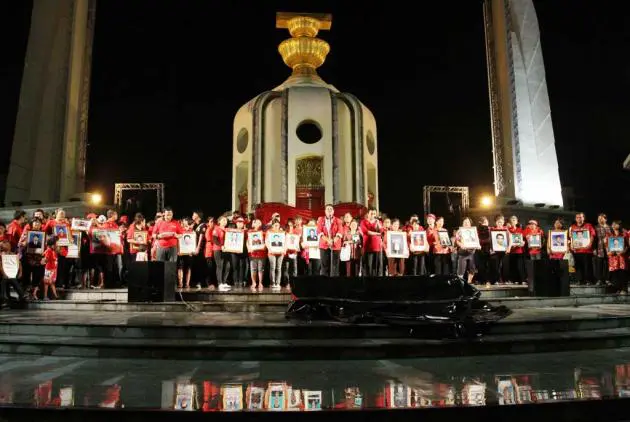
Abhisit tells the reader how he felt on the night of April 10, 2010, when many people were killed after grenades were fired at soldiers and shots were fired at protesters near the Democracy Monument. He called the incident “guerrilla warfare in the guise of protest”.
“[It] was the longest night and saddest time during my premiership. That night I cried for a very long time,” he says.
In addition to the many serious comments and hard facts, the book contains several humorous remarks and light-hearted anecdotes from the times of crisis. Abhisit talks about a government spokesman “who never slept” and quips that he had good health while living at 11th Infantry Regiment headquarters as a security precaution – because “I didn’t eat much”.
On the book’s cover is a candid shot of Abhisit sitting at a table while “in asylum” at the military base, at the height of the unrest in the spring of 2010. The 176-page pocketbook includes 43 chapters with photos on almost every other page taken during the protests.
For many politicians, half-truths and little lies are normal, but it’s uncommon in Thailand to stoop to attributing blame to others. Abhisit’s book condemns such politicians. His fans will surely agree, but his enemies will scorn any attempt to turn the tables.
In the end it’s not an act or a series of acts that bring credibility. It’s acting in a credible manner over a long period. When assessing events without political bias, it’s not too difficult to tell who’s speaking the truth. Those blinded by bias will have to wait to discover who lied to them.
Kwam Jing Mai Mee See (The Truth Has No Colour)
By Abhisit Vejjajiva
Published by Watchdog, Thai language only
Available at SeEd Books, Bt120
Reviewed by Kittipong Thavevong
