
Life as a house


Play
The environmentally friendly home that nurtures the elderly and whose functions can be controlled by smart phone will soon become a reality. A new expo explains how
WITH ELECTRICITY prices soaring, wouldn’t it be great to live in a home that runs on low energy and allows its inhabitants to control lighting and security from a smart phone or tablet computer?
In the not too distant future, it should be possible to do all that and more in a smart home designed by Siam Cement Group (SCG) that even goes so far as to automatically adjust brightness to the appropriate levels for each activity while filling the kitchen with a wonderful chocolate aroma.
If it all seems a little space age, make time to visit the prototype home that’s on show in the SCG Experience building until September 1 as part of the celebrations to mark the firm’s centennial.
The three-storey building is home to various working prototypes that seek to enhance living conditions through innovations in building materials, papers and plastics.
Take, for example, the new durable plastic with high heat resistance that can contribute to energy saving in the family car. Or the self-disinfecting and bacteria-protecting paper that’s strong enough to be made into furniture and air-conditioning filters, as well as the marine cement that can be mixed with seawater to construct a salt-water proof seaside facility.
“Innovations that are based on social and environmental concerns are required to meet the more complicated demands of modern life. HVA or high value added is vital to products and services and the research and development component is very important,” says SCG’s president and chief executive Kan Trakulhoon.
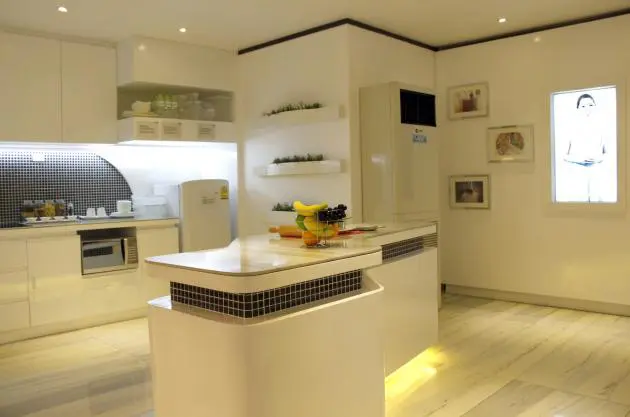
The 240-square-metre smart home prototype displayed on the third floor is an energy-saving, heat-protecting and well-ventilated residence tailor-made for sustainable living. It’s equipped with a power management system to control various electricity sources including the grid and power generation from solar roof tiles and fuel cells.
“During a blackout, it instantly turns on the power back-up from the supporting fuel cell and distributes the electricity to such significant areas as the stairs, the bedroom of an elderly member of the family, the refrigerator and the CCTV. Priority locations can be customised for convenience and safety,” explains an SCG engineer.
The living room is made from insulation cement to decrease thermal conductivity and energy consumption. SCG says it should reduce the average electricity bill by about Bt10,000 a year. The vent wall also has insulated board and a frame wall system that incorporates a solar-powered fan for ventilation. The air-conditioner has an evaporative cooling pad for reduced energy consumption. The pad is produced by special kaft paper made from high-quality fibre and special chemicals to increase paper strength and resin absorption.
Equipped with smart daylight harvesting and a motorised curtain system, the bedroom allows it occupants to customise the level of lightness as well as the temperature of air-conditioners through a smart phone or tablet. The occupancy sensor allows the system to automatically dim the light in the unused area and adjust the brightness to your preferred level.
“Most of us have experienced that sinking feeling where we can’t remember if we turned off the air conditioner or locked the door when we left home. The system allows you to do both with your smart phone,” says the SCG engineer.
Even the bedspread is eco-friendly. It’s made of dissolving pulp from the eucalyptus tree, rendering it smooth, soft, breathable and lightweight. Dissolving pulp is a major raw material in the production of rayon and will open up major opportunities for textile manufacturers in the future.
SCG highlights solutions for small spaces by turning a two-square-metre area into a small but functional bathroom equipped with toilet, basin, digitally controlled temperature faucet and modular shower.
The kitchen boasts a refrigerator made from several plastic materials including a polyurethane (PU) insulator to keep the cool in, a PVC door gasket that’s anti-bacterial and lightweight plastic trays made of polystyrene (PS).
The kitchen’s wall is covered with glass tiles coated with a special substance that gives off a chocolate scent when touched. The shelves are stacked with anti-microbial kitchenware made from plastic resin and coated with silver-ion to prevent the growth bacteria and thus enable longer food storage. Next to it is a set of microwaveable melamine crockery made from a special grade compound that's resistant to 1,000 watts for three minutes.
With Thailand’s senior population set to increase dramatically over the next decade, emphasis is placed on the needs of the elderly, with the floor of the house covered with a soft vinyl that looks just like wood but absorbs any impacts from dropped items. It also reduces noise and is easy to clean and anti-bacterial.
Older visitors are also invited to undergo a check-up to categorise into which group of elderly they fall, thus helping a consultant design the safest and friendliest house.
The testing, which is carried out by staff from Mahidol University’s College of Sports Science and Technology, checks cognitive impairment and dementia with clock drawing test. The hand grip strength test, kinetic skeletal motion test and force platform balance test help to identify the centre of gravity. The results are then computed and the elderly are graded by colour code. Green means they are still strong, self sufficient and able to live alone while yellow indicates a need for assistance for certain activities. Seniors falling into the orange category are considered unable to live by themselves.
“If you find it hard to grip, you should replace doorknobs with a lever-style handle or sliding door. Slip-resistant floors, adequate lighting in every room and the entire stairways are a must. A step-in shower with grab bar is safer than a tub and a single-handled faucet control is easier to use for someone with limited mobility,” says a design consultant.
For exterior applications, SCG introduces magic mortar, a decorative cement that reveals a picture or pattern when exposed to water or moisture but which disappears when it dries. It’s designed for wet areas, like a bathroom, garden wall or swimming pool. Also on show in this section is photochromic mortar, an ingenious cement that changes colour when exposed to sunlight or UV rays - and a solar-reflective concrete floor that illuminates sidewalks and parking lots at night.
Another groundbreaking material is concrete fabric – a flexible concrete cloth that when activated with water can be moulded into the desired shape. Thanks to its flexibility to bend and curve, it is ideal for outdoor furniture and can also follow the natural contours of the land, including ditches and slopes.
HOME OF THE FUTURE
>>“SCG 100th Anniversary Innovative Exposition” continues until September 1 at SCG Experience on Ekamai-Ram Intra Road.
>>It is open Sunday to Thursday from 11am to 7pm and stays open until 9pm on Friday and Saturday.
>>Free shuttle buses run from MRT’s Phra Ram 9 station. Call (02) 586 2222 or www.SCGExpo.com.
