
Performance for Paris
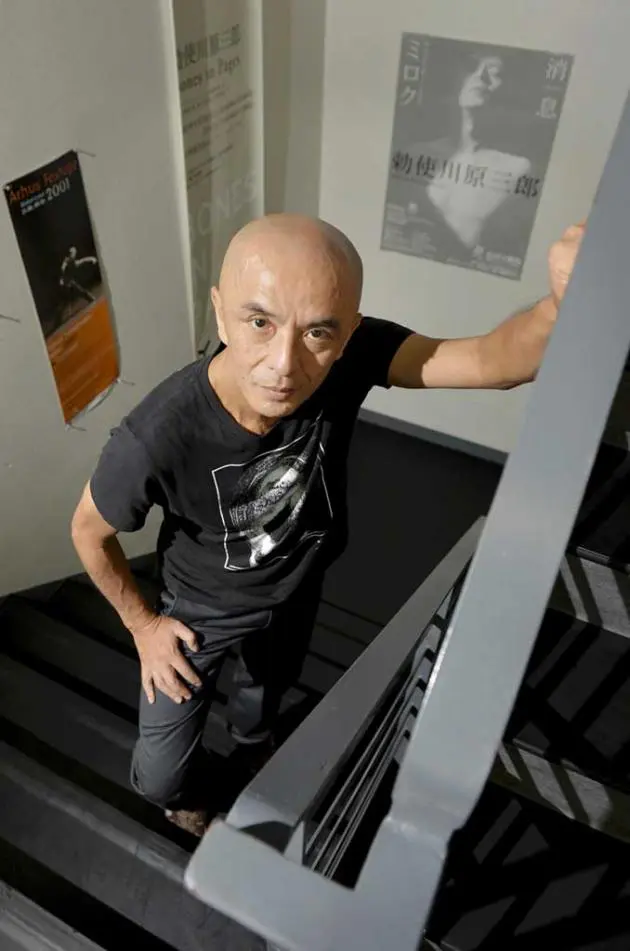


An acclaimed Japanese dancer joins up with a leading French ballet company
Internationally acclaimed contemporary dancer Saburo Teshigawara has created a new performance piece for Ballet de l’Opera in Paris, which is scheduled to run from October 31 to November 14 at the Palais Garnier opera house in Paris. He is the first Japanese to choreograph for the prestigious ballet company.
He has also opened a new studio, Karas Apparatus, in Tokyo’s Ogikubo area to be used as a platform for sending more contemporary dance out into the world. The studio takes its name from his company.
A multimedia exhibition titled “Accelerating Stillness” is being hosted by the studio until November 4 to showcase his career and features drawings created by Teshigawara himself as well as videos, also created by him, and those of dances by him and his company members.
When dancing, Teshigawara’s lithe movements seem to suggest a symbiosis between his body and the light, sounds and air moving around him. He has performed his original works worldwide, which are departures from both ballet and buto.
This is his second work for the Paris ballet company since his “Air” in 2003. His new piece, titled “Darkness is Hiding Black Horses”, is a 40-minute dance incorporating male and female dancers.
The company’s four star dancers in two duos — Aurelie Dupont with Jeremie Belingard and Marie-Agnes Gillot with Nicolas Le Riche — will perform duets in turn.
“For humans, giving and receiving are important,” Teshigawara says. “This new work using a minimum number of dancers is designed to express this idea. I’ll have the four dancers learn my methods as much as possible.”
After opening Karas Apparatus studio, he created another new piece and performed it himself in early September at the Tokyo Metropolitan Theatre. The work, titled “Second Fall”, was conceived from a short story with the same title written by Bruno Schulz, a Polish-Jewish writer killed by the Nazis. The work focuses on the outer and inner sides of humanity and the world and things in between.
Teshigawara says he could find elements in the story that could be made into a dance in Schulz’s rich, but strange, poetic language that expressed feelings of being trapped, and the harshness of his daily life.
“Schultz escaped his mental limitations and suggested the world could change into another form,” Teshigawara says. “Human weakness and vulnerability can rather be a way to relate with the world. I thought it was also an important theme of dance.”
Karas Apparatus has one floor above ground and two below, comprising a hall, gallery and rehearsal room. All floors are covered with dance mats.
“When practising and rehearsing, we try out various experiments and innovations to find new ways of expressing ourselves. I hope people will come to us and share our sense of value,” he says.
Meanwhile, at the studio, he is also hosting an event called “Hibi Appudeito suru Dance” (“Dance that is updated everyday”) to introduce his dance company’s daily efforts and experiments to the public.
As a part of the project, he opened up the process of creating “Second Fall” last month.
“Think, speak, convey, express and take on challenges to create your new life. I want to make this place a space to form life itself,” he says. “I also think it’s important for us dancers to compile our efforts to tackle problems in today’s society by dancing.”
