
Britannia all washed up


Play
Two centuries after ruling the waves, Nelson's warship sits dreaming of victory in an English dry dock
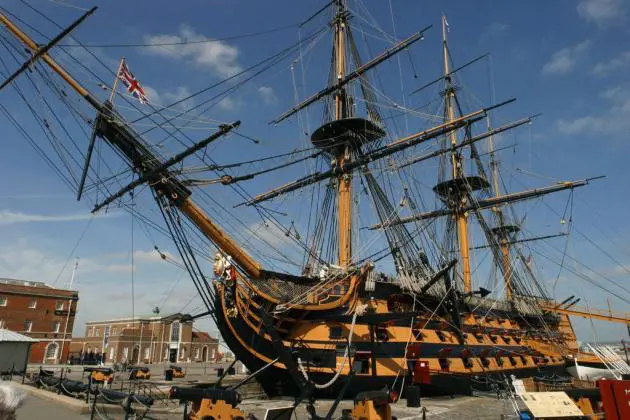
The cannons that blew the French fleet apart still bristle from the flank of HMS Victory.
Just over 200 years ago Admiral Horatio Nelson was pacing the deck, screaming orders to fire the fearsome weapons as the British warship ploughed slowly into the heart of the French fleet.
Seconds later he was kneeling, shot fatally through the spine by a sniper’s bullet. But his fate as a national hero was already sealed. The French and Spanish ships under Napoleon Bonaparte’s command were smoking wrecks and Nelson had won the final battle of his brilliant military career.
HMS Victory, on which Nelson was mortally wounded in 1805 during the Battle of Trafalgar, survived the encounter and now sits in a dry dock in Portsmouth, which built British warships for hundreds of years.
Climb the nearby Spinnaker Tower and from the 100-metre-high observation deck you can look down on Nelson’s flagship, the old naval dockyard, a neighbouring naval base and two modern HMS destroyers in the harbour – centuries of British naval power at your feet.
And though the days when Britannia ruled the waves are long gone, the Victory remains as a living reminder of that glory, preserved as a museum ship. Built in 1765, she is the world’s oldest naval ship still in commission, and now a major tourist attraction, with some 350,000 visitors walking her gangplank every year.
Behind the Victory’s yellow-and-black-striped hull lie six decks. The ceilings are so low that this 170cm-tall writer had to duck for every beam.
I imagine that even Nelson, who stood 168cm tall, would have bumped his head a few times. Inside, the decks are so narrow that the ship’s 104 guns must have been its masters, not the crew.
Ocean voyages aboard Nelson’s flagship could last for two or three years, and its 821 sailors had to live, work and sleep in extremely cramped conditions. As cannonballs ripped into the hull at Trafalgar, the claustrophobia must have been truly terrifying.
Each crewmember received a daily ration of five litres of beer and rum because life on board was unbearable without drink, says Simon, a 60-year-old HMS Victory tour guide.
Nelson, who had already lost his right arm and sight in his right eye in combat, led a fleet of 27 ships at Trafalgar and won a clear victory against a combined French and Spanish fleet of 33 ships.
He won the battle by breaking through the line of enemy ships, but, easily identified by his blue tunic and medals, was singled out by a sniper as the Victory drew within shooting distance of a French ship.
He was taken below but succumbed to his injuries three hours later. As he lay dying, Nelson murmured, “Thank God I have done my duty”. The words quickly became famous as a symbol of British pride and responsibility, and a fitting epitaph for a national hero.
But Nelson was far from a model human being. His exploits as an unfaithful husband and a glory-seeking showoff would have tarnished his reputation had he lived to old age, says 32-year-old Andrew Baines, curator of HMS Victory.
His reputation has remained intact only because he was killed in battle, Baines adds.
After Victory’s career as a warship ended in 1812, the vessel was used as a depot ship in Portsmouth and was then fitted out as a signalling school. It was transferred to a dry dock in 1922 and survived German bombings during World War II.
Defence budget cuts closed Portsmouth’s military BAE shipyard two months go, putting nearly 2,000 people out of a job.
Now, the town’s last link to its glory days lies anchored in the concrete of Gunwharf Quays, safe for the moment from the tide of history.
kISS ME OR KISMET?
Horatio Nelson was born in Norfolk, Southeast England, to a minister’s family and joined the navy at the age of 12. He quickly distinguished himself and was appointed master and commander at the age of 20. Brilliant and unorthodox tactics helped him defeat the Spanish fleet in 1797, for which he was knighted. He defeated the French Navy in three battles – at the Nile in 1798, Copenhagen in 1801, and the Battle of Trafalgar – and prevented Napoleon Bonaparte’s invasion of Britain. Among his dying words in 1805 were “Kiss me, Hardy”, addressed to his flag captain. Claims that he actually said “Kismet [fate], Hardy” are unlikely to be true since the earliest recorded use of “kismet” in the English language is 1849.
