
Huayi's delectable feast


Play
Singapore's annual cultural festival goes way beyond the Chinese diaspora
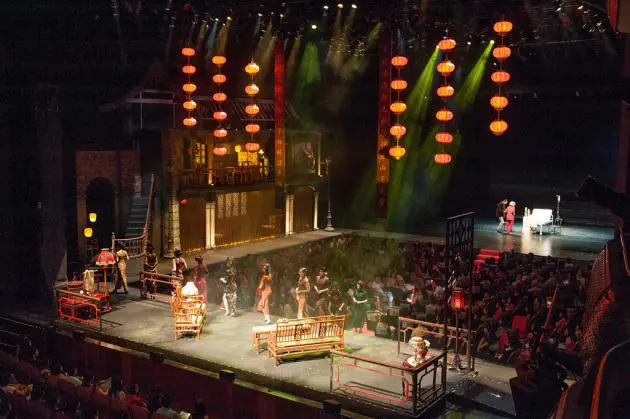
The highlight of the Esplanade–Theatres on the Bay’s recently ended “Huayi: Chinese Festival of Arts 2014” was undoubtedly Taiwanese playwright and director Stan Lai’s two-part eight-hour epic drama “A Dream Like a Dream”.
I first experienced a theatre work of similar epic length two decades ago with “The Soul’s Awakening”. However, my perceptions only managed to stay sharp for half of it so it was thus with a great deal of thought that I prepared for the event – and not least because the play was in Chinese and I needed to wear headphones to hear the English interpretation.
The story is centred on a young doctor starting her first day of work at a public hospital in Taipei and discovering that four out of five patients in her ward pass away in one day. As she attends to her fifth patient, she listens to the story of his life, a journey through time that takes them to Paris and Normandy as well as Shanghai and to another character whose life dates back to the 1930s.
Using various storytelling techniques, Lai masterfully kept the pace of the play on an even keel, with the result that that it was never too dull or too quick. Nor did the plot becoming confusing. Instead, the audience could draw parallels between the characters and the play’s messages were felt and understood without ever sounding overly didactic. Twenty-eight professional actors from China and Taiwan portrayed more than 100 characters – the major roles were performed by a few actors – and Lai successfully created a strongly knit ensemble among his cast members.
As the major characters recounted their interconnected stories, “A Dream Like a Dream” reminded the audience of why we love going to theatre – to listen to other people’s stories, to watch them acted out live in front of our eyes, to be emotionally touched by them and finally to think about our own lives and what we can do to improve them once we leave the theatre. Personally I would love to watch this play again and again.
My only complaint is that I booked too late and couldn’t get into the Lotus Pond, the seating area on the stage surrounded by four acting areas and with a central aisle for the characters to walk through, to watch the play. This would have allowed me to watch the play the way Lai intended. Sitting in a normal seat in the theatre, my view of stage actions in certain scenes was frequently blocked by some characters. However, blocking off the normal seats and offering only Lotus Pond seats would not make financial sense for such a grand production.
An evening before “Dream”, I made sure that my cultural activity was short and allowed me ample time to rest. Local Singaporean company Nine Years Theatre’s Chinese-language production of Yasmina Reza’s “Art” fit the purpose perfectly.
Despite personal relationships are not in the nature of Asian men – ”Art” revolves around three male friends fighting over an insanely expensive plain white painting one of them has just bought – the mastery of Reza’s playwriting coupled with Nelson Chia’s deft direction made the story entirely credible.
Actors Oliver Chong, Liu Xiaoyi and Peter Sau made the audience forget that they were performing French characters speaking Chinese and instead focus on enjoying the play’s unique and universal humour and subject matter. I wished, though, that Gong Baorong’s translated script had included shorter sentences as this would have allowed the play to move forward more quickly and set the pace closer to the original French as well as Christopher Hampton’s English version. Also, Chia’s staging of scene transitions and his use of the pianist on stage left to provide entertainment while the characters addressed the audience and the stage managers delivered props, further stripped the comedic tempo from the play.
But in the end, both these “Chinese Theatre” experiences demonstrated that the scope of the Chinese diaspora is increasingly expanding and enjoying Chinese dramatic arts is neither as difficult nor as rare as it once was.
My interest in contemporary Chinese theatre has also increased and that can only be a good thing.
The writer wishes to thank Koh Sian Eng and Gina Koh for all their assistance.
See you next year
_ Next year’s Huayi: Chinese Festival of Arts will be held around Chinese New Year.
_ Until then, there’s still a chance to see “Rotations: The Art of Tim Yip”, an exhibition of the Academy Award-winner’s set and costume design works. It’s at the Esplanade Jendala until June 29.
_ Find out more at www.esplanade.com.
