
Under morlam's SPELL


What gives the music of Isaan its hypnotic appeal? The Jim Thompson Art Center chimes in with the answers
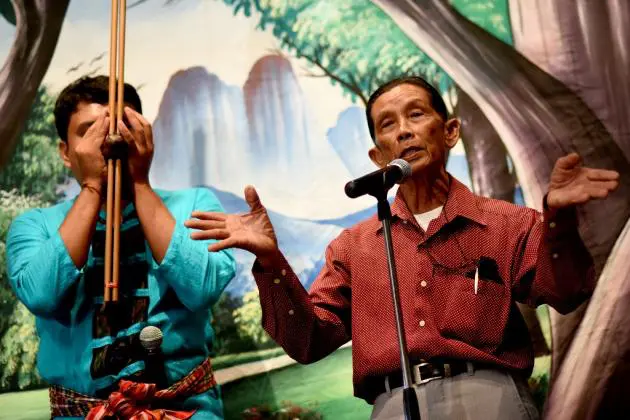
WHEN THAIS IN the Northeast start rolling with the folk music known as morlam, the players’ sprightly rhythms and the circle jig their listeners quickly fall into can be seen by outsiders as just a bit of local fun.
As with any great tradition, though, there’s much more to it than that. There’s no denying the music’s trance-like appeal – it does indeed have mystical roots. And, at any level, this is the living embodiment of Isaan’s heart and soul.
Bangkok’s Jim Thompson Art Centre, whose own deep roots reach as far as the Northeast, acknowledges the fun aspect of morlam in the title of its current exhibition, “Joyful Khaen, Joyful Dance”.
In a rare if not unprecedented survey of the genre, it explores the origin, early growth and the modern transformation of morlam. Anyone who didn’t grow up in Isaan will come away with a better understanding and appreciation of the region’s culture – and quite possibly a hankering to dance along.
Morlam encompasses the Isaan identity, recording all the teachings and beliefs of the olden days even as it tracks the changes in modern times. In fact it plays a role in shaping thought, transmitting attitudes as it connects different segments of society.
Outsiders watching a performance on TV or at a public event – or hearing it booming from their favourite somtam cart – will wonder where morlam came from and how such a seemingly simple musical structure achieved such universal appeal. The Jim Thompson Art Centre has some of the answers.
“The exhibition is an extension of Sud Sanan Dan Isan, the Jim Thompson Farm’s morlam competition for student bands that began in 2012,” explains curator Gridthiya Gaweewong.
“We didn’t want to just stop there, because there’s so much about morlam that’s interesting and historical that we wanted a broader audience to experience. We felt the urge to take this cultural preservation project to another level.”
The centre’s staff spent a year consulting experts on Isaan culture and assembling visual material and audio files.
“Our goal is to build an artistic and cultural network among the Isaan community, and to collaborate with those who wish to maintain, promote and preserve the Isaan heritage shared with Laos and the Mekong sub-region.”
Gridthiya jokingly calls the colourful, vibrant exhibition “Morlam 101” and says it’s “a great guide for those who’ve already heard morlam but don’t really know what the music is all about”.
The show is concise in providing an overview of how morlam was conceived theoretically and how it evolved into the form known today, she notes. “I must say that, even though we have good, solid information, we didn’t get everything. If people have suggestions or corrections, please let us know so we can make the exhibition even more complete.”
There are three segments to the show, each in its own room with its own “guest curator”.
Sarawut Sihakot put together the opening display on “The Birth of Morlam” and its three main types in the early days. Phi fah morlam involved faith healers and is closely linked to the cult of Phaya Thaen – the powerful spirit overseeing people’s wellbeing – which also gave birth to such northeastern traditions as the world-famous rocket festival.
“Courtship morlam” usually has a male and female engaged in call-and-response repartee known as toey, accompanied by the lunging drone of the khaen, the endlessly versatile reed pipe.
Kab morlam is storytelling with music, regularly rendering temples in Isaan more “fun” than they are anywhere else. The stories are often about the Lord Buddha, though, even if they drift into the secular with fables and folklore, all of it narrated in a sort of slow rap. The solo performer will sing, dance and act out all the characters’ parts.
Arthit Mulsarn’s second section, “A Horse with Horn and a Pole with Flowers”, demonstrates how morlam has sometimes served as a tool of political propaganda. The title alludes to the modernisation of Isaan in the 1960s by the Office of Accelerated Rural Development, which brought in motorcycles (the horned horses) and utility poles (crested by bouquets of electrical gear).
The changes were rarely welcomed, and morlam artists voiced their criticism, sometimes in the pay of political figures, sometimes earning arrest for evoking such “dangerous” ideas as communism.
Somsuda Piamsumrit has playfully titled the last segment of the exhibition “Saraburi Turn Left”, which was the oft-quoted advice to Isaan people on how to get to Bangkok, where they migrated in the tens of thousands in the 1990s in search of jobs.
Saraburi, “the gateway to central Thailand”, was the point where the migrants left home behind, though they carried their culture in their bags and boxes, including their music. The old Isaan identity soon gained a fresh face, clearly differentiated from its Lao ancestor.
The photos, rare film footage and other mementoes of the past transport viewers back in time to a rustic landscape of rice fields whose flatness is broken only by temple spires. From there, after a long southerly journey by bus and pickup, the music of the farm flourished anew in the city. And from there, carried by radio and then television and now the Internet, morlam found the whole world listening.
SPIRIT IN THE SOUND
“Joyful Khaen, Joyful Dance” continues through March at the Jim Thompson Art Centre, Soi Kasemsan 2, off Rama I Road, close to the National Stadium BTS station. It’s open daily from 9am to 8pm. Admission is free.
Find out more at (02) 612 6741 and www.Facebook.com/pages/|The-Jim-Thompson-Art-Center/92206703015.
