
Taking note of Note


Play
Samsung's latest smartphone comes with so many improvements over its predecessor, you won't know where to start
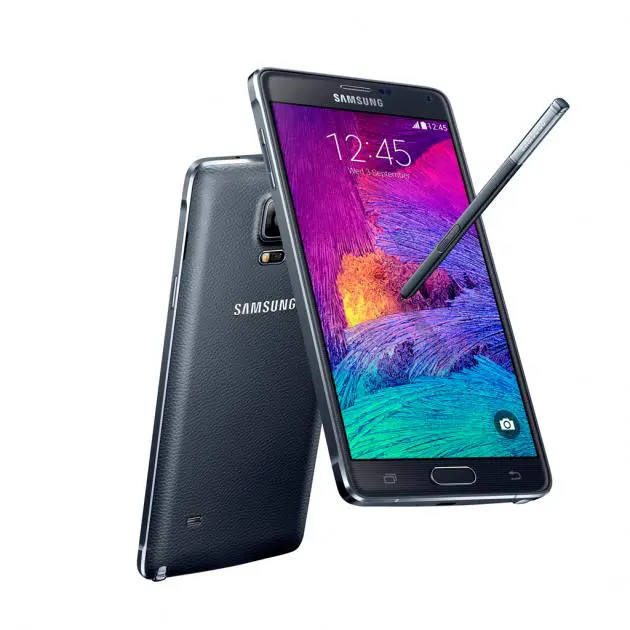
The latest addition to the Note family of smartphones, the Samsung Galaxy Note 4, brings with it’s a range of improvements over earlier models particularly in the areas of design, performance and photography.
In terms of design improvement, the Note 4 features a premium metallic frame wrapping around its edge replacing the plastic edge of the Note 3. It does however still retain the stylish faux leather for its back.
The most outstanding improvement can be found in the display resolution. The size remains the same at a generous 5.7 inches but the screen packs in 78 per cent more pixels. That’s 2560 x 1440-pixels or Quad HD with a pixel depth of 515 pixel per inch, compared to the Full HD resolution of 1920 x 1080-pixels with 388 ppi depth of Note 3. The Note 4’s display also boasts a 100,000: 1 contrast ratio, which is 100 times higher than a conventional LCD display. And it also features a brighter screen of 50 candela per square metre, making it highly readable even in outdoor situations.
With Quad HD resolution and 5.7-inch Super AMOLED display, Note 4 displays rich colours and contrast, making it excellent for watching video clips and viewing photos. During the test at The Nation newsroom, we were impressed by the brightness and clarity when looking at photos.
Another improvement is that Note 4 comes with a heart rate monitor, the sensor for which is placed on the back below the main camera’s lens and beside the LED flash. The monitor is particularly useful when used with apps like S Health.
The new smartphone also has fingerprint scanning for extra security and convenience. Note 4’s home button functions as the swipe-based scanner. You set a fingerprint for unlocking the screen and the Note 4 will guide you to place the finger and swipe it down over the home button. It will record the same fingerprint ten times to ensure that you have it right. It will also require you to set an unlock password in case you cannot somehow unlock the phone with the swipe.
The fingerprint scan can also be used to sign in to certain websites as well as to your Samsung account.
Both Note 4’s cameras are an improvement on the Note 3. For example, the 4 has a 16-megapixel main camera and a 3.7-megapixel front-facing camera while Note 3 uses a 13-MP main camera and 2-MP front-facing camera.
And Note 4’s main camera uses Smart OIS (optical image stabilisation) technology to ensure that shots will not be blurred. Those addicted to selfies either as an individual or in a group should be happy with Note 4’s front-facing camera, which has a very bright f/1.9 lens allowing 60 per cent more light. The front-facing camera also comes with a Wide Selfie mode that activates a 120-degree angle lens so no one will be left out in a group selfie or “wefie” shooting.
The battery recharging function is about 30 per cent faster than that of the Note 3, going from zero to 50-per-cent capacity in about 30 minutes. The full charge takes about 55 minutes.
Another improvement is that Note 4 comes with Ultra Power Saving Mode that can extend your remaining 10-per-cent battery life to some 36 hours of standby time simply by turning the display to monochrome and turning off all but essential apps
The advanced S Pen is a star of the Note series and Samsung has made improvements here too. Not only is it lighter to the touch but also offers an improved digital handwriting experience with enhanced pressure sensitivity. Note 4’s S Pen now has 2048 pressure levels and it can hover 15mm above the screen to interact with it. With the improved S Pen, Note 4 also provides a range of apps that work with the stylus. The new S Pen also adds two new pen types – Fountain and Calligraphy.
Note 4 supports both 4G LTE connection and 3G HSPA+ connections.
The version on sale in Thailand is powered by 1.9 GHz octa-core processor, divided into 1.9 GHz quad core and 1.3 GHz processors.
Note 4 runs on latest Android 4.4 (KitKat) operating system. It has 3 gigabytes of RAM or working memory, thus enhancing its multitasking performance and 32 GB internal storage, expandable with a microSD card.
Note 4 has dropped the use of USB 3.0 port and switched to the microUSB USB 2.0 port, which is smaller.
In terms of physical dimensions, Note 4 is a little longer, thicker and heavier than Note 3 with a footprint of 153.5 x 78.6 x 8.5 mm and a weight of 176 grammes.
I tested the Note 4 on TrueMove H’s HSPA+ 3G network and was pleased with the speed for downloading and installing apps. I was also able to check my Hotmail and Gmail accounts without problem and update my Facebook page without a hitch. When I took 16MP photos, I could upload them to my Facebook wall fast and smoothly.
I was very impressed by the smartphone’s performance. The touch screen and menus were very responsive and the screen scrolling was fast and smooth. Video clips and YouTube clips ran smoothly during the test. Samsung says Note 4 even supports Ultra High definition video though I didn’t have time to test this aspect.
As an indicator of its high performance, Note 4 supports playing back Hi-Res audio files in 24-bit/192 kHz FLAC format, which Samsung calls Ultra High Quality Audio format.
When playing a Hi-Res Audio file, Samsung’s Music app displays the logo of UHQ 24 bit 192 kHz on the screen. I tried playing Pink Floyd’s “The Final Cut” album in Hi-Res Audio format on Note 4 and loved the clarity and detail. The 24 bit/ 192 kHz FLAC format has five-time more details than a normal music CD.
I also had fun with the heart rate monitor and S Health app, measuring my heart rate by placing my index finger on the sensor. The app reported that my normal heart rate was 71 beats per minute, which is well within normal limits. Walking up 31 floors of stairs at The Nation head office increased the rate to 103 bpm, also normal for such strenuous exercise.
S Health can also function as a pedometer to count your steps and calculate the calories you have burned based on height, weight, age and gender. S Health will also back up your data to Samsung’s cloud service.
The app also serves as an exercise monitor whether you run, walk, hike or bike and can be set to help you achieve your workout goal.
The main camera is impressive and if you set it on the HDR option, you’ll get richer tones. Shooting modes include Auto, Beauty Face, Selective focus, Food, Sports and others can be downloaded and installed,
The Selective focus can make objects stand out from the background but the subjects must be within half a metre from you and at least three times this distance from the background.
I mostly tested with the Auto mode with the HDR option on. Note 4’s camera captured sharp and clean photos with saturated colours in most environments. Night shots were sharp and colourful.
I also used the S Pen function in Smart Select mode to select content easily and save it to Clipboard or Scrapbook.
Another nice app that works with the S Pen is Photo Note. You can use it take a snapshot of hand-written notes on a whiteboard or a piece of paper and convert it to editable digital notes. You can move the sections around, change colours and put in additional content.
Note 4 now supports three modes of multitasking – Recent App, Split screen Multi Window and Pop-up Window.
Split-Window lets you work on two apps on the same screen. The Recent App will show multi windows on top of one another. You swipe to rotate the list and select one of them to start the Multi window. You can also set some apps to float on an app window.
While you are multitasking, you can easily drag and drop content from one to another window.
Samsung Galaxy Note 4 is available here in Charcoal Black, Frost White, and Bronze Gold and retails for Bt25,900.
Key specs:
Network: 4G (LTE Cat 4 150/50Mbps)
Processor: 1.9 GHz Octa-Core (1.9 GHz Quad + 1.3GHz Quad-Core) Processor
Display: 5.7 inch Quad HD Super AMOLED (2560 x 1440)
OS: Android 4.4 (KitKat)
Camera: Rear Facing: 16 Mega pixel Auto Focus camera with SmartOIS; Front Facing: 3.7 Mega pixel camera with f1.9
Video: Codec: H.264, MPEG-4, H.263, VC-1, WMV7, WMV8, Sorenson Spark, MP43, VP8; Recording & Playback: up to UHD
Audio: Codec: MP3, AAC/AAC+/eAAC+, WMA, AMR-NB/WB, Vorbis, FLAC (~192KHz, 24 bit) support
Connectivity: Wi-Fi 802.11 a/b/g/n/ac (HT80) MIMO PCIe, GPS / GLONASS, NFC, Bluetooth v 4.1 (BLE, ANT+), IR LED (Remote Control), USB2.0, MHL 3.0
Sensor: Gesture, Accelerometer, Geo-magnetic, Gyroscope, RGB, IR-LED, Proximity, Barometer, Hall Sensor, Finger Scanner, UV, Heart Rate Monitoring
Memory: 3GB RAM
Storage: 32 GB Internal memory + microSD slot
Battery: Standard battery, Li-ion 3,220mAh, Fast Charging (Adaptive Fast Charging & QC2.0)
Dimension: 153.5 x 78.6 x 8.5mm
Weight: 176g
