
She shows the way forward


Play
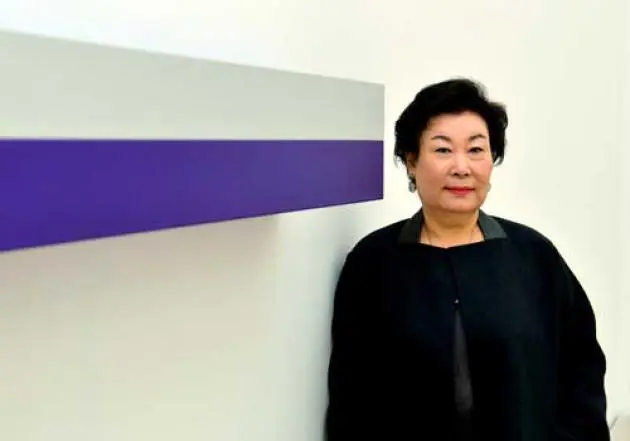
Gallery owner Lee Hyunsook introduced Koreans to contemporary Western art and the West to the best of Korea
Items from some of the most significant contemporary-art exhibitions in South Korea over the last couple of years are on display in Lee Hyun-sook’s private office above her gallery in Seoul.
The small space overlooking Gyeongbokgung Palace is ultramodern, with a sculpture by Anish Kapoor, a painting by Jean-Michel Basquiat and a glass sculpture by Roni Horn alongside her designer furniture.
Lee’s Kukje Gallery, opened in 1982, has been the first in South Korea to showcase work by many prominent foreign artists since the early 1990s. The gallery has introduced some of the biggest names in modern art, including Kapoor, Louise Bourgeois, Damien Hirst and Alexander Calder.
Lee’s position in the global art world has risen as a result. Last year she was listed as a powerful player by the art magazine Art+Auction and this year named one of the 100 influential women art dealers by Artnet magazine.
“What I’ve done is small compared with the big art dealers, but I think people have recognised my role in Asia,” she says.
A collector of Korean traditional paintings, Lee opened a gallery in Insa-dong, then the hub of major galleries in Seoul, when she was 33. Her first exhibition, by a group of modern South Korean masters, was a resounding success, with almost every piece sold.
The 1980s were the most vibrant time in the Korean art scene, she says. Work by the modern masters fetched almost as much as that of contemporary foreign artists.
But soon after visiting modern-art exhibitions in the US in the late 1980s, she sold most of her Korean paintings and began to focus on foreigners.
“I was shocked after seeing a mobile by Alexander Calder at an exhibition in the US. Minimalism was ending in New York. Koreans were still buying and selling impressionistic paintings.
“The gap between the Korean and foreign art markets was so wide that I used to compare it with the gap between life in South and North Korea. We only traded work that we knew.”
The first foreign artist she introduced in Seoul was abstract expressionist Helen Frankenthaler, in 1991. Lee saw Frankenthaler’s exhibition at the Museum of Modern Art in New York and decided to exhibit her work at her gallery when it reopened at its current location next to the royal palace.
She visited the gallery that represented the artist and told its owner that she wanted to hold an exhibition of the artist’s work in Seoul.
Intrigued by the idea of exhibiting the artist’s works in an Asian gallery, the owner agreed to let her display them in Seoul.
But Lee’s job required more than bringing the works to Korea. She had to convince the anxious artist, who was afraid of a possible North Korean attack during her exhibition.
After she opened the gate to the foreign art world, she brought big-name modern artists such as Cy Twombly and Louise Bourgeois.
The gallery has lived up to its name, “Kukje,” which means international in Korean. About 60 percent of her clients are foreign collectors and renowned art institutions such as the Museum of Modern Art and Guggenheim Museum in New York and Tate in London. Her gallery has three separate buildings named K1, K2 and K3, along with a sleek Western-style restaurant and wine bar. K3 won a prestigious architectural award.
Lee has introduced Korean artists overseas, including Kimsooja, Haegue Yang, Gimhongsok and Hong Seung-hye. Some of them have been featured in prestigious art institutions abroad and international biennales.
Recently, she decided to shine the spotlight on the artists of the 1960s and 1970s.
For the last two years, she has worked to create a market for Korean monochrome paintings called “dansaekhwa.” The often overlooked painting movement, formed under the authoritarian governments from the 1960s to 1980s, received eulogies in the global art market when they were first showcased in 2013 at Frieze London.
“All of them were sold,” said Lee with enthusiasm.
The showcase of the dansaekhwa paintings captured the attention of international art circles. People were fascinated by the monochrome style of painting which had emerged outside the mainstream art world of New York and its historical and cultural significance.
Los Angeles-based gallery Blum and Poe focused on several dansaekhwa artists at the 2014 Frieze Masters. The gallery is holding a solo Ha Chong-hyun exhibition at its New York branch this month while the Perrotin Gallery in Paris is presenting a retrospective on Park Seo-bo.
“Dansaekhwa is everywhere now,” says Lee. “It’s not related to K-pop or anything, but it definitely shows that South Korea is emerging in the global art scene. The Korean art market needs more artists like Kim Whanki and Lee Ufan.”
Art fairs in New York, Hong Kong, Basel, Paris and Miami dominate Lee’s yearly schedule. Though in her mid-60s, Lee is more enthusiastic than ever.
“My business is in Seoul, but my clients move around the world. I meet them all over the world at the big fairs. It’s important that I show up at openings.”
She makes about US$20 million (Bt660 million) worth of art transactions a year abroad. The government monitors Lee and the owners of other major art galleries in South Korea to guard against family-owned conglomerates laundering money via artwork purchases. Prosecutors questioned Lee at one point over allegations that the Samsung Group’s founding family had raised slush funds.
“Korean collectors are now afraid of even visiting the gallery,” she says. “It’s important to increase the pool of Korean collectors, but buying artwork at galleries means the money is tracked by the National Tax Service.”
Her voice rises as she talks about the negative perceptions of purchasing artwork in Korea.
“If no one buys artwork it will be difficult to see great paintings like dansaekhwa come out in the future. We can’t expect young artists to grow when we don’t buy their works!”
Lee regrets that art transactions are monitored and supervised in South Korea as if they were an illegal activity. “It’s a great asset to a country, culturally and economically. People don’t realise the important roles of galleries in promoting homegrown artists and their works and making contributions to economic and cultural growth.
“Korea needs more time to be more mature in art.”
