
Skills for a brighter future


Play
A livelihood training programme helps displaced Karen in Mae La camp prepare for new lives at home
Standing at the edge of a pond in the jungle, Pyone Cho starts to sing, in a pleasant, wordless, rhythm that rises and falls.
The 46-year-old Karen refugee from Myanmar uses the song to call his fish to eat.
With his upturned hat serving as a bowl for the fish pellets, he gently throws small balls of the food into the pond. Catfish, the size of an adult's arm, eagerly gulp down the pellets, making big splashes and painting a smile on Pyone Cho's face.
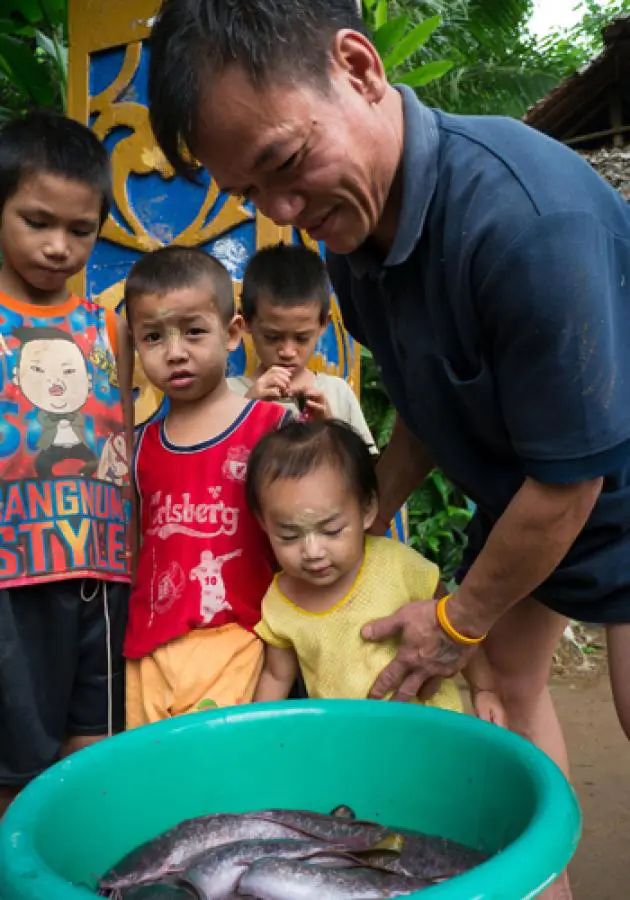
Inside the confines of a remote refugee camp Pyone Cho has found a new career, raising catfish for sale, thanks to an innovative programme that combines livelihood training with business skills.
“Now that we learned the business side of it, we can pick it up and do it for a living when returning home,” he says.
In 2006 Pyone Cho and his family fled their home in Hpa-an, capital of Karen State in Myanmar, and sought refuge in Mae La Temporary Shelter in Mae Sot.. Since then he and his wife have earned a little money making and selling snacks to school children inside the camp.
But this year, thanks to his new catfish farming skills, Pyone Cho made his first surplus income. “Bt1,600," he says, grinning as he recalls the sale of his first catch.
Livelihood training programmes had been run at the Mae La Temporary Shelter for three years by the humanitarian organisation Solidarites International. About 300 refugees were given equipment, catfish fry, tadpoles and fish food and trained to raise catfish and frogs to eat themselves, with the aim of improving their diet by boosting their protein intake.
“It failed. People didn’t continue after their first attempt,” says Apisit Laolumpuk, Solidarites International’s Livelihood Team Leader. “People who live in refugee camps are very used to receiving. They become dependent. To get them to do something or invest in anything is very hard.”
Having identified the problem, Solidarites International changed its strategy and combined the 2014 livelihood training with the ILO's Community-Based Enterprise Development (C-BED) course for Aspiring Entrepreneurs.
Pyone Cho was one of 36 refugees who took the new livelihood-plus-business skills course.
Five months later, all 36 trainees sold their first harvest of catfish and started nurturing a second batch.
“It’s a success. They have continued to raise the fish and even expanded production on their own initiative. I’m very happy,” Apisit says.
A second, combined livelihood-plus-business training was held in May 2014.
Say Lar Htoo, 57, took part and her catfish are now more than three months old.
.They are so big already,” she says proudly. "I myself eat only twice a day, but I feed my fish three times a day.”
“What I learned from the training was make a small business that will survive wherever we go,” adds Say Lar who now owns three ponds for small, medium and large fish.
“I’m proud of them,” says Sho Sudo, Programme and Operations Specialist for the ILO/Japan Multi-bilateral Programme, which funds the project during a visit to the refugees' fish farms at the camp. “They have mastered it here and the knowledge can travel with them. They can do it when they return home too.”
Funded by the ILO/Japan Programme, C-BED has worked with more than 40 partners in the last two years, in Thailand, Cambodia and the Lao People's Democratic Republic. More than 2,500 people have received training in business development. Particularly well suited to marginalised and vulnerable communities, the C-BED approach has helped rural migrants and displaced people, refugees and asylum-seekers, ex-combatants, people with disabilities, school-leavers, vulnerable women and people living with HIV/Aids.
C-BED's training approach is innovative in that it teaches without the involvement of trained trainers or experts. Instead the training tools are self-facilitated in and by communities and new skills are developed through activities designed to draw on the existing life experiences, skills and knowledge of trainees.
“I never thought the C-BED's training methodology, the kind of training without a trainer, would ever work,” says Kanika Tamrongsaksanguan, Area Coordinator, Adventist Development and Relief Agency Thailand (ADRA), another NGO that has added C-BED's business skills training to its livelihood training.
“But it got them to argue and share. Also, as they work in groups, they are more relaxed and prepared to speak up.”
