
Tap, type, load and print


Play
We kick off the first in a threepart series of trends in 2015 with a look at taxi apps, online shopping sites, wearable gadgets and 3D printers
Taxi at a tap
After years of overcharging, touting, serious concerns about safety and refusal to take passengers, taxis – at least getting one – became easier in 2014 thanks to the advent of the taxi app.
E-hailing applications, as they are known, such as Grab Taxi from Malaysia and Easy Taxi from Brazil, make life easier for everyone as they connect drivers and passengers through a few taps on the smartphone screen. Instead of trying to hail a cab in the heat or pouring rain, you can now enjoy the convenience of requesting a taxi in the comfort of your home or office or even from a shop or restaurant. The apps help you find the nearest taxi willing to take you to your destination and provide full details of the driver, estimated fare and time of arrival, all for a very reasonable Bt20 to Bt25 surcharge.
Of course, the apps haven’t solved all our taxi problems but they are convenient and safe both for drivers and passengers, making them a very welcome salve for our transport problems. They are also available for free on all smartphone platforms. Launched in Bangkok a little more than a year ago, both applications already have thousands of taxis in their databases and users are growing by the day.
And with that kind of popularity, what’s the betting we see more apps like these arriving in Bangkok this year?
- MANTA KLANGBOONKRONG
Desktop shopping
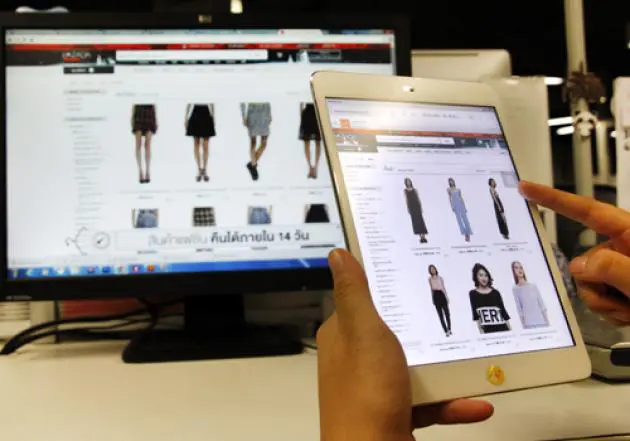
While not yet as big as in the UK or the US, online shopping has seen phenomenal growth in Thailand in recent months, as consumers discover the convenience of partaking in retail therapy without leaving home.
The service, which extends to just about every type of product including big purchase items like washing machines and furniture, to fashion, food and gizmos, not only saves the busy consumer time but guarantees quality and price thanks to special promotions and after-sales service.
One of the pioneers of e-commerce, Lazada promotes itself as a 10-floor online shopping centre that brings together fashion gear, furniture, IT gadgets, beauty products and educational toys from thousands of popular labels on one platform. For those who prefer to use their mobiles or tablets, the website has three shopping apps on the Android, Apple and Windows phone platforms.
Last month Lazada held a one-day online festival campaign that saw 10 million shoppers visit its websites and mobile applications and 200,000 customers placing orders for more than 500,000 items.
“With 500 million consumers, online spending across Southeast Asia has the potential to hit US$35 billion by 2020, according to a UBS study released in June 2014,” Riccardo Basile, chief executive of Lazada Thailand, told XP.
“The eCommerce market in Southeast Asia is growing rapidly. The results of our Online Festival campaign in one single day demonstrate that the region’s consumers are ready to shop online.”
With fashion the fastest growing category, the website recently launched multi-brand online boutique LZD that brings five street fashion labels – Rock and Religion, Dead Lovers, Neon Rose, Bellfield, Motel Rocks and Your Eyes Lie – from the UK and the US to Southeast Asia.
Operated by Rocket Internet, popular online fashion retailer Zalora offers clothes, accessories and beauty products for women and men by such brands as Mango, Ray Ban, Aldo, New Look, Steve Madden, Levi’s, Nine West, Jacob International, Flip Flops, Yves Rocher, Casio and Clarks. Based in Singapore, it has localised sites all over Asean and in Thailand alone counts four millions followers on its Facebook page. It recently launched its own online boutique Ezra and hosts a live chat service that provides information on products and services.
Established in 2006 by Internet entrepreneurs Fabrice Grinda and ACF Oxenford, OLX (OnLine eXchange) is designed as an online classifieds marketplace for used goods ranging from furniture, cars, children’s items to cameras, mobile phones and property. It has local operations in more than 100 countries including Thailand and the Philippines.
The much-loved IT complex Pantip will soon be no more but Siamget is rising in its place by offering a wide range of IT gadgets from hundreds of popular brands and manufacturers. PetLoft, meanwhile, has food, snacks, toys and daily life products for every domestic animal.
-PATTARAWADEE SAENGMANEE
Technology on the wrist
Smart wearable gadgets and mobile devices that can play high-resolution audio are expected to be at the top of every health enthusiast’s shopping list in 2015.
As more of us chase a fitter and healthier lifestyle, we want to keep track of our exercise and fitness data and so a smart wearable accessory becomes a must-have. Better still, the device can act as interface for accessing functions on a mobile phone or tablet computer and tell us of incoming emails, Facebook alerts and SMS messages while on the go. Some models can even be used to make or receive phone calls.
Most devices function as a pedometer, using accelerometer and altimeter sensors to calculate steps and then calculate the lost calories, using personal data of age, height, sex and weight as a guide. The devices also link to users’ online accounts where the data is stored and can be accessed at a glance.
Some devices can be worn as watches, others as wristbands and many brands are now on offer in Thailand as well as via online stores. Two of the leaders on the market are the Sony SmartBand Talk and the Vivosmart. Both track users’ steps and monitor exercise data on the connected smartphone. SmartBand Talk can make and receive phone calls as well. The SmartBand Talk sells for Bt5,990 while Vivosmart retails for Bt6,590.
Devices capable of playing high-resolution music are also expected to sell well in 2015. High-resolution music, such as the FLAC 24bit/192kHz format, offers up to five times more detail than an audio CD.
Several models of high-resolution music players have been released and most of latest flagship smartphones and tablets can now play high-resolution music files, among them the Samsung Note 4 and the Sony Xperia Z3. The new Sony NWZ-A15 is a state-of-the-art digital music player capable of playing high-resolution music. It has 16 GB storage and retails for Bt6,990.
- PAISAL CHUENAPRASAENG
Press P for solid stuff
Think of how much easier life would be if we could produce a new smartphone case, a sofa or even a house at the touch of a button. Today, that’s actually possible thanks to 3D printing and while we may need to wait before constructing our dream mansion, the printers could well become the must-have gadgets of 2015.
In China, for example, a company named Winsun announced this year it had built 10 small 3D-printed houses in just one day at a cost of $5,000 (Bt165,000) each.
At Nasa’s International Space Station, the first 3D printer helped create spare parts and tools to make the ISS less dependent on expensive resupply ships, in addition to improving crew safety, while surgeons at Morgan Stanley Children’s Hospital in New York have credited 3D printing with helping to save the life of a two-week-old baby who required complicated heart surgery.
And in Thailand, a 48-year-old elephant that stepped on a landmine and lost a leg now has a state-of-the-art prosthesis made by a 3D printer.
Thailand’s 3D printing business enjoyed a boom in 2014 with dozens of companies offering products made with the new technology. Shoppers at Commart Thailand, the Baan Lae Suan Fair, the Architect Expo and the Bangkok Design Festival went home with affordable products ranging from chic home decor items and sophisticated artworks to trendy dresses and futuristic sofas.
The cost of the printers has also decreased thanks to the expiry of patents. Today they cost anywhere from just under $1,000 to more than $3,000, thus making the technology accessible to the consumer.
However, the 3D horizon is not totally bathed in sunshine. We can expect fights and debates over printing and intellectual property right, not to mention non-biodegradable 3D junk adding to environmental concerns.
- PHATARAWADEE PHATARANAWIK
