
Gentlemen and rascals
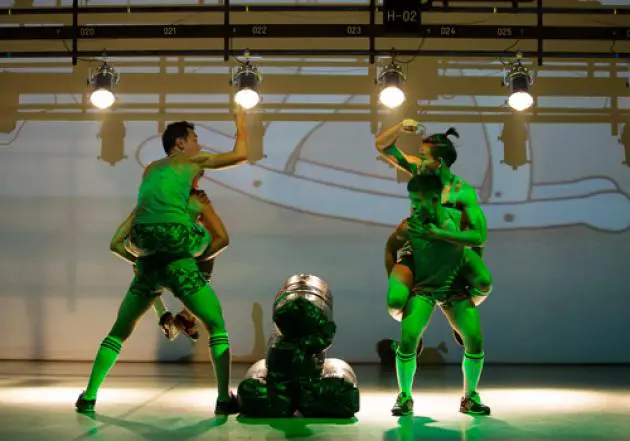


Pichet Klunchun thoroughly entertains with a performance that offsets violence with homoerotic fun
PICHET KLUNCHUN is best known for his contemporary reinterpretation of khon Thai classical dance through a repertoire that solemnly explores the marriage between classical form and contemporary content and vice versa, traversing artistic boundaries and transgressing cultural customs.
Last weekend at Chulalongkorn University’s Sodsai Pantoomkomol Centre for Dramatic Arts, his dance company offered a fresh take on the troupe’s signature characteristics in their latest creation “The Gentlemen”. Although the meshing of classical Thai and contemporary elements was still present, the production branched out to include presentation styles never before seen in the company’s works, from the use of the reality TV show format to pumped-up club music and flashy strobe lights.
As the audience filed into the black box theatre, they saw in front of them four figures in transparent plastic garments adorned with colourful LED lights. Although one of the costumes comprised a puffy sleeved blouse and a long skirt, it was obvious from the silhouettes underneath that all four were men. Constantly moving scrambled letters were projected onto the screen at the back, bringing to mind a hacker’s computer screen from a code-breaking thriller.
Drawing inspiration from Chanon Yodhong’s controversial book “Nay Nai Samai Rathchakan Ti Hok” (Gentlemen-in-Waiting During the Reign of King Rama VI), the show obviously didn’t break any computer codes, but instead metaphorically explored how gender codes and norms were “broken” during the early 20th century. The book’s key question of who replaced the ladies-in-waiting when women weren’t welcomed in the royal court was answered through the actions of four extremely competitive and complex men onstage.
Representing the gentlemen-in-waiting of the past through familiar modern activities, the performers, appearing as game show contestants, competed to become the audience favourite by flaunting toned bodies as their names and cheesy graphics flashed behind them. They underwent different challenges, from fighting each other with black punching bags to wrestling based on the rules of traditional Thai children’s game tee chab. Homoerotic humour balanced out the violence as the performers bounced around with the same punching bags between their legs and intertwined their bodies to crawl comically on the floor.
This struggle to the top of the pack, however, wasn’t only about macho bravado and racy antics. Towards the end of the show, the performers also displayed camaraderie as they built on each other’s still image to create beautiful khon-inspired tableaux. While one performer held a delicate feminine pose, the next would add to it after carefully observing and working out how to find a perfect void between the limbs or the curves of the body to fill.
The intriguing coexistence of violence and play as well as masculinity, femininity and somewhere in-between was also featured in other stage components. Combat boots worn at the beginning of the performance and later used to mark the wrestling area had rather pointed heels and blinking lights on the laces. An image of a white horse, a strong and elegant stereotypical animal for a knight, when projected at the start of the “game show”, turned out to be a cute cartoon animation of a rocking horse.
The story of the gentlemen-in-waiting, both in reality and in the show, was obviously so much more than the homoerotic elements that made Chanon’s book controversial and Pichet refrain from post-show discussions. These men weren’t just soldiers, or athletes, or actors, or even Thai classical dancers. They were trained in a diverse range of fields and could fill all of these roles regardless of their traditional gender assignments.
Those who see this blurring of gender lines in the royal court as a taboo should perhaps ask themselves if this phenomenon might also be seen as a starting point of progress.
BACK ON STAGE
- Next week, the Pichet Klunchun Dance Company heads to TPAM: Performing Arts Meeting in Yokohama. “Pichet Klunchun and Myself”, “Black and White”, and Kornkarn Rungsawang’s collaboration with Japanese artists in “about ANGELS” will be performed thanks to Japan Foundation’s Asia Centre.
- For more details, please visit www.TPAM.or.jp.
