
A place to ‘tell Asia’s story’


Play
The vast new Asia Culture Centre in Gwangju, South Korea, offers artists a test bed for developing ideas
If you exit the subway station connected to the Asia Culture Centre in Gwangju thinking that the multicultural complex will be similar in scale to the Seoul Arts Centre, you should think again.
With its five interconnected buildings based on different yet synergistic and convergent themes, the Asia Culture Centre strikes awe in visitors, who marvel at the architecture and the interior maze of exhibition and performance halls, artists’ studios, research rooms and conference venues.
It would take a full day to enjoy all of the ACC’s programmes and tour the buildings.
The facility comprises ACC Creation, where artists can develop ideas; Archive and Research, where published materials from around Asia are stored; ACC Children; ACC Theatre; and ACC Culture Exchange, with exhibitions about the May 18, 1980, Gwangju Democratic Uprising.
“The ACC will be a test bed where both local and international artists can develop ideas and experiment, creating works of art not only in Gwangju but also abroad,” says Bang Sun-gyu, acting president of the ACC.
“The ACC is different from other exhibition halls. This is not a place that just collects and shows art. We want to create an ecosystem focused on enabling artists to create original stories, or recreate or reinterpret traditional arts with modern technologies.”
Bang adds that the facility stands out in the region by being an artist-centred multicultural complex.
Fully equipped with what artists need to realise their ideas – studios, materials, theatres, exhibition halls and archives – what the ACC is really trying to do is help create and tell “Asian stories” for the world, Bang says.
“With its long history and traditions, Asia was never able to raise its voice or tell its stories on par with Europe. We offer a variety of programmes both for artists, scholars and other people to share and develop ideas through public seminars, artists’ residencies and exhibitions.”
Bang hopes that, as a testing ground, the ACC will produce art and stories that can be showcased and distributed well beyond South Korea. “One of the most important tasks is expanding its networks and ties with overseas art institutions, museums and galleries so that artists can get a chance to show and share their work overseas.”
The operational concept – enabling artists to create – is similar to the central government’s “cultural belt”, which includes a “venture centre” and the K-Culture Valley in Seoul, where tech-content start-ups can develop and commercialise stories.
“They are very similar, and both are bound to generate synergy in this field where the arts are increasingly converging with technology,” Bang says. “We also see a lot of opportunities to work with the private sector, to which the cultural arts sector can lend its artistic and design expertise in commercialising products. It would be a win-win for sure.”
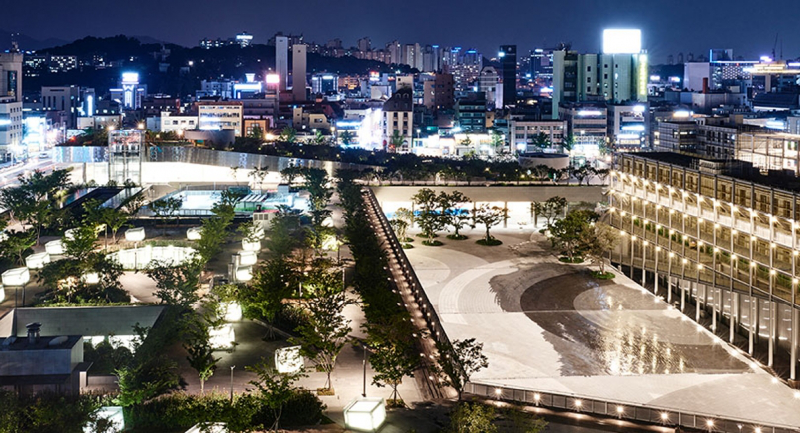
The 158,700-square-metre ACC, which emulates a Hollywood movie-studio lot, opened last month. Designed by architect Woo Kyu-sung, who is known for his involvement in the development of the Olympic Village for the 1988 Games, the complex is located below ground level, except for the Culture Exchange Centre. A park has been created on the top level.
Under the slogan “Asia’s Cultural Window to the World,” the ACC aims to become the cultural hub of Asia, Bang says. “We’re currently moving into an age where culture, arts and content are becoming the main growth-drivers of the economy.”
On the Web:
www.ACC.go.kr.
