
Musician returns to his roots to revive forgotten music


Play
Troupe of poor farming villagers breathe new life into ancient Tay Nguyen rhythms
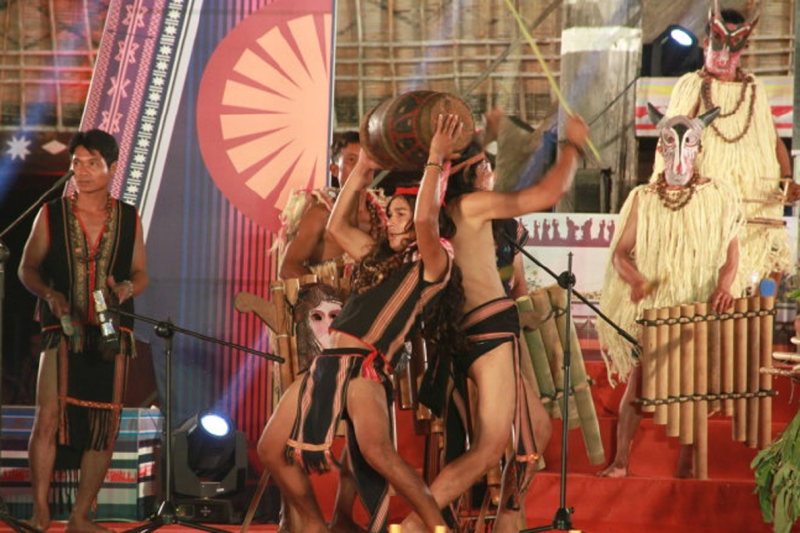
Kaly Tran has almost single handedly revived the Tay Nguyen (Central Highlands) music of the Ba Na people and is now leading an extraordinary musical troupe of his own assembled from once-reluctant farming villagers.
He smiles proudly at the end of a show on a hot summer night in the hustle and bustle of Ho Chi Minh City. Hardly anyone can imagine that the well-built Ba Na man is so interested in Tay Nguyen music and is now spending a lot of time leading a musical troupe of his own.
Tran says, “I had a special family background. I was sent to an orphanage when I was a little child. My love for music grew day by day through the activities and services at the orphanage.”
Decades ago the Ba Na people led a poor life, yet every household had its own trung and klong put instruments and gongs. When it came to the harvest or festivals, villagers gathered together, playing instruments and drinking ruou can (tube wine).
“When I went to high school, I found that no young people played instruments. Ba Na families hung the gongs on the wall or even sold them at the market. It was pretty sad,” he said.
In 2015, after his graduation from the Military University of Culture and Arts, Tran decided to return to his home village to teach children to play instruments and to gather adults to set up a music troupe. To pay for his dream, Tran performed on several pop music stages around Ho Chi Minh City and whenever he has free time he takes a bus back to his home in Kon Klor Village of Kom Tum Province.
In the beginning, it was very hard to persuade villagers to join him. Most said, “We cannot sing. We are farmers who are just familiar with the fields and the forest. We have no talent for singing.”
It took Tran time and effort to show them that passion, dedication and patience can help revive Ba Na music. After a while they slowly came to believe him.
“Ba Na people are among the biggest music lovers in Central Highlands. They have an aptitude for music. I have been addicted to music since I was a child. Music and I cannot be separated,” he said.
In the early days after he returned home, Tran could call on about 30 people to participate in the music. Everyone was excited to go to the forest to find bamboo trees which were then carved and dried to make instruments such as the klong put, ting ning, bong boh and especially trung instruments. Some were even lifted off walls as ornaments to be played again.
Thanks to their constant efforts and creation, Tran and his troupe have put together a new gong collection named Ding Dong, based on the working principles of the old gongs.
“For ages, Central Highlands people have been using the old gongs made on the pentatonic scale which is very popular in traditional music but not in new music. However, I would like to develop new gongs that can play all kinds of music. It will help popularise ethnic musical instruments to foreigners,” Tran said.
The old gong collection has only 12 or 13 gongs while the new one has 27 gongs. Of these, 16 are used to play main rhythms and the other 11 are for support. “That is why the new gong collection can create strange and soothing sounds,” Tran said.
Tran’s troupe now involves about 70 regular members, although it can be expanded to 100 members if they need to play the new gongs.
“We just want to let people know how wild and free Ba Na music can be. If we can make money, it’s good,” he said.
Now, Kon Klor Village in Kon Tum Province is famous not only for its traditional, rustic houses, but also for the musical troupe led by Tran.
Most of the troupe members are poor farming villagers who were convinced by Tran to get involved and eventually became talented instrument players.
A Rung, a member of the troupe, said, “I just finished Grade 9 then stayed home to do farming. When Tran called, I was hesitant at first. Then I was curious and excited to join him. Now it has become so familiar to me. I will definitely be sad if I don’t sing once a week.”
Pham Thi Trung, director of Kon Tum’s Department of Culture, Sports, and Tourism, said that she was touched when she saw Tran’s troupe playing. “Tran has developed the troupe based on the wildness and freedom in the souls of the Ba Na people,” she said.
