
Building on greatness
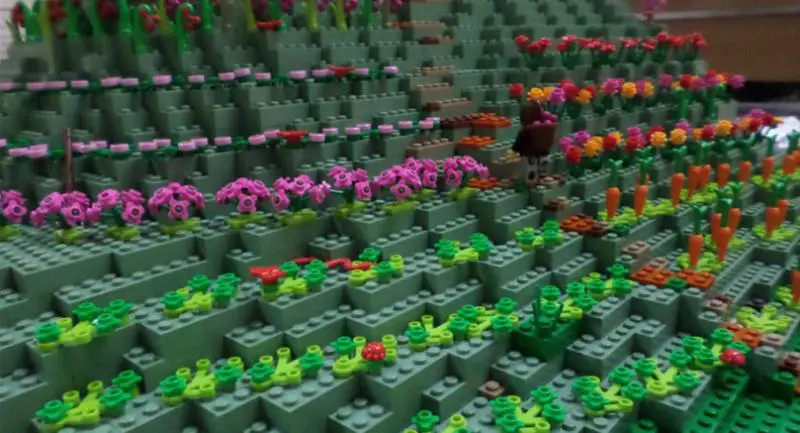


Members of Thailand's Lego user group emulate the royally initiated projects for a show that celebrates Children's Day
NATIONAL CHILDREN’S DAY falls on January 14 and as befits a country still in mourning for His Majesty the late King Bhumibol Adulyadej, celebrations will be muted, with many events seeking to pay tribute to the late Monarch while keeping the little ones entertained.
Regulars at Children’s Day activities, members of Thailand Lego User Group have chosen to mark the occasion while also remembering His Majesty through an exhibition of exquisite building-brick sculptures including a 64 x 64 inches portrait of the beloved King with a beautifully designed frame.
The display is part of “Siam Paragon Playground 2017: Play it Forward”, which runs from January 12 to 15 at its fashion hall. Dubbed “Wholeheartedly Made, Assembled by Bricks”, the exhibition features Lego models of several Royally Initiated Projects focusing on soil, water and forests. They include the Royal Rainmaking Project, the Chang Hua Mun Project, the Baworn Project consisting of houses, temples and schools, the New Agricultural Theory Project, the Khwae Noi Bamrung Dan Dam Project, as well as the Phra Maha Dhat Nabhamethanidol and Nabhapolbhumisiri pagodas at Doi Inthanon in Chiang Mai province.
Dr Picharn Charoensri, president of the T-LUG, is particularly proud of the portrait of His Majesty, which is made of some 40,000 Lego bricks in 19 colours. Before even starting the work, which took two months to complete, Picharn and his co-builder, Supathanit Sripaiboon, had to determine the size of the mosaic and its eventual installation. The next step was to choose a clear and meaningful photograph of King Bhumibol.
“We had to think hard about how to assemble the brick pieces. We needed to try and source Lego pieces from abroad too. Although there is a computer program that helps with design, we were constantly making adjustments and fine tuning, which meant dismantling the Lego pieces on several occasions,” Picharn explains.
Picharn is not new to creating works showing the late King. An earlier piece was taken from a photograph of King Bhumibol bending down to receive a flower offered by an elderly woman. The Lego creation was exhibited at the National Science and Technology Fair 2011, with Her Royal Highness Princess Maha Chakri Sirindhorn graciously assembling the last nine Lego bricks. The mosaic, which measures 60 x 60 inches, is still on display at the National Science Museum at Chamchuri Square.
“I’ve been happy with all of my works. The first Lego picture I made by myself, spending time after work and at weekends. It took me four months and was an exercise in trial and error. For the latest one, I had Supathanit helping and I was able to apply what I had learned from my previous works to the new one, which speeded things up considerably. This picture will be later be presented to His Majesty King Rama X.”
To Picharn’s fellow T-LUG members Pongsit Rattanakornwit and Sucheep Setthatananont, Lego is much more than a toy that enhances young imaginations. It’s also an artwork that can be presented as a three-dimensional sculpture.
“We think that if we use Lego bricks to illustrate the Royal Initiatives, children will be better able to understand what His Majesty King Rama IX did for his subject,” Pongsit says.
The models, each measuring 2 x 1 metres, have been created by more than 10 Lego builders, and illustrate projects from the North to the South. One shows His Majesty travelling in a car across a stream to visit his subjects in Narathiwat and another depicts him getting out of his jeep at a bridge in Baan Jao Bakong. Yet another celebrates his skills as a sailor, recalling the occasion when the late monarch crossed the Gulf of Thailand from Klai Kangwon Palace to Sattahip in the Vega sailboat he crafted from scratch.
“We discussed the projects that interested us the most and how they could be presented. The more difficult part was how compose them into stories. For example, should be use a square form or an L shape? We have tried to portray stories from the coasts to the hilltops,” Sucheep says.
“It’s often hard to find bricks that correspond to a real-life story,” Pongsit adds. “You need to come up with your own designs based on research. I believe that many builders, after having studied the information, will feel encouraged. And of course you learn so much from seeing pictures. For example, we discovered that the King himself was driving the car as it crossed the stream.
“That led us to further study the car and the location. We needed to portray the stories we have seen in the photos using the bricks we have. And that was particularly difficult for this work.
“Normally when we have special projects, we can plan as much as a year in advance and that gives us the chance to place orders with suppliers abroad. We didn’t have the luxury of time for this project and our team has only a limited number of bricks. On some occasions we designed the patterns only to discover we didn’t have enough bricks. So we had to make a lot of adjustments and beg and borrow bricks from our friends. The late King once said ‘do not let shortages be an excuse not to work. Work despite shortage and make it accomplished. Do it deliberately and honestly’. We followed that advice throughout.”
The Lego creation “Sustain HM the late King’s aspirations regarding his Royal Initiative Projects” features a total of 20,000 bricks. Pongsit took personal charge of the Highland Agriculture Project, two pagodas and the Royal Rain Project and also assembled the photo’s frame. Every project, he says, was a challenge
“Each builder has his own working style. For highland agriculture I started by preparing a sketch and then thinking about the types of trees that grow there. Lego Company doesn’t produce bricks of every kind of fruits, so I had to think about how to illustrate iceberg lettuces and wild Himalayan cherry trees. A lot depended on the pieces we were able to adapt. We built them then took them apart until we got it right.”
Sucheep is the man between |the Pan Poom Thong (Golden |Bush-Shaped Tray), Pan Poom Ngeun (Silver Bush-Shaped Tray)and the Krueng Thong Noi (Royal Little Homage Set). The structure, he says, required some 3,800 Lego bricks.
“Usually when we work we put all our gear together and even walk across the bricks to pick them up. This time, I arranged piles of bricks and reached for them. This seemed more fitting for the Krueng Thong Noi or Pan Poom. They are sacred,” he says
Sucheep built the Pan Poom by trial and error. He originally specified a nine-inch diameter then changed to an eight-inch diameter, “The most difficult step was arranging the square-shaped pieces into a round shape with a gradation effect so the work would be more beautiful,” he explains.
Building perfect models requires patience and a creative imagination and Pongsit says he enjoys using his mental prowess to assemble little pieces. “Seeing the work accomplished certainly makes me happy,” he says with a grin.
Sucheep agrees. “A distinctive point of Lego is the mini-figures or small human figures used in storytelling. Using Lego bricks that have their own appearance and expression is a kind of storytelling. Model builders like us enjoy implying the stories behind our models.”
