
Daeng Somdet silk shines with Thailand’s first AGT winner Nene Royal
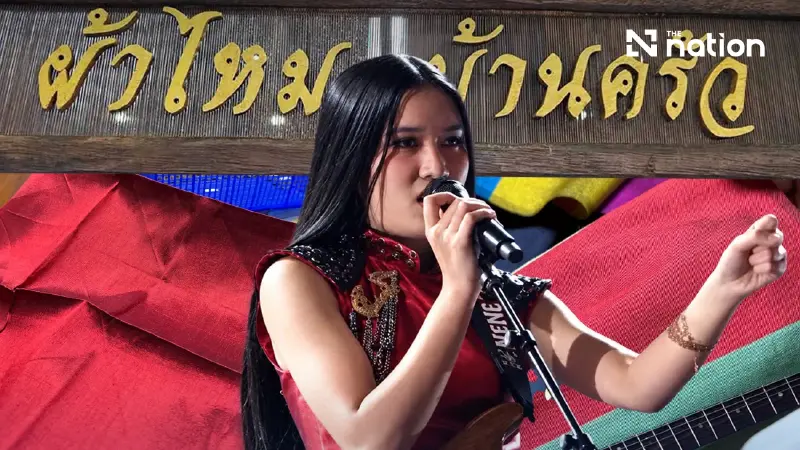


Nene Royal wore Ban Krua’s handwoven Daeng Somdet silk in the AGT 2026 final, bringing the Bangkok community’s historic weaving heritage to a global stage.
- Nene Royal, Thailand’s first winner of America’s Got Talent, wore an outfit made from Daeng Somdet silk for the competition's final.
- The distinctive red silk is handwoven in Bangkok's historic Ban Krua community, the last remaining traditional silk-weaving workshop in the area.
- Daeng Somdet has a royal heritage, with its name and signature colour originating from commissions by Queen Sirikit The Queen Mother for royal garments.
- The international exposure has brought immense pride to the weavers, highlighting how a centuries-old craft can remain relevant through contemporary design.
A piece of traditional Thai craftsmanship took centre stage at the America’s Got Talent (AGT) 2026 final when 16-year-old Phuket rocker Nene Royal wore a striking outfit made with handwoven silk from Bangkok’s historic Ban Krua community.
The fabric has since been identified as Daeng Somdet, a distinctive red silk produced in Ban Krua, a historic Cham Muslim community along Khlong Saen Saep that is home to its last remaining traditional silk-weaving workshop.
Wootthinan Nahim of the Ban Krua Historical Learning Centre revealed the story behind the fabric in a Facebook post, recounting details provided by Niphon Manuthas, owner of Ban Krua Silk.
Niphon recalled being surprised when reporters contacted him after Nene referred to Ban Krua’s handwoven silk in a Facebook post. Although he knew the young Thai performer had made a name for herself on AGT 2026, he did not realise the silk used for her outfit had come from his workshop.

How Nene’s team found Ban Krua silk
When Nene’s team visited Ban Krua to buy the fabric, Niphon was away exhibiting silk at the Jim Thompson House Museum across the canal from the community.
An employee later told him that customers had visited the family’s two-storey wooden house, where the ground floor serves as the community’s remaining silk-weaving workshop.
They bought about five to six yards of silk without revealing what it would be used for. Niphon only discovered later that the fabric had been transformed into Nene’s outfit for the AGT final.
For the veteran weaver, seeing Ban Krua silk worn by a Thai performer before an international audience was a source of immense pride.

Royal heritage behind Daeng Somdet
Niphon explained that his family has been involved in silk weaving since the reign of King Rama V, while his mother had longstanding ties to weaving silk for royal use at Sra Pathum Palace.
He recalled that Her Majesty Queen Sirikit The Queen Mother had previously commissioned Jim Thompson to produce silk for royal garments worn during visits to Europe.
That royal connection inspired Ban Krua weavers to develop two signature colours, red and purple, which became known as Daeng Somdet and Muang Somdet.
The names honour the royal association with the silk. Producing the distinctive shades requires precise control of the dyeing formula, giving the fabrics both their characteristic colours and cultural significance.
The weaving process is equally demanding. Using a traditional fly-shuttle loom, a weaver takes about 45 minutes to produce one yard of plain-coloured silk, with daily output averaging six to seven yards.

Ban Krua silk’s earlier international spotlight
Nene is not the first prominent Thai to take Ban Krua silk onto an international stage.
Porntip Nakhirunkanok wore Ban Krua silk for the national costume designed and made by Lamyong Boonyarataphan at the Miss Universe 1988 pageant.
The costume won the Best National Costume award, while Porntip went on to become Thailand’s second Miss Universe and the 37th winner of the international pageant.
For Niphon, Nene’s outfit represents more than international exposure for Thai silk. It also shows how a centuries-old craft can remain relevant through contemporary design while helping to preserve the skills of Ban Krua’s weavers for future generations.

More than 200 years of Ban Krua heritage
Ban Krua is a historic community along Khlong Saen Saep in central Bangkok with roots stretching back more than 200 years.
Covering about 2.24 hectares on both sides of the canal, from Hua Chang Bridge to Wat Phraya Yang, it is divided into three sections: Ban Krua Nuea and Ban Krua Tai in Ratchathewi district, and Ban Krua Tawan Tok in Pathumwan district. Together, they comprise 1,376 households.
The community traces its origins to the reign of King Rama I, when Cham Muslims settled in the area. They brought silk-weaving knowledge from their homeland and combined it with Thai silk, developing distinctive fabrics and techniques that have been passed down through generations.

Ban Krua later became closely associated with American businessman Jim Thompson, whose fascination with the community’s silk helped bring Thai silk to international attention.
Thompson worked closely with Ban Krua artisans, learning their weaving techniques and patterns while helping to improve quality, develop new designs and introduce Thai silk to overseas markets. The Jim Thompson name subsequently became internationally associated with high-quality Thai silk.
Despite changing times, Ban Krua continues to preserve its weaving heritage. Some households now serve as learning spaces, offering silk-dyeing and weaving workshops and developing contemporary patterns to help generate additional income.
The community has also retained much of its traditional character. Several houses are more than a century old, ranging from traditional Thai wooden homes to colonial-style buildings incorporating Malay-Pattani architectural influences, reflecting the distinctive history and identity of Ban Krua.

