
Laos wind farm seen as model for wider ASEAN electricity trade
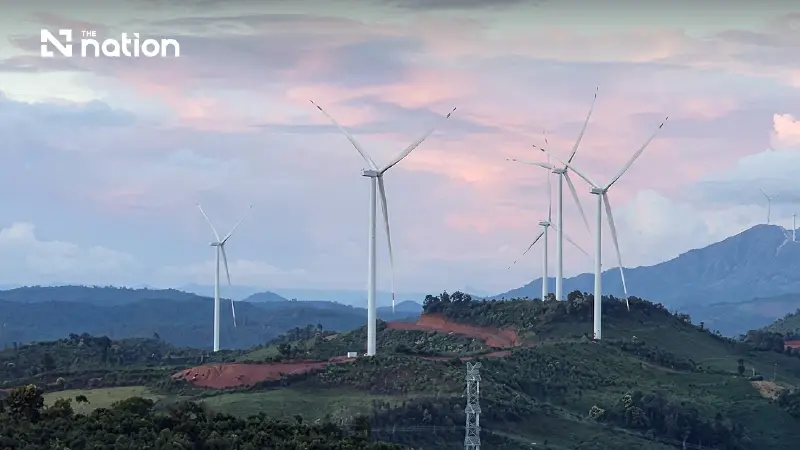


The US$950 million Monsoon project exports clean power to Vietnam and supports local livelihoods, as experts call for safeguards in regional energy trade.
- The Monsoon Wind Power project in Laos, which exports electricity to Vietnam, is being hailed as a successful proof-of-concept for the long-delayed ASEAN Power Grid.
- As Asia's first cross-border wind power project, it demonstrates the feasibility of regional renewable energy trade, with potential to expand surplus power exports to Thailand, Malaysia, and Singapore.
- Advocates, including the Asian Development Bank, see the project as a way to strengthen regional energy security, accelerate green energy investment, and diversify national power sources.
- While the project is a milestone, experts caution that a wider regional grid must move beyond bilateral agreements to a robust multilateral framework to protect against energy protectionism and political disputes.
Monsoon Wind Power’s electricity exports from Laos to Vietnam could offer a model for the long-delayed ASEAN Power Grid, according to Narut Boakajorn, the project’s general manager.
“Our project is in Laos but we are selling our electricity to Vietnam, which is showing that we as an ASEAN community can achieve the ASEAN Power Grid,” he said.
Narut considers exports beyond Vietnam possible in the near future, with surplus power potentially reaching other countries.
“If we have surplus, we want to support the ASEAN Power Grid through our existing system to Thailand, Malaysia, Singapore as well,” he said.
“Our project can demonstrate that effort. If we have the right structure, if we have the collaboration between ASEAN nations, we can have more sustainable energy collaboration,” he added.
Supplying electricity across a border illustrates renewables’ potential to meet regional demand. Monsoon’s backers hope it will accelerate the much-discussed grid. The Asian Development Bank (ADB) is working with development partners to mobilise funding for full regional integration by 2045.
ADB argues that efficient electricity transfers between the region’s fast-growing economies will strengthen energy security and accelerate investment and the integration of green energy.
For Shobhakar Dhakal, a professor in the Faculty of Climate Change and Sustainability at Thailand’s Asian Institute of Technology, Monsoon is a “milestone in the region”. He wants its model extended across the region beyond the Laos-Vietnam bilateral agreement.
“Over-reliance on bilateral mechanisms has potential to bring energy security implications for both countries in times of trouble such as global energy disruptions, friction in bilateral relations between participating countries and the unfair market protection campaigns,” he cautioned.
“We have seen that individual countries often try to cope with the global energy crisis fallout by a protectionist approach.
“Additionally, there are ample examples that the energy trade and the energy reliance have been weaponised to achieve other political or strategic objectives,” Dhakal added.
To prioritise domestic energy needs, Indonesia started cutting the natural gas supplied to Singapore by 31 billion British thermal units a day on October 24. Singapore produces most of its electricity from gas and imports substantial volumes through Indonesian pipelines.
Prime Minister Lawrence Wong stated on October 25 that he expected all parties to fulfil their commercial contractual commitments.
Dhakal, whose remarks did not refer to that incident, stressed that bilateral and multilateral power trade agreements should be “adequately backed by robust regional or bilateral regulatory provisions and a regional framework that provides a fair level of protection to survive the rough tide”.
Energy protectionism could complicate the grid’s development, according to Mirza Sadaqat Huda, a Singapore-based senior research fellow in ODI Global’s Climate and Sustainability Programme and an associate fellow at the ISEAS – Yusof Ishak Institute.
“Continued dialogue, predictable long-term agreements and regional dispute resolution mechanisms will be important in maintaining confidence among trading partners and sustaining regional energy cooperation,” he said.
The 11-member Association of Southeast Asian Nations (ASEAN) has been trying to hasten the grid’s implementation, particularly since US-Israeli attacks on Iran disrupted global oil supplies in February.
The grid’s memorandum of understanding was signed in 2007 and implemented in 2009. Sub-regional links involving Singapore, Malaysia, Thailand and Laos have since extended the initiative beyond its original bilateral electricity connections.
Annual electricity demand growth of about 4% offers considerable opportunities but requires substantial investment in generation and transmission. Progress towards a grid enabling affordable electricity flows across a region of more than 680 million people nevertheless remains slow.
Power trading among Thailand, Laos and Vietnam sets the Greater Mekong sub-region apart. The wider region has numerous national grids of varying modernity and relatively few cross-border connections.
Most countries still generate power using costly fossil fuels. This dependence persists despite abundant wind and solar resources and increasingly competitive, less polluting alternatives involving wind, solar and battery storage.
Singapore’s Energy Market Authority has conditionally cleared 9.25 gigawatts of low-carbon electricity imports from Australia, Cambodia, Indonesia, Malaysia and Vietnam. Meanwhile, Singapore and Malaysia are progressively strengthening their grid connections.
Wind gives countries another option as they diversify their energy sources; investment in cross-border electricity links could also unlock billions of dollars for green projects.
Monsoon entered service in August 2025 following 27 months of construction. A consortium of international and regional financial institutions, including ADB, financed the US$950 million (S$1.2 billion) project.
The project originated with Impact Electrons Siam, a Thai developer working in clean energy and digital infrastructure. Monsoon is South-east Asia’s largest wind farm, Laos’ first and Asia’s first cross-border wind power project.
Its clean electricity goes to Vietnam, with 600MW of capacity sufficient for more than one million homes. Across its 25-year operational life, the plant is expected to help avoid around 33 million tonnes of greenhouse gas emissions, equivalent to taking roughly seven million cars off the road for a year.
Laos gets the best performance from wind power during the dry season, when hydropower generation generally declines, according to Shanny Campbell, ADB’s country director for Laos.
“Wind is free, so of course we should harness it,” she said. “So in terms of complementing the power mix, it’s fantastic.”
Scott Roberts, ADB’s country director for Vietnam, sees Monsoon as evidence that governments can jointly address cross-border technical difficulties and align power development plans through trust, political will and cooperation.
“It’s easier for countries to plan alone, it’s harder for them to plan jointly.
“We are delighted to see that there is momentum around this and that momentum builds year after year as test cases like Monsoon Wind come to market,” Roberts said.
In south-eastern Laos’ Sekong province, the once-quiet landscape now features 133 turbines towering above villages on mountain ridges, their blades turning like huge fans to generate electricity. At around 1,600 metres above sea level, the wind’s force can be heard and felt daily.
Adding wind to hydropower and solar strengthens Laos’ “Battery of Asia” reputation. Locally, roads have improved and a minimum of 1,600 jobs have been created, more than 1,000 for Laotians. No village needed relocation despite the turbines occupying 25 hectares.
About 2,800 households, or almost 16,000 residents, have benefited from the community programme, according to ADB. Its US$1.1 million annual budget covers education, healthcare, agriculture and infrastructure improvements in surrounding villages.
For local villager Sunsamone Saypanya, 42, stable construction employment with Monsoon means US$10 (S$13) daily, compared with US$6 from odd jobs previously.
“We benefit a lot. One of the benefits is how they helped develop our livelihoods,” he said.
The community initiative also supplies coffee seedlings, encouraging villagers to grow coffee instead of rice, whose cultivation can involve polluting slash-and-burn practices.
“It will bring more income and improve living conditions,” Sunsamone added.
Amy Saychai, 19, did not know the turbines’ purpose, saying only that “they look nice”, but welcomed benefits including better roads. Hoping for further benefits, she suggested the project could attract tourists to her little-known village.
“This creates a new landmark attraction. Some areas in the past were inaccessible. But with better roads now, people can come and enjoy the view,” she said.
Source: Asia News Network
