
Forty years young


The United Arab Emirates celebrates four decades of independence and development
It’s said that life begins at 40. Usually that applies to people but it also holds true for the United Arab Emirates (UAE), which have undergone an amazing transformation from barren desert to mature development in just four decades. What the future holds though, is a far more important question.
The federation of seven emirates is ranked among the countries with highest per-capita income (US$49,600 as of 2010) and possesses nearly 10 per cent of the world’s total oil reserves.
It has also learned the hard way that growing rapidly is not always good for the country. Dubai, the UAE’s business centre, suffered a real-estate crisis two years ago. That served as a wake-up call and prompted the country to reconsider its rapid-growth model.
On December 2, the UAE celebrated its 40th National Day, completing four decades since the establishment of the state in 1971 after achieving independence from the United Kingdom.
Each of the UAE’s seven emirates - Abu Dhabi, Ajman, Dubai, Fujairah, Ras Al-Khaimah, Sharjah and Umm Al-Quwain - is governed by an inherited emir. Collectively, the country has Abu Dhabi’s emir as the president and Dubai’s ruler as the prime minister.
The prime minister, Sheikh Mohammed bin Rashid Al Maktoum, who is also the UAE’s vice president, expressed his pride in the UAE’s achievements on the eve of national day.
“The 40th national day is the stage of maturity for our country, which has made great achievements at the national, cultural and humanitarian levels. Through these achievements, the UAE has not only vied with others but has also set an example for others to follow and learn from its long experience,” he said during his speech on theme “Spirit of the Union” at the Dubai World Trade Centre.
He has good reason to be proud.
In 1962, the UAE’s first oil exports from Das Island, a small island in Abu Dhabi, set the stage for unification. But it was Dubai that attracted the world and became one of the world’s fastest growing tourist destinations and the most popular in the Middle East. Twenty-five years ago, the tallest building in Dubai was the Dubai Trade Centre. Today, skyscrapers dominate the emirate’s skyline.
The Dubai way is to dream the impossible, its ruler Sheikh Mohammed says. So it is no surprise that there is always something new to delight and astonish the world.
Burj Al Arab, the first-ever seven-star hotel situated just off the main tourist area of Jumeirah Beach, first put Dubai on the world map and is still a world-class symbol. The Palm Jumeirah holds the record for the world’s largest man-made island.
Keeping up with its reputation as a destination for offering the fastest, biggest and highest, Dubai unveiled the 828-metre high, 160-storey Burj Khalifa last year and claimed the world record for the highest building. Dubai fountain boasts the largest and most technologically advanced water works of its kind. The Dubai Metro is the first urban train network in the Arabian Peninsula. The route passes many areas in the emirate that are almost deserted, pointing to a vision of its ruler over infrastructure development.
“Gold to go”, the world first gold vending machine, installed early this year at leading shopping malls and luxury hotels in Dubai is amazing. The idea is simple; take the world's reliance on the idea of gold as a solid investment and then give them quick and easy access to it.
But things can and do go wrong. When the real estate bubble burst two years ago, Dubai found itself facing a financial and Dubai World, the investment vehicle for the emirate, proposed to delay for six months payment on $26 billion of debt.
If Dubai represents the desire for rapid economic growth, Abu Dhabi, the capital, is the UAE's balancing force -- focusing on sustainable development rather than fast but fragile growth. This refers not only to economy but also environment and culture.
Abu Dhabi, dubbed the Garden of the Gulf, looks more eco-friendly and tranquil than its neighbour with palm trees planted along the roads. Unlike Dubai, which is full of futuristic-looking high buildings with glittering glass windows, Abu Dhabi has smaller buildings that are less colourful and mostly Islamic in style.
Abu Dhabi is the largest and wealthiest emirate of the UAE in terms of per capita income. Its achievements have been impressive, with such world-class development as Yas Island, the emirate’s entertainment destination, and Masdar City, a hub for all things green, clean, and environmentally friendly. When completed, Masdar will rely entirely on solar energy and other renewable energy sources, with a sustainable, zero-carbon, zero-waste ecology – as visualised by the UEA’s founding father, the late Sheikh Zayed bin Sultan Al Nahyan, who foresaw the day when the world would run out of oil.
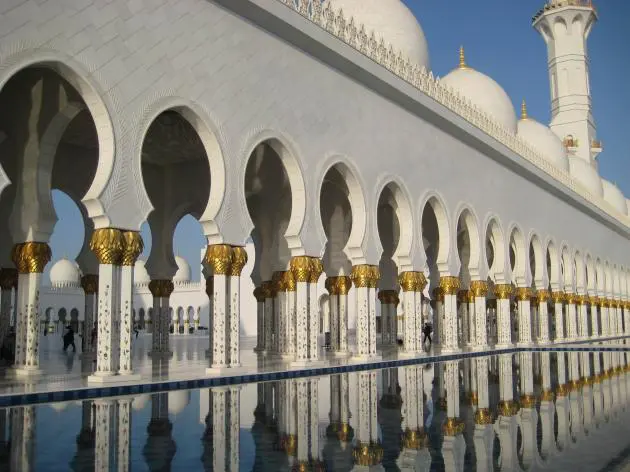
Abu Dhabi’s cultural masterpiece is the Sheikh Zayed Grand Mosque, home to the world’s largest Iranian carpet and a set of Swarovski crystal chandeliers. The emirate is also planning to build a world-class cultural destination at Saadiyat Island, or “island of happiness”. It will be home to Louvre, Zayed National, and Guggenheim museums.
The UAE has experienced successes and failures over the past four decades but its rulers are confident about the country’s future.
“The sense of satisfaction over what we have achieved should not be a reason for lethargy and relaxation; rather it should provide inspiration for more efforts,” said Sheikh Khalifa bin Sultan Al Nahyan, the UAE president and ruler of Abu Dhabi, in his 2005 National Day address.
“Only thus, will it be possible both to preserve what has achieved so far and guarantee further success in the future in terms of offering dignity, security, and stability for the generations to come.”
And with the “spirit of the union” that was forged under his father as strong today as it was 40 years ago, there’s no reason why the UAE shouldn’t look forward to a stable and prosperous future.
