
A descent into hell


Play
Its sulphur-spewing vents are dangerous, but nothing survives the 'beast' that lurks at the bottom of Mount Ijen's crater
Human sacrifices; people being sizzled alive in a lake of fire. These were the first images that sprang to mind when a friend asked if I wanted to trek up a volcano to see the world’s largest acid lake. I thought she was crazy.
Fortunately, the adventurous side of me won, and I found myself more than 250 kilometeres from the nearest city of Surabaya, Indonesia, at a homestay in the foothills of the Ijen mountain range, in East Java.
I was the told the trek up Mount Ijen would deliver spectacular views from precarious ledges. While the adventuress in me was thrilled, I also worried what would happen if my fear of heights gripped me during the climb to the crater’s rim, 2,499 metres above sea level.
After a relaxing time in the natural hot springs close by our homestay, we turn in early.
We are awakened in the wee hours next morning by our local guide, Afif Mahrus, to the familiar aroma of hot coffee, which helps steady my nerves.
Following a bumpy ride aboard a four-wheel drive, the mountain road brings us to base camp at Paltuding, where our ascent to the Ijen Crater, hiding an almost-kilometre-wide acid lake, begins.
A flat pathway of lava soil stretches ahead of us, but soon starts winding uphill. The lush jungle foliage gives way to rockier terrain, and I am thankful for the protection of my sturdy hiking boots on the 3km hike.
We had been told it would be cold, but I am soon sweating with the exertion. Fortunately, Afif had advised us to layer our attire so we could easily add or discard items according to the unpredictable weather.
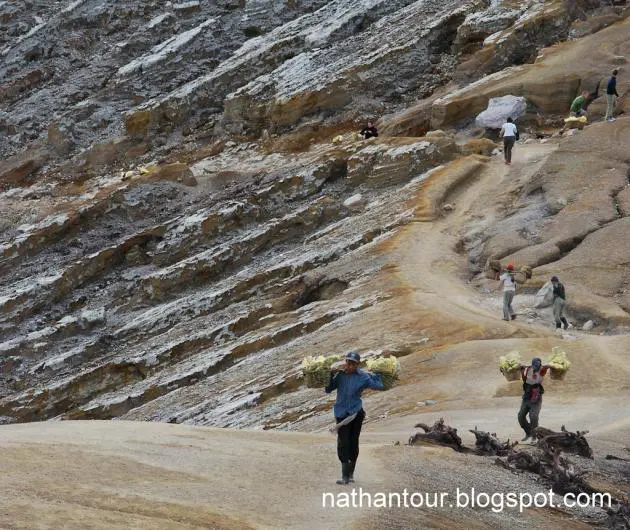
Along the way, we come across miners, trudging under the weight of baskets filled with sulphur. We are shocked to discover they carry loads of between 80kg to 120kg, from the heart of the crater, up to the rim and down the rugged rocky slopes of the mountain. It is a brutal job, especially since they are also exposed for long periods to the poisonous sulphur fumes that belch from the volcano’s vents. The miners’ ages range between 21 and 60, but many are wizened beyond their years by the hard labour.
Mining is a means of earning fast money for many of the villagers, explains Afif, but often at the expense of their health. To them, US$6 (Bt178) per day is good money. Many work four days mining sulphur, and the rest of the week farming and tending their livestock.
As we get higher, the air becomes cooler, and breathtaking scenery begins to stretch out before us. I keep my eyes focused on the distance, trying not to look down at the steep drops.
As we near the crater’s rim, the acrid smell of sulphur burns at our nostrils and we put on our masks. But luck is on our side, and the wind blows the fumes away from us.
Soon, the gravel beneath our feet gives way to solid volcanic rock, and we climb on to the crater rim. To take my mind off the height, I think how Neil Armstrong must have felt when he walked on the surface of the moon – a barren crater-filled landscape considerably “higher” than the one I am standing on.
Although the path along the crater rim is fairly wide, there are sheer drops on either side, and a step or two in the wrong direction can send one tumbling down a rocky slope on one side, or into a turquoise-blue acid lake on the other.
Suddenly I am overwhelmed with fear. I hesitate, feeling dizzy more from the height than the walking. If not for the encouragement of the friends alongside me, I might not have made it. They keep urging me onwards and I figure that I might as well keep going as I’ve already made it this far.
We climb slowly up the 45-degree rock slope, keeping our bodies low and our eyes away from the drop below, as Afif advises.
It is already mid-morning by the time we arrive at the top. The sky is a profound azure blue, and below us in the distance, a turquoise mirror spreads across the base of the crater.
We watch miners descend into the heart of the volcano.
There is an active volcanic vent at the edge of the acid lake, which is the source of sulphur. Nearby are signboards prohibiting anyone from venturing too close to the lake. It gleams invitingly in the morning sunshine, but it is deadly to anything that enters its waters. That is, of course, if you can get that far without first choking to death on the toxic sulphur fumes.
The miners are friendly, and willingly pose for photos with us. Some sell tiny figurines of turtles and other animals, carved out of the sulphur crystals. These are said to be good lizard repellents and cost around 10,000 rupiah (Bt30).
After a short rest and photo break, we head back down the trail. The journey downhill seems easier and we are relieved to make it back safe to base camp. Tucking into a lunch of sandwiches, we also chew over the bizarre dangers Mother Nature can conjure up – deadly gases and lethal acid lakes.
I learned two things from this trip. First, that nothing is impossible if you set your mind to it. Keep moving forward and you can overcome your fears. And second, your choice of companions is very important, because it can either make or break the journey. It was only with the encouragement of my fellow travellers that I made it all the way to the lake of acid – and back.
Take an acid trip
For more information on trekking Mount Ijen to visit the world’s largest acid crater lake, pay a visit to globaladventureindonesia.com.
