
Beauty in the silk


Play
The Queen Sirikit Museum of Textiles opens an interactive studio
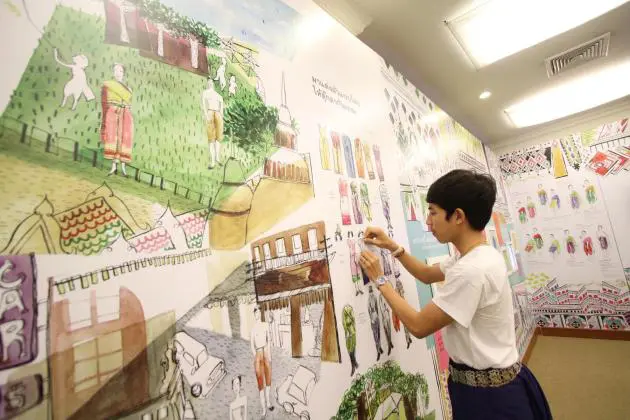
Even though Her Majesty the Queen Sirikit has not been well in recent months, her devotion to the preservation of traditional Thai textiles continues unabated with the opening last week of an activity studio at the Queen Sirikit Museum of Textiles, offering visitors the chance to augment their knowledge and understanding of traditional textiles through interactive activities.
“Through interactive learning,” says the Queen’s deputy secretary and head of the museum’s executive committee, Thanpuying Charungjit Teekara, “young people will be able to appreciate the country’s heritage and enjoy learning more the local textile wisdom.”
Piyavara Teekara, head of the Queen Sirikit Museum of Textiles project, adds that like other spaces in the museum, the studio is designed to promote knowledge and understanding related to the museum’s main exhibitions. Visitors can take part in activities through hands-on experiments and practical exercises, absorbing information through the built-in learning process while having fun with activities that are not only entertaining but help them to better understand and remember the contents of the main exhibitions.
The studio comprises four activity spaces. “Dress the Dolls in Thai Style”, as its name implies, allows visitors to dress dolls in the costumes of Thai ladies from various periods. They include eight modern Thai traditional styles created by Her Majesty: Thai Dusit, Thai Boromphiman, Thai Siwalai, Thai Chakri, Thai Chitrada, Thai Amarin, Thai Chakraphat and Thai Ruen Ton. Also featured are the traditional blouses and jong kraben (hip wrapping) favoured during the 19th century as well as men’s costumes for various occasions including the Raj-pattern jacket and purple jong kraben.
The dolls’ costumes and jewellery are made of flexible magnet sheets, allowing visitors to move them around to dress the dolls as they please on the illustrative magnetic board, all the while absorbing the similarities and differences between the costumes of each period.
“The second section, ‘Play our guessing game’, is a kind of quiz. You reach into a box and touch what’s inside then answer questions on it. It’s a game that’s designed to tests visitors’ general knowledge about textiles,” Piyavara continues.
Visitors are also invited to touch and visually examine models, raw materials and tools to help them answer what is inside each of the eight boxes..
“It’s not only fun but visitors can also actually experience the silk that they have observed in the exhibition displays,” Piyavara says.
The next section invites visitors to imagine wearing colours that are matched to each day of the week. This part is truly enjoyable, with visitors encouraged to dress in traditional costumes according to the auspicious colours of the days as detailed in the memoirs of HSH Princess Chongchitrathanom Diskul (1886-1978), daughter of Prince Damrong Rajanubhab.
In the 19th and early 20th centuries, Thai courtiers wore specific colours matched to each day of the week, believing that this would bring good luck. Princess Chongchitrathanom described how fashionable women at the court of her uncle King Rama V followed the lucky colours for each day by wearing one shade for their jong kraben and another for their sabai or shoulder cloths. Various props are provided by the studio against which visitors can pose for a photo op. The lucky colours include a lychee red jong kraben teamed with light green top or light green bottom with ruby red top for Sunday and for Monday a pale yellow jong kraben with blue or reddish pink top or dove grey bottom with orange yellow top.
For other occasions, such as the Buddhist Observance days, women would wear red jong kraben with a
pink top. When in mourning, they would wear purple jong kraben with an off-white top.
The last section is home to the “Textile Pattern Stamps”, inspired by the patterns found on Thai textiles such as “mat mii”, “phrae wa”, “phaa yok”, “chok, khit”, Visitors can use rubber stamps provided by the studio to create their own patterns on a card to take home as a souvenir.
The museum has generated a great deal of interest since it opened last year. Thanpuying Charungjit says more than 1,000 people visit the museum a day, mainly thanks to its prime location in the Grand Palace compound. Thais flock in at weekend.
Thanpuying Charungjit is also full of praise for the young Thai designers who have used the Support Foundation’s silk in their contemporary designs. “The styles have been minimal and modern and these new design suit younger generations, which is good. The clothes are fashionable while the production of silk fabric remains the same. This is key to preserving Thai traditional textiles,” she says.
The museum is planning to celebrate Her Majesty the Queen’s birthday anniversary next month by replacing some of Her Majesty’s ensembles with more exquisite attire that will certainly draw gasps of admiration. There are also plans to launch a study trip project for schools, colleges and universities. Students visiting the museum in-groups will receive information handouts free of charge and can participate in quizzes to win prizes.
SEEING IS| BELIEVING
n The Queen Sirikit Museum of Textiles is on the ground floor of Ratsadakorn-bhibhathana Building on the grounds of the Grand Palace. It’s open daily from 9 to 4.30.
n The main exhibition is spread across four galleries and divided into three sections. Gallery 1 houses “Artistry in Silk: The Royal Style of Her Majesty Queen Sirikit”, which features Her Majesty’s designer ensembles all made from hand-woven textiles.
n Gallery 2 showcases Her Majesty’s work in creating Thai national costumes in “Fashioning Tradition: Queen Sirikit Creates a National Dress for Thailand”.
n Galleries 3 and 4 are dedicated to Her Majesty’s tireless efforts to create sustainable careers and self-sufficient livelihoods for Thai artisans.
n Find out more at www.QSMTThailand.org
