
Just add boiling water


Play
But only after you drink in the magnificent sights and smells of South Korea's famous green-tea plantations
Since first being introduced to the country in the early ninth century by merchants returning from China, green tea has acquired a long history and rich culture in Korea.
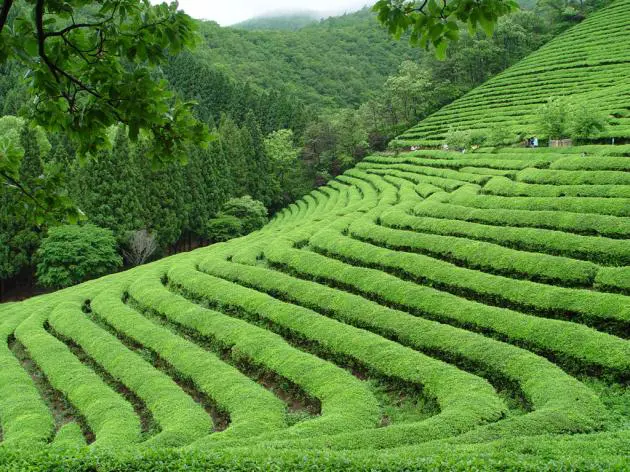
Today, one of the nation’s best-known areas for the aromatic plants is the Daehan Tea Plantation in Boseong on the south coast. The vibrant green fields here attract around 1 million visitors every year, who come to experience green tea in its most natural state and marvel at the beauty of hillsides braided by neat rows of bushes.
“Visiting the green tea plantation during any of the four seasons is a great experience,” says Choi Oh-bog of the Boseong District Culture and Travel Centre. “However, I highly recommend a trip during May and June when the leaves are at their greenest.”
A walk through Boseong’s labyrinth of green tea fields, which are spread out over some 560 hectares, is an unforgettable experience. Nestled in the centre of a heavily forested area, the plantation features row upon row of green tea plants in a wavy pattern, giving it a maze-like feel.
In between each row are narrow paths where visitors can wander touching, picking and smelling some of South Korea’s premier tealeaves. In the springtime when the plants begin to flower, the fields engulf visitors in an intoxicating scent.
“Boseong’s tea has a unique taste unlike any other because the plantations are located about 100 metres above sea level, and the cool breeze that comes in from the ocean, as well as the mist, changes the air temperature of the area,” says Choi.
Surrounding the plantation is a never-ending array of cedar trees, providing natural shade for the bushes.
“The tealeaves grown here are also distinct in the fact they are hardly ever exposed to any direct sunlight, which is not good for the leaves,” explains Choi.
The vast Daehan plantation was established in 1939 during Japan’s colonial rule over Korea. After Korea’s liberation in 1945 and the subsequent departure of the Japanese, the plantation was left abandoned until a Korean entrepreneur purchased the neglected fields and began cultivating again.
Boseong was originally selected as an ideal place to produce green tea because of the area’s deep and fertile soil, as well as its location near the sea. This makes for an ideal climate of cool, moist air. The premier location gives Boseong’s green tea a unique aroma, as well as a full-bodied taste.
The aroma and flavour are also greatly affected by both the roasting process, and the time chosen to pick the leaves.
Ujeon green tea is made from young buds and leaves picked around late April and is the most expensive, averaging around 70,000 won to 130,000 won (Bt1,900 to Bt3,500) per pack. Sejak green tea is typically considered the next best grade and is made of young leaf buds hand-picked between the end of spring and the start of summer. Sejak costs about 30,000 won per pack.
Boseong is the birthplace of the commercial tea industry in Korea and also its largest producer, accounting for approximately 40 per cent of the country’s total green tea production.
The Daehan Plantation is the country’s most visited, thanks to the Boseong Green Tea Festival, held every May at Korean Tea and Sori Cultural Park.
Popular events held during the festival include trips into the fields to pick tealeaves, then learn how to roast them. Participants also get the chance to sample all sorts of green-tea-infused snacks and drinks.
The festival also features a hanbok fashion show, live-music performances and various workshops such as tea-bowl making, tea-based cookery classes, health and beauty classes, green-tea soap making and more.
Aside from the popular springtime festival, the plantation also hosts a special winter festival for guests to experience the hillsides at night.
“Visiting the fields during the Boseong Green Tea Light Festival in the wintertime is a truly a wonderful experience,” remarks Choi.
One of the highlights is the 120-metre-high Millennium Tree, whose more than 100,000 fairy lights put it in the Guinness Book of World Records in 2000.
Boseong locals have managed to infuse green tea into almost every aspect of their lives. The county has a delicious tradition of green-tea drinks, cakes, cookies and ice cream, but perhaps the tastiest local speciality is nokcha samgyeopsal – grilled pork belly from pigs that have been fed on green-tea leaves.
Daehan has stiff competition from Jeju Island’s Seogwang Tea Field, located next to the O’Sulloc Museum, which attracts more than 1 million visitors each year. O’Sulloc tea is the signature brew of Jeju and is appreciated by connoisseurs for its distinct flavour.
“First off, Jeju Island has unique soil and organic matter in that it originated as a volcanic crater,” says Kim Jeong-hoon, O’Sulloc Tea brand manager.
“In addition to that, the area has an average temperature of 16 degrees [Celsius] as well as an average rainfall of 1,880mm, which are great conditions for cultivating tea.”
Seogwang is located in the south of Jeju Island and it produces O’Sulloc green tea, one of Korea’s most familiar brands.
Aside from the plantation and the museum, O’Sulloc has also established a chain of cafes that serve green-tea concoctions such as straight latte, soda, and shake variations, to name a few, as well as cakes and desserts infused with the aromatic leaves. Visitors should also check out the face-masks and lotions sold at the O’Sulloc Tea House – the delicious brew is said to be rejuvenating for skin, too.
