
Death by orchid


Play
Hunters in the highlands of Vietnam brave many perils in their quest for rare and valuable specimens
Orchids hidden deep in the forests of Vietnam have a beauty which ranks high in the minds of plant buyers and enthusiasts, but seeking these treasures is a dangerous business.
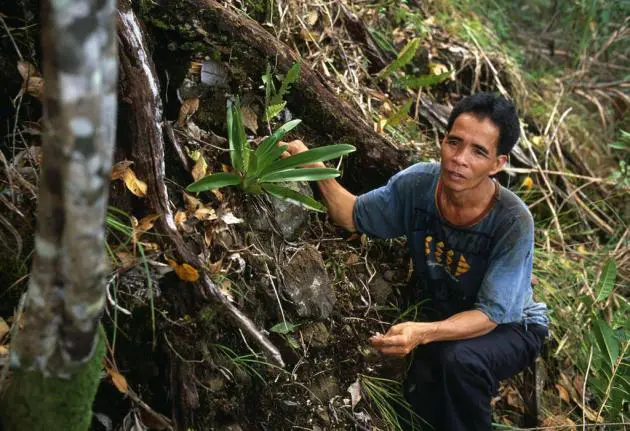
Men like 23-year-old Ho Van Dinh risk their lives plunging deep into the jungle or climbing high into the canopies on foggy mountaintops, in search of rare plants that can fetch up to US$5,000 (Bt155,800) per specimen.
At the first gleam of daylight, cooking flames light up the kitchen in Dinh’s house in Huong Hoa District, Quang Tri Province. His wife finishes making a large breakfast, “fuel” for his tough hunt ahead.
Soon, other men in Dinh’s team arrive with tools and wine, the latter to help them “keep warm” on their trek to the forested peak. Stuffing climbing rope, rivets, knives, hammers, flashlights and food into their bags, they set off for the 1,700-metre Voi Mep Peak.
After three hours’ walking, they stop by a stream for a break. Dinh pours wine into the waters to commemorate the orchid hunters who lost their lives in a recent flash flood.
“They were swept away by the water and slipped from the cliff to the stream,” he says.
At dusk, the team reach the peak, where they light a fire and pitch their tent.
At daybreak they begin their quest, made easier at this time of year because the orchids are in bloom.
The hunters’ staple prey is the foxtail orchid (Rhynchostylis gigantea). It has long, thick, densely packed clusters of fragrant flowers, which can take white, purple, pink, dark red or spotted forms. People buy them to celebrate Tet, the lunar New Year.
Dinh notices a cluster of foxtails at the top of a tree and soon the men are hammering nails into the century-old trunk to assist their climb. They use ropes to secure themselves to the tree while they extract the orchid’s roots from high in the canopy.
The team is happy to bag nine big foxtail orchids plus a bunch of small ones.
“We sell wild foxtail orchids to dealers for 200,000 dong (Bt280) a kilogram and they sell to retailers and customers in the lowlands,” says Dinh. “The wholesale dealers never refuse to buy from us, especially the wild, scarce orchids which are not easy to get.”
Gathering orchids has its dangers, but it is not just the hunters that are threatened. The precious wild flowers are in danger of disappearing from Vietnam’s forests.
Duong Tan Nhut, vice director of the Central Highlands Institute of Scientific Research, says: “Wild orchids should be protected, otherwise they may be lost for ever.”
Propagating wild orchids in a laboratory is difficult, but specialists are working on it. It takes a year for the seeds to sprout. Then the seedlings are brought out of the laboratory and planted in their natural environment, where the survivors bloom after three years.
Meanwhile, growers are aware that the natural reservoir of wild orchids is drying up. They have set up groups to share experience in cultivating the plant.
Quoc Dung, a member of the Vietnamese Bonsai Club, is keen to share his knowledge and experience of growing orchids with others. He says owning a pot of wild orchids gathered from the forest is wonderful, but growing your own until it blooms is also an amazing experience.
For Dinh, the hunt is hard and dangerous. A man from his village was recently bitten by a venomous snake while out searching for orchids. His body was found several days later by fellow hunters.
A man in Dinh’s team, Ho Van Kham, tells his story of the dangers involved in harvesting the plant in the wild: “I broke a hornets’ nest by accident when I tried to take a cluster of orchids one day. Thanks to a nearby stream, I escaped but I suffered bad fever for the next few days.”
Before each trip, Dinh and his colleagues pray for a safe hunt by preparing offerings to the gods of the forest and to fallen fellow gatherers. When the men leave their homes for the forest, their wives wait anxiously.
“One day I would like to have another job, while I’m still young and healthy,” Dinh says. “If I pursue this work I may lose my life – dangers are everywhere.”
