
Beauty unrecognised


Play
It has so much to offer visitors, yet Nepal's tourist potential remains under-appreciated and undeveloped
In July 1988, Himal magazine’s first issue carried an interview with famous Kiwi explorer Sir Edmund Hillary. When the subject turned to Himalayan tourism, he told this reporter, “…the young and the impecunious must not lose their access”.
I have always respectfully disagreed with the late Sir Edmund. While the impecunious must have the opportunity to travel to interesting places, there is also the right of a host society to earn as much as it can from the natural and cultural resources at its command. In Nepal, the goal would be to maximise income from tourism, while optimising equity in the distribution of profits.
Nepal has consistently under-sold its assets, mainly, it seems, because we fail to appreciate their value.
We have the entire central Himalayas from the Kanchenjunga mountains to Api-Saipal in the northwest, a gift of geology and history. We have diversity in mountain communities, the Kathmandu Valley civilisation, the Lumbini and Janakpur regions (associated with not one but four historical Buddhas and Sita of the Ramayan), the jungles of Chitwan/Bardia, the birds and butterflies, the rafting and soaring – there is actually no other country in the world with this level of variety-in-quality.
There was a time about two decades ago, when the prospect of achieving high-value tourism looked attainable.
The advent of democracy had promoted hopes for egalitarian growth, the national airline had energy (and planes), trekking was booming. There was hot-air ballooning, “forbidden” areas were opened up, the Annapurna Conservation Area Project (ACAP) was setting standards for trekking tourism and artefacts were being improvised for tourist consumption.
That was before the conflicts began, which dimmed prospects and reduced incomes, even though the Thamel tourist quarter in Kathmandu and trekking destinations continued to develop in defiance.
That was before we diligently worked at despoiling tourism, including muddying the rafting river of Trisuli by using its waters to wash the sand mined from the hillsides.
Back when Nepal was developing as a high-end destination, there was little spread of tourism profits. Today, there is a lot of spread, but the conflict and continuing political turbulence has reduced income possibilities. The hotels may be full but can only offer abysmal rates, with rooms in New Delhi selling at prices three or four times compared to those in Kathmandu.
Beyond the conflict and political chaos, we have not been able to achieve “haute tourism” because we seem to lack the socialisation to provide for the simple needs of high-spending overseas travellers.
We are naive when it comes to making the internal ambience of a lodge attractive to the visitor, nor do we really understand the importance of having dry bathrooms.
Thankfully, during the “people’s war” period, there were few incidents where tourists were directly targeted. But economists have yet to calculate the opportunity costs of the conflict.
The fighting ended in 2006, but we have yet to enjoy a “peace dividend” in tourism. Nor do we have “tourism scholars” analysing the relationship between politics and tourism.
Certainly no one has come forward to suggest the impact of holding an election smack in the middle of the autumn travel season.
If we had tourism scholars, they would be taking the lead today in helping us calibrate Nepal’s tourism for the future, with the slogan, “Maximise income and equity”.
We need to wake up to the advent of roads and highways that are transforming the face of the trekking industry. Do we go higher, as with the Great Himalayan Trail, or simultaneously promote mid-hill trekking so that we can catch higher-spending middle-aged travellers?
It is time that Nepal’s tourism industry got its second wind through planning and innovation, based on the understanding that Nepal will remain “exotic”, only so long as we understand our assets.
Chitwan must prepare for the inevitability of high-volume arrivals. Since elephants can only carry so many, a raised walkway would be useful for travellers to appreciate the forest fauna, undergrowth and canopy.
Gorkha’s Palungtar airport could be a national hub for hang-gliding and micro-flights-under the unique ice fields of Lamjung Himal. Alpine-style mountaineering must be promoted right up to Api-Saipal, so that the volume of climbers increases, and this can be triggered from Manang, also known as the “Chamonix” of the Himalayas, with its proximity to “trekking peaks”.
Innovations are needed in cultural tourism. As an example, we should try to ensure that the ghatu meditative dance of the central-midhills people is only performed on the designated days of the calendar in the traditional sites, rather than at dance restaurants in Pokhara and Kathmandu.
Elsewhere, the beyuls of Nepal – the high sacred valleys – provide opportunity to develop tourism for the benefit of isolated communities.
There is no dearth of resources and material to provide texture and depth to Himalayan tourism, but we have not taken advantage of what is easily available: such as the writings of the raconteurs of the great age of Himalayan exploration, including Tilman, Shipton, Herzog and Tenzing Norgay.
Likewise, we have barely begun to delve into the deep history of the Lumbini region. Together with the sites associated with the life of Gautama Buddha, from Kapilvastu to Ramgram, this landscape has been made spiritually hallowed by the three other historical Buddhas – Krakuchhand, Kasyap and Kanakmuni.
The possibilities are endless.
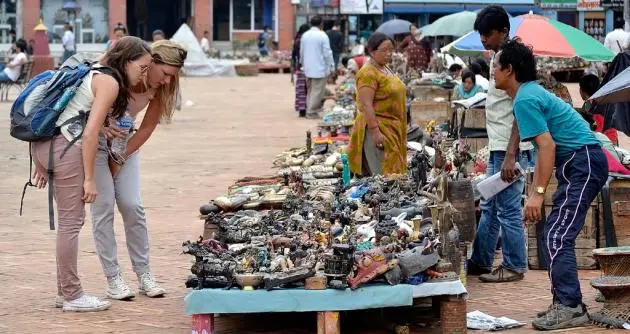
More detailed brochures are needed for the towns and bahas (meeting places) of the Kathmandu Valley, enough to keep a tourist in Kirtipur for a full day, for example. More localised artefacts and gifts must be developed, beyond the singing bowls and lakhe (protector) puppets.
Our challenge is to ensure value in mass tourism, a high-end industry that will increase profits for the exchequer, airlines, hoteliers, lodge owners, trekking/travel agencies and local communities-and at the same time, jack up the take-home salaries of porters, waiters, cooks, guides, artisans, taxi-drivers and kirana pasalwallahs (local green grocers).
